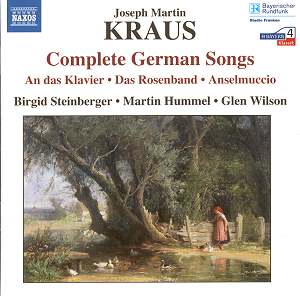
Naxos
have already done sterling service to Joseph Martin Kraus
with their recordings of his symphonies (see review of
Volume 4) and his piano music (see review).
Now we have a recording of all of his song settings of
German texts.
Kraus – whose life was almost coterminous with that of Mozart – was
himself a man of letters as well as of music. After false
starts as a student at the universities of Mainz and Erfurt,
he attended the university in Göttingen. Though ostensibly
studying law, the young Kraus became more and more involved
in poetry and music. Before he was twenty he had published
a verse tragedy (Tolon) and a collection of poems
(Versuch von Schäfersgedichte), as well as
writing a number of pieces of sacred music, including a
Requiem. While at Göttingen he became a member of the literary
group known as the Göttinger Hainbund (the ‘Göttingen Grove’),
made up of a number of young poets including J.H. Voss, Ludwig Hölty and the Stolberg
brothers, which was apparently formed during a moonlit
walk one night in 1772! As a group they were amongst what
one might regard as the anticipators of romanticism, keen
on German folk traditions and the poetry of nature and
sentiment. Kraus committed himself more fully to music,
and soon wrote a book, Etwas von und über Musik furs
Jahr 1777, in which his sympathies for the Sturm und
Drang and the growing energies of the movement that was
to become German Romanticism were clear.
Both his
early-Romantic sensibility and the educated responsiveness
of his knowledge of poetry are evident in this collection
of Kraus’s songs. There is one song (‘Das Rosenband’)
setting words by Friedrich Klopstock, one of the major
influences on the Göttinger
Hainbund; there are no less than thirteen settings of
poems by Matthias Claudius, whose simplicity of manner
(and often of subject) was much admired by the young
poets with whom Kraus mixed. Claudius was to remain popular
with composers; indeed four of the poems by Claudius
which were set by Kraus – ‘Die Henne’, ‘Ich bin vergnügt’, ‘An
eine Quelle’ and ‘Phidile’ – were later set by Schubert.
There are three settings of poems by Alois Blumauer,
the poet set by Mozart in his ‘Lied der Freiheit’. There
are also two settings of Kraus’s own words.
Compare one of Kraus’s settings with Schubert’s of the same text and – not
surprisingly – one becomes aware of the limitations. But
one is also made aware of the ways in which Kraus’s work
genuinely anticipates that of the later master, more so,
for example, than is the case with Mozart’s songs. Kraus’s
melodies are rarely particularly memorable, but they are
always very sympathetic to their texts; he has that skill
at the rapid creation of a convincing protagonist that
is one of the hallmarks of the best composers of songs. ‘Der
Abschied’ (one of the songs which sets words by Kraus
himself) easily sustains interest over its seven minutes,
a grand, quasi-operatic exploration of Norse mythology;
very different is the comedy and pseudo-folksiness of the
setting of ‘Die Henne’. There is homely charm in ‘Die Mutter
bei der Wiege’ and a moving dignity in ‘An – als ihm die – starb’.
Kraus’s range is, in other words, pretty wide, and all
of these songs are accomplished and engaging.
Birgid Steinberger characterises her songs very well and sings with
clarity and grace; Martin Hummel sometimes over-characterises
and his voice is not, for my tastes, particularly ingratiating.
Glen Wilson does an admirable job as accompanist; I have
followed Naxos in listing his instrument as a piano, but
it is surely a fortepiano?
Keith Anderson’s well-informed and perceptive notes don’t anywhere
seem to explain that the VB numbers which identify Kraus’s
works are to be found in Bertil van Boer’s Joseph Martin
Kraus (1756-1792): a systematic-thematic catalogue of his
musical works and source study (1998).
Full texts
and translations are available from the Naxos
website.
This is a CD which in any one interested in the history of the German
lied will surely want to hear; admirers of Schubert should
find it of considerable interest.
Glyn Pursglove
see also review
by Göran Forsling
BUY NOW
AmazonUK AmazonUS
|
Advertising
Rates
Visitor
stats
MusicWeb
International
has over 40,000 Classical CD reviews on offer
Discs
received
Having a problem
Donating?

Gerard
Hoffnung Concerts &
The
Bricklayer Story
MusicWeb
can now offer
you discs from the following catalogues:
Prices include postage
There will be NO
VAT Rises
Musicweb
Special
Offers
Monthly
Best Buys
New
Releases

New
Releases


MusicWeb
sells the Polish
catalogue CDAccord
£10.50 post free W-W

MusicWeb sells the
Arcodiva catalogue
£12.00 post free W-W

£11.75
post-free world-
wide
Google
Ads - for information about privacy matters, click here.
Amazon Musicweb International is a participant in the Amazon
EU Associates Programme, an affiliate advertising programme designed to provide
a means for sites to earn advertising fees by advertising and linking to Amazon.co.uk
and Amazon.com
|