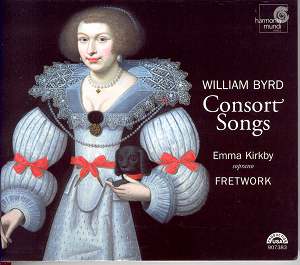
Byrd’s
first songbook “Psalmes, Sonets & songs of sadnes and
pietie” only reached print in 1588, to be followed in 1589
by “Songs of Sundrie Natures”. His third venture into
print within this genre was much later, in 1611, with Psalmes,
Songs and Sonnetts. These are not light, skittish pieces.
The style is far removed from the canzonets and madrigals of
the Elizabethan period and it is denser than the baroque monody
that was coming in towards the end of Byrd’s life.
The
songs’ style is very much Byrd’s own, though in the liner notes
David Pinto comments that the songs owe something to the Franco-Flemish
chansons of Byrd’s youth except that Byrd has the four
parts played instrumentally with the texted voice part above
them.
For
the texts, his earlier songs were influenced by the rather sober
tastes of Edward VI’s court. Something like O Lord, bow down
thine heav’nly eyes is a paraphrase of a psalm which invites,
and receives, a sober performance. I’m reminded of Goudimel
writing sober psalm settings to give the French Protestants
suitable, Godly entertainment.
Later
songs, such as My mistress had a little dog (dateable
after 1596) can take on a certain madrigalian vivacity, helped
by Byrd’s word-painting. But the overall impression is of something
serious and slightly sober; there is liveliness but there is
little skittishness here. But in My mistress had a little
dog Kirkby’s delivery is so dead-pan than I’m not really
sure that it works. Surely she would imbue the line with more
vivacity if it was Monteverdi, say.
Perhaps
part of the reason for this soberness is that the accompaniment
is viol consort. Fretwork provide admirable accompaniment, their
rich dark tones complemented by lively articulation and fine
phrasing.
In
his preface to the 1588 book Byrd says that the songs were to
persuade everyone to learn to sing, but then goes on to emphasise
the need for a beautiful voice to perform them. This emphasis
on sheer beauty of sound and the expressivity of the vocal line,
rather than simple word-painting, is what characterises Kirkby’s
interpretations.
They
come into their own in the purely instrumental numbers, including
one based on In Manus tuas from the 1605 Gradualia.
Instrumental music seems never to have been one of Byrd’s main
concerns, though the two Fantasias were published in 1611 when
fashion favoured including such pieces in vocal collections.
The
songs performed here include a couple of curiosities. The
noble and famous Queen comes from a manuscript owned by
the catholic Edward Paston. The text is Paston’s replacement
text, in memory of Mary Queen of Scots; the original text was
While Phoebus us’d to dwell. Inevitably this sort of
substitution can sound forced and disjointed. David Pinto postulates
that Out of the orient crystal skies from the same collection,
is also a substitute text.
And
what of the singer of these songs? Her crystalline timbre is
in wonderful contrast to the richness of Fretwork’s accompaniment.
This means that you never lose sight of the vocal line; it is
always distinct. Kirkby also brings to the songs her fine sense
of line and a great musicality. Though she projects the text
well, I did find her overall interpretation a little cool; perhaps
this is her response to the style. Where some reviewers have
heard sincerity, crisp diction and a highlighting of the poetry
of the text, I tend to hear a beautiful, cool perfection that
leaves me wondering whether I would prefer a performance that
emoted a little more.
It
is interesting to turn to the Hyperion disc recorded in 2003
by Robin Blaze and Concordia. Like Kirkby, Blaze has a beautiful
voice albeit one with different qualities. The keen edge that
he brings to his tone seems to suit this music well and I feel
that the songs on his disc sit rather better in his voice than
those on Kirkby’s disc. Blaze also points up the words more
than Kirkby, which is something that I like. Another difference
is that Blaze and Concordia experiment with adding a lute to
the mixture, based on fragmentary evidence from the Paston manuscripts.
This creates an interesting texture, which I rather like.
I
can’t honestly articulate reasons for choosing either the Kirkby
or the Blaze disc except personal preference when it comes to
voices. They barely overlap in repertoire, so perhaps I should
urge people to buy both.
This
is a varied well-chosen programme, beautifully sung and played.
Kirkby and Fretwork complement each other both in style and
timbre. You never feel that Fretwork are simply accompanying;
all the performers are partners. Lovers of this repertoire will
want to buy Robin Blaze’s fine disc as well, but if you just
choose one then you won’t go far wrong with this.
Robert Hugill
BUY NOW
AmazonUK
AmazonUS