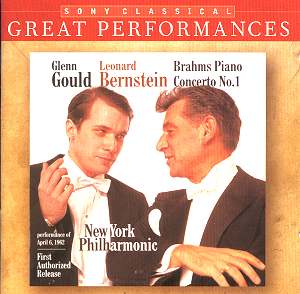
This infamous Gould-Bernstein first appeared in a legitimate form,
so far as I recall, in the late ’nineties on Sony Classical SK60675
though doubtless many will have heard it through other channels.
It appears now in the uniform livery of the Great Performances
series, a nomenclature that’s clearly stretching things to breaking
point in this particular case.
The disc faithfully reproduces Bernstein’s opening announcement,
a witty and clever disclaimer and as an appendix we have a snippet
of a Gould radio interview. Gould’s humour was generally of the
adolescent variety but his seriousness was much more appealing
and he doesn’t disgrace himself. The booklet notes reprint excerpts
from the earlier Sony release’s liner notes – Schuyler Chapin
and Tim Page set the scene. One needn’t delve into the gladiatorial
aspects too much or the Duel at Dawn prose.
As a performance it represents Gould’s established desire to emphasise
continuity over contrast, to recast dynamics, to make organic
“connections” between motifs and movements, to sculpt in Gould’s
phrase “a giant fresco.” It would perhaps have made more sense
to do this – if it was necessary to do it at all – with a work
with which he was more familiar. He’s first played the Brahms
in the 1959-60 season but not often and this “contemplation-not-competition”
approach, saliently concentrating on the contrapuntal and inner
voicings, smacks more than a little of artifice. With Gould it
was not really a question of slow tempi per se but of rhythmic
enervation and a fatal lack of momentum.
As far as mere timings go the performance is not desperately slower
than some we’ve become accustomed to. Zimerman’s recording with
– of all people – Bernstein was in fact very slightly slower still.
The same pianist’s recent recording with Rattle was similarly
leisurely. What distinguished them, at least in pianistic terms,
was a sense of internal contrast and a sense of forward momentum,
however skewed one might believe it to be; the question of tonal
resources is something better addressed elsewhere.
As for the solo playing Gould’s trills are ponderous, his conception,
as intended, static and withdrawn. Some left hand accents mince
along and he is inclined to force through the tone; at times the
playing is plain nasty. The devitalised nature of this playing,
Bernstein faithfully following, sounds – unintended surely – self-mocking
not least in some of the treble runs of the first movement. Lassitude
squats over the slow movement, a sort of rocking trivia, a directionless,
badly voiced nothingness. The finale is galumphing, Gould singing
away as ever. Articulation is variable – clear lines but so deadened
that one can’t wait for the end. As a lecture on the strict application
of a common pulse it takes some beating.
The live recording – they’d actually played the concerto the day
before with a similar announcement-disavowal from Bernstein –
is prey to plentiful coughs, stamps and general noises off. If
you’ve yet to encounter Gould’s “baroque-ish” Brahms, refashioned
dynamics and straight-line implacability, then here’s your chance.
I’ll be keeping it on the shelves – but only for Bernstein’s gorgeous
introductory talk.
Jonathan Woolf
BUY NOW
AmazonUK



 Glenn Gould (piano)