The Polish tradition
is especially rich in pianist-composers:
musicians, that is, who were internationally
famous as pianists and also wrote music
which has endured - to one degree or
another. Chopin, Theodor Kullak, Franz
Xaver Scharwenka, Moritz Moskowski,
Ignacy Jan Paderewski, Leopold Godowsky,
Józef Hofmann, Ignaz Friedman,
Alexandre Tansman, etc. The list is
a long and distinguished one. Amongst
twentieth-century exemplars of the line
one might count Miłosz Magin, without
claiming for him quite the stature of
some of his predecessors.
Magin
was born in Łodż and after
studies in Warsaw won prizes at a number
of prestigious piano competitions,
including the Chopin competition in
Warsaw, the Vianna da Motta in Lisbon
and the Marguerite Long-Thibaud in Paris.
He toured extensively and made an important
recording of all of Chopin’s piano music
for Decca. A serious road accident in
1963, in which
his left wrist was broken, interrupted
his career as a performer but gave him
the opportunity to return to work as
a composer. As a teacher, and as founder
in 1985 of the Miłosz Magin international
Piano Competition, he has been an important
influence on a number of younger
pianists. He died of a heart attack
– while on a concert tour – and was
buried close to Chopin in the Père-Lachaise
cemetery in Paris.
As a composer Magin
wrote works in many genres and for a
variety of musical forces – including
pieces for solo piano, chamber music,
four concertos for piano, two violin
concertos, a clarinet concerto and a
cello concerto, as well as two symphonies.
More details on Magin can be found at
a website devoted to him: http://membres.lycos.fr/miloszmagin/.
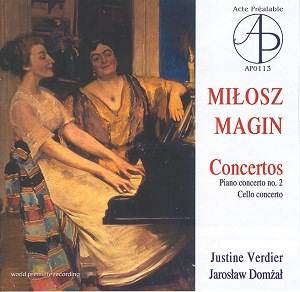
Magin himself premiered
his Piano Concerto No. 2 in 1967 in
Germany, with the Duisburg Symphony
Orchestra, conducted by Reinchard Zilcher.
I suspect that many listeners hearing
the concerto without being told anything
of the composer would imagine it to
be the work of a French composer – a
French composer of an earlier generation.
There are affinities with Ravel and
with Poulenc in this tuneful, thoroughly
tonal composition, which is firmly within
the neo-classical tradition. The first
movement is both graceful and lyrical,
its materials developed in text-book
fashion. The flowing melody which dominates
the central andante is charming. The
final movement is rather more specifically
Polish, in its use of the oberek, a
Polish dance in triple meter.
The Cello Concerto
is also in three movements and is rather
more thoroughly Polish in manner and
material; perhaps not coincidentally
it is the more fully convincing of the
two works on the disc. The opening allegro
is in sonata form, the first theme rhythmically
lively, the second more lyrical. There
are extended unaccompanied passages
for the soloist, which Domżal presents
persuasively. The very pleasant second
movement is based on the traditional
polish dance, the kujawiak. This
was a dance from central Poland, a simple
circling dance, slow and ceremonious.
The scholar Ada Dziewanowska (Polish
Folk Dances and Songs, 1999) describes
it as "reminiscent of the tall
grain stalks in the fields swaying gently
in the wind" – and such an image
might reasonably come into one’s mind
listening to this andante cantabile.
Orchestral storms intermittently threaten
the kujawiak, but its quiet dignity
finally triumphs. The closing movement
is a rustic sounding oberek, at some
moments almost melancholy, at others
very vigorous. This is a very interesting
concerto, of which I would like to hear
more performances.
I happened to hear
Justine Verdier while on a visit to
her native France a year or two ago
and was very favourably impressed. She
is a young pianist of immense potential
– she was only seventeen
at the time of this recording and acquits
herself admirably. She studied with
Magin and her sympathy with his music
is evident here. Jaroslaw Domżal
is a somewhat more experienced soloist
(though he was only in his twenties
at the time of recording). He
plays with passion and a secure, full
tone, entirely in sympathy with the
‘Polishness’ of this concerto. The orchestral
playing is perfectly adequate, while
falling slightly short of the highest
international standards.
This is not music of
great originality, but it is well-written
in a rather old-fashioned manner. What
matters, of course, is that Magin is
being true to himself in writing in
the way he does, and the honesty of
the music shines through. The youthfulness
and relative inexperience of the performers
lends an entirely fitting innocence
to the music, itself free of doubts
or excessive self-awareness – such freedom
being both its strength and its limitation.
Glyn Pursglove
see also review
by Jonathan Woolf
Full
Acte Préalable Catalogue



 The Orchestra of the Chopin Academy of Music
in Warsaw, Bialystok Branch/Jan Milosz Zarzycki
The Orchestra of the Chopin Academy of Music
in Warsaw, Bialystok Branch/Jan Milosz Zarzycki
 for
details
for
details











