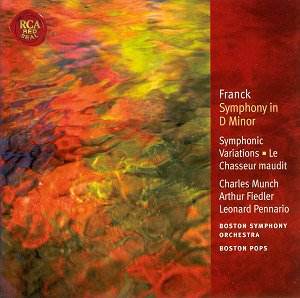
These performances,
dredged up from various sources in the
RCA vaults, comprise a logical CD-length
program, if not, in this instance, a
consistently successful one.
The Symphony offers Munch at his most
mercurial. The first movement goes with
the tensile line favored by French interpreters
(compare Martinon and Paray), emphasizing
forward momentum, eschewing traditional
unmarked ritards. Thus, the horn solo
introducing the development stays strictly
in tempo; so does the oboe, though the
instrument's uneven "speaking"
suggests relaxation; finally, the flute
is allowed the customary expansion.
Even when Munch's impulsive accelerations
get carried away - in the development's
headlong climax and the overlapping
entries in the coda - the Boston Symphony
takes the rather manic pacing in stride.
After this, the central Andante movement,
with its yearning, expressive cantabile,
is trim and gentle. The Finale is once
again taut and driven, though tempered
in spots - the back-and-forth phrases
after the second theme (track 3, 1.46
- where an indicated pause is elided,
by the way), for example, and that theme's
triumphant tutti recap (3.44) - by a
surprising rubato. A coherent pulse
underpins the tempo adjustments, however,
and the performance hurtles to a blazing
finish.
The best thing about the Symphonic Variations
is Arthur Fiedler's conducting: his
authoritative, nicely honed accompaniment
demonstrates the breadth of his well-schooled
musicianship beyond his usual "Pops"
repertoire. His orchestra - basically
the BSO minus some principals - sounds
good, if not particularly French. The
wind chords don't have the sheen that
comes with more careful tuning - though
they aren't out of tune, exactly - and
the brass choir sounds competent but
unrefined. Leonard Pennario projects
the quieter bits of the solo part sensitively,
with a nice variety of tonal colors
and dynamic shadings, but he's taxed
by the grander rhetorical passages,
which sound monochromatic.
Munch's febrile account of Le chasseur
maudit got lost in the proverbial shuffle
on its original issue, coupled with
the Chausson symphony - on an LP I recall
fondly. The tone-poem still isn't played
or recorded all that frequently, so
one wants to like the performance. Unfortunately,
the conductor's impulsive, driving energy
merely exposes the score as threadbare,
episodic fustian, for all its gorgeous
orchestral colors. Intonation goes seriously
awry at 0.46 of track 9, where the unison
winds aren't.
The sonics are bright-toned, in the
classic RCA manner: tuttis in the symphony
are a bit congested, as they always
were, while Le chasseur maudit sounds
less rich than I had remembered. Both
shorter works get multiple tracks -
good for study purposes, but a drawback
if you like to listen in the mp3 format.
At midprice, recommended for the symphony.
Stephen Francis
Vasta



 Leonard Pennario (piano)