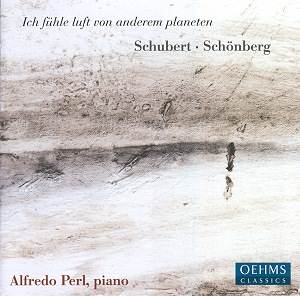
"Ich fuhle luft von anderen planeten". I feel the air of other
planets. That is the title of this new disc by the Chilean pianist
Alfredo Perl. The line is a quotation from the poem by Stefan
George that forms the text for the last movement of Schoenberg's
String Quartet No. 2. It is used here to unify the spiritual
complexities of Schubert's last three piano sonatas - the second of
which is heard on this disc - with the new harmonies, or musical
worlds, if you prefer, of Schoenberg's first full-fledged example
of dodecaphony-the Suite for Piano Op. 25, also here.
Alfredo Perl is best known for performing the complete cycle of
Beethoven piano sonatas in London and several other cities. He also
recorded all 32, as well as the cello sonatas. He has made a number
of recordings of Romantic repertory and on this disc stretches a
little past Romanticism in both directions.
Schubert's last three piano sonatas, Nos. 19-21, or D. 958-960 were
written in the last few months of his life, along with a number of
other works. They are considered the summit of his piano music, if
not of all his works. Certainly, he never wrote more profoundly for
the piano than at this time. Critics have famously pointed out the
length of the works and some people perhaps do not have the
patience for the style of development evidenced here or the overall
lengths of the works themselves. Alfredo Perl obviously does not
feel this way as he delivers a performance that not only keeps the
sonata moving, but also shows the inter-relations between
movements.
Perl's interpretation of the d-Major sonata can be described as
more poetic than forceful. In the first movement the legato playing
is very expressive and he maintains interest throughout. Yet he
doesn't lose sight of the overall structure of the movement,
bringing it to a close with a beautiful transition to the coda. The
slow movement is somewhat reminiscent of the same movement in
Beethoven's Seventh Symphony, and Perl doesn't loose a chance to
underline this. Again, his strengths are attention to overall
structure and poetic feeling, but he doesn't lose sight of the
danger of longeurs and keeps complete control of pacing. Perl's
sense of pace continues into the scherzo, although I disagree with
the way he took the trio. Perl's "structural integrity" also
carries over into the last movement ending with an excellent
handling of the coda - its tonal summation.
As stated above the Suite for Piano Op. 25 was Schoenberg's first
piece entirely written according to his new twelve-tone technique.
Indeed the same tone-row is used in all seven movements. Schoenberg
illustrates his own idea that Baroque music had twelve-tone
elements by casting each movement in an old dance form: gavotte,
gigue, etc. Certainly the working out of the tone-tow in this
context provides both a framework and a forward impetus that is not
shared by some of his later works. Perl seems to realize this
making the opening Prelude spiky and driven at the same
time. The Gavotte is more pedestrian, with some questionable
dynamics. This dynamic problem occurs in several of the Suite's
movements and leads to a hazy overall impression, although Perl
recovers in the final Gigue. Oehms' recording does not help:
it is either over-resonant or muddy; the studio at Radio Bremen is
a poor choice of recording venue.
This disc has an impressive Schubert performance, but a very uneven
one of the Schoenberg Suite. Those who prefer a more muscular
Schubert will probably prefer the recordings by Schnabel or Rudolf
Serkin. Alfredo Perl's performance is more in line with those of
Mitsuko Uchida or Alfred Brendel, but is imposing in itself. As for
the Schoenberg, I'll stick with the old Glenn Gould.
William Kreindler



 Alfredo Perl (piano)











