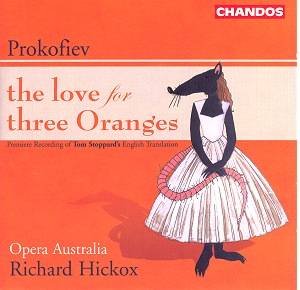
It was Vsevolod Meyerhold, the important
Russian theatre director of the period,
who gave Prokofiev The Love for Three
Oranges to read in the spring of
1918, but the original play, by Carlo
Gozzi, was premiered as early as 1761.
It was a parody of the high-flown Italian
theatre of the day, and Prokofiev’s
opera is also a parody, even if it was
uncertain what he parodied. "Some
critics tried to guess whom I was mocking
– the audience, Gozzi, the opera reform
or those who didn’t know how to laugh",
wrote Prokofiev in his autobiography.
First performed in Chicago in 1921,
sung in French, it wasn’t exactly a
success and when it was produced in
the Soviet Union four years later the
reception was also mixed. On the other
hand the orchestral suite that Prokofiev
put together later with motifs from
the opera, immediately became popular,
especially the march.
Prokofiev was partly
inspired by Rimsky-Korsakov’s fairy-tale
operas, The Golden Cockerel in
particular, but his tonal language is
much more daring, even though the colourfulness
of the score certainly is on the same
level as Rimsky’s – though they use
quite different palettes. Satirical
elements are also to be found in Rimsky’s
operas, which I commented on in a review
of a four-opera-box last year (review).
Prokofiev, though, goes a step or two
further and The Love for Three Oranges
is more farce than comedy. It is hilariously
funny and the composer, who was still
in his late twenties when he wrote the
music, must have been in an unusually
inventive mood. It is definitely not
music that coddles the audience and
to the first listeners in the 1920s
it must have come as a shock.
Through the years it
has been performed on many occasions
but has never quite been incorporated
in the standard repertoire. One reason
for that, besides the partly daring
music, is that it requires such large
forces. There are Eccentrics, Tragedians,
Comics, Lyrics, Empty Heads, Doctors,
Little Devils, Courtiers, Monsters,
Drunkards, Guards, Servants and Soldiers
and sixteen solo roles, not all of them
that large, but still demanding. And
the orchestral forces are also considerable.
But the whole opera, with a playing
time of around 100 minutes, is so fresh
and funny and stimulating one wishes
it could be performed more often. The
only time I have encountered it was
a performance on Swedish Television
many years ago and my memories of it
are not very vivid. But this Australian
production, recorded live in tremendous
sound, is a real knock-out and readers
as yet unfamiliar with the work are
advised to try it. They will of course
recognize the famous march, although
it is tantalizingly short when it first
appears in act 2, It returns in snippets
a couple of times later.
Competition is not
very keen. There is a very good Mariinsky
recording under Gergiev, sung in Russian,
on Philips, and on Erato there was a
version in the original French, conducted
by Kent Nagano. The present offering
is the first in English, so in a way
it has the field for itself.
Tom Stoppard’s translation
is worth a paragraph of its own. Comparing
it with the French text, by Prokofiev
and Vera Janacopoulos, which is printed
side by side with Stoppard’s, one immediately
notices that it is far from a "translation".
Stoppard grabs every opportunity to
go his own way, to find brilliant references
to all sorts of things. Let me just
quote something from act 3, when the
Prince and Truffaldino have found the
three giant oranges and the sorcerer
Chelio says: These oranges are not
to be opened, except near water, proper
H20…whereupon
the Prince sings: I’m dreaming of
an Orange Christmas!
The recording engineer
and producer, Allan Maclean and Ralph
Couzens, have found a perfect balance
between the orchestra and the voices
and practically every syllable can be
heard, even from the various choral
constellations, which is a rare thing.
It’s a big bold sound and Richard Hickox
draws excellent playing from the orchestra,
where some of the instrumentalists also
have a field day. Hickox prefers brisk
tempos and there is a rhythmic vitality
and springiness that keeps the whole
performance alive. The choral singing
is also delivered with resilience and
precision, the Doctors’ chorus in act
one (CD 1 track 2) being as fine an
example as any.
As for the solo singing
there are no traditional arias – the
dramatic tempo is too high for that
– and what is needed is not bel canto
singers but character singers, who can
act with their voices. Of course one
often misses the visual element but
still surprisingly much of the action
was brought over to my living-room with
amazing vivacity. There are some wobblers
among the cast but that matters fairly
little in this case. All the singers/actors
are well inside their parts and my listening
session gave me two of the most amusing
hours I have had for a very long time
– and I am not leading a particularly
dull life.
An extra bonus is the
96 page booklet. Besides Stoppard’s
text and the French original, there
is an interesting essay by David Nice,
a synopsis, CVs for all the soloists
(with photos) and a number of photos
from the performances. The live recording
is uncommonly clean, considering that
there is a lot of "business"
on stage, there are traces of the audience
laughing at some of the wittiest turns
in the text and after the last act a
short round of applause.
All in all: great entertainment
presented with the highest possible
production values.
Göran Forsling



 Opera Australia Chorus, Australian Opera and
Ballet Orchestra/Richard Hickox
Opera Australia Chorus, Australian Opera and
Ballet Orchestra/Richard Hickox