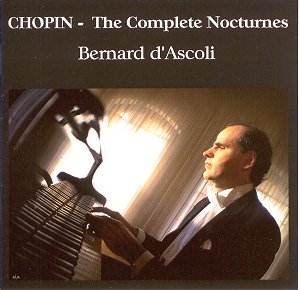
How
good it is to hear an artist of such exceptional sensitivity
and tonal refinement in music that suits his style so well.
It is a long time since I‘ve heard the blind virtuoso Bernard
D’Ascoli yet it seems only yesterday that I saw him being led
onto the platform for the 1981 Leeds Piano Competition. He didn’t
win first prize, but then the Leeds
is almost as famous for the runners-up (Schiff, Uchida, Berezovsky,
Donohoe). D’Ascoli was always assured an international career.
He hasn’t done all that much on disc, but Athene are putting
that right with an excellent series of recordings, the last
of which was a well-received Chopin Impromptus and Scherzi,
when various reviewers actually mentioned looking forward to
when he tackled the Nocturnes. Well, here is the two disc set,
and very good it is too.
It
strikes me that D’Ascoli plays in a tradition that goes back
to Artur Rubinstein, whose Nocturnes recording has held sway
for so many years. There are differences of course, but the
emphasis on legato and the singing line are clearly paramount
to D’Ascoli. That view has been challenged in recent years by
Maria Joao Pires, whose DG set seemed for a while to topple
Rubinstein, certainly in the eyes of Gramophone magazine. I
have also stood by Pires and her muscular, no-nonsense approach;
she seemed to be saying that these pieces have far more fire
in their belly than people have given credit for, and we shouldn’t
mollycoddle them. Some years on, and listening side-by-side
with D’Ascoli’s gentler but still dramatic spontaneity, Pires
seems in places to be just too aggressive
That’s
not to suggest for a moment that D’Ascoli shirks from the darker
side of these amazing pieces. Many of them have a troubled undercurrent,
something Pires exploits fully; D’Ascoli’s innate subtlety makes
his a more selective process and in the end we get a more rounded
blend of poetry and fire.
Take,
for instance, the central con fuoco passage of the F
major, Op.15 No.1 (track 4, 1’20 in). Here, Pires’s bass line
is so fast, furious and over-pedalled as to sound muddied. D’Ascoli
holds back a fraction and delineates Chopin’s textures with
more emphasis, bringing out both harmony and line to perfection.
He also observes more fully Chopin’s andantino marking
in the G major, Op.37 No.2, his slightly reflective approach
giving an almost filigree lightness to the main semiquaver figuration.
Here, he is more at one with Barenboim, who I find unbeatable
in this particular Nocturne, mainly because he keeps a steady
tempo throughout. This brings me onto the thorny question of
rubato, which I have to say D’Ascoli employs more sparingly,
but ultimately more satisfyingly, than Pires. Take Op.15 No.2,
where Pires leans rather indulgently into all the main phrase
repetitions, whereas D’Ascoli keeps things fairly strict until
the central doppio movimento section, where he expands
and contracts the phrases as the flow of the music dictates
to him – very personal to each artist but entirely convincing
to my ears.
All
the huge variety of moods within these miniature masterpieces
strike me as fully realized by D’Ascoli. He rarely courts controversy,
certainly not to Pires’s degree, but is fully alive to the improvisational
aspects of the works. This leads him to indulge in the now-frequent
practice of inserting those little extra flourishes in the famous
E flat, Op.9 No.2, apparently all down to the composer jotting
some markings in a number of student copies. Angela Hewitt does
the same on Hyperion and though D’Ascoli is a little more tasteful,
I have to say I could live without it. Still, as his scholarly
and immensely readable insert not tells us, he does not include
these variants to ‘overburden this essentially simple, nostalgic
text ... but to reinforce the improvisatory character and refined
virtuosity of the work’. That word, improvisatory, crops up
time and again in D’Ascoli’s note and, along with his frequent
reference to operatic bel canto and the singing line,
could sum up his performances in one. It is surely playing that
the composer himself would have recognized, and though these
pieces were never meant to be heard at one single sitting, it’s
very easy to do so with this recording.
Of
course, in mainstream repertoire competition is always fierce.
Alongside the previously mentioned Pires (DG, upper mid-price),
Barenboim (DG, budget), Hewitt (Hyperion, full price but with
the Four Impromptus as coupling) and Rubinstein (RCA, mid-price)
we have an excellent budget version from Ricardo Castro (another
ex-Leeds winner on Arte Nova) and Livia Rev on budget Hyperion
Dyad, to say nothing of Katin, Arrau and a brand new (full price)
set from Pollini. But with those excellent notes, wonderfully
refined pianism and a very decent recording that captures D’Ascoli’s
full expressive range – as well as his beautifully voiced grand
– this is a very considerable achievement, especially at not
much above budget price.
Tony Haywood