This is a real eye-opener.
To eavesdrop on Karajan at work reveals
a true master-musician. Karajan knows
exactly what he wants, and how to communicate
it to the orchestra. Often, too, he
will tell the orchestra why he wants
something done in a particular way;
in the introduction to the first movement
of the Schumann, he tells the violins
exactly how to take away the harmonics
as they play so that the doubling flute
can come through. Note that the Schumann
is the only extant document of Karajan
rehearsing an entire work.
The Schumann, in fact,
was the last rehearsal before the DGG
Vienna Symphony recording, yet Karajan
remains fastidious – no run-through
here. He will take strings at a fraction
of full speed to ensure unanimity. His
imagery is accurate – the last bars
before the first movement proper ‘hold
the idea of the whole symphony’. They
are taking an idea ‘to the point of
madness’ - surely a reference to the
composer’s malady? Illuminating comments
come thick and fast – the writing, Karajan
posits, comes from a keyboard background
idea and the players must take that
into account in their bowings.
He refers to the Richard
Strauss and Weingartner re-orchestrations
to bring out what was important ‘to
the Romantic era’. He, however, tries
to remain true to the romantic impulse
by staying faithful to the score. It
is telling that he says about two specific
bars of the first movement ‘too much
rhythm and too little expression’, a
clue perhaps to the genesis of the later
Karajan splodge? Yet there is so much
here: his thoughts on ostinato - always
equally accented notes - and his clear
grasp of Schumann’s tricky structural
thought. He brings a quasi-Wagnerian
breadth to the transition to the finale
before castigating his players for playing
the last movement in too frivolous a
fashion - ‘For Heaven’s sake this is
not a jolly piece!’
It is the long-range
vision that is the most striking aspect
of the film. Again in black-and-white,
although shot slightly darker than the
rehearsal, Karajan, himself clad all
in black, gives the first movement introduction
a darkly magisterial slant. The Allegro,
when it comes, is rightly determined.
The sound congests a little too much
at forte, though. Karajan, conducting
from memory, uses his hands, arms and
body to sculpt a performance that is
quite simply electric. The filming is
imaginatively unpredictable – aerial
shots and spotlights on soloists are
juxtaposed – then suddenly the camera
freezes, as if mesmerized, on Karajan
for a period.
The filming of the
solo oboe and solo cello at the opening
of the slow movement is particularly
memorable. They appear as isolated figures,
juxtaposed against each other against
a backcloth of darkness. There is a
real fire to the finale. The close-up
filming of the fugato gives it an added
edge of intensity; as if Karajan would
let up anyway! As it reaches its climax,
a shot of Karajan shows the Maestro
in typical, concentration-drenched pose.
‘The Art of the Conductor’
is the title of the second (shorter)
film on Beethoven’s Fifth with the Berliner
Philharmoniker. There is an added and
unannounced bonus – a 1966 Unitel interview
with Karajan, who is seated at a piano;
it is not separately indexed. He refers
to a series of thirteen broadcasts preceded
by an introduction: rehearsal or even
conducting masterclass. Taking as his
example the opening of the second movement
of Beethoven Fifth, he then stands and
watches an unidentified student conductor
and tells him to be a sculptor with
sound as he rehearses the cellos and
violas. Karajan even demonstrates the
art of connection between notes at the
piano - in itself a seemingly contradictory
idea! - and even introduces some motivic
analysis.
Then to the Beethoven/Karajan
film of the performance. There is a
mighty intensity to the playing we hear
- as well as some of the Karajan bass-heaviness.
Some of the filming is superb – the
way the camera focuses on the solo oboe
cadenza and then juxtaposes Karajan;
the characteristic view of Karajan with
closed eyes, but seen through a forest
of violin bows ... this is not only
dramatic but carefully considered. And
all this while the music positively
blazes; this even displaces my preferred
Karajan reading, the early Philharmonia.
And if Karajan does slow up for the
big orchestral restatement of the ‘Fate’
theme, it is not a huge halting.
The slow movement is
affectionately shaped on every level
although some will doubtless find it
too personally shaped. The depth
of the string sound is a particular
joy here. This movement emerges as a
personal and deeply felt utterance.
Its shadow is felt over the Scherzo;
the camera’s dwelling on the double-basses
that form the bedrock of the sound is
hardly accidental. The finale is absolutely
monumental – it reminds us that clichés
like ‘hewn in granite’ have a starting
point somewhere, and that starting point
is from performances like this. The
camera zooms into Karajan’s upper torso
for the final couple of chords. It is,
after all, his performance!.
Informed notes by the
Karajan authority Richard Osborne complete
a significant release.
Colin Clarke



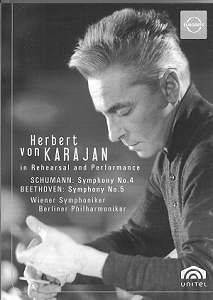

 aVienna
Symphony Orchestra, bBerlin Philharmonic
Orchestra/Herbert von Karajan.
aVienna
Symphony Orchestra, bBerlin Philharmonic
Orchestra/Herbert von Karajan.  EUROARTS
2072118 [120:00]
EUROARTS
2072118 [120:00] 











