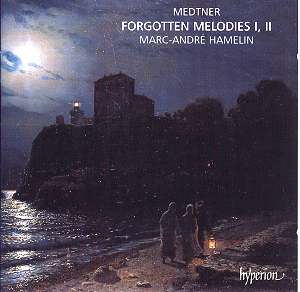
Nikolai Medtner is another of those sad
cases whose music was largely ignored in his lifetime and is
only now coming out of the shadows to become recognized for
its brilliance and originality.
He had several
misfortunes happen to him. Firstly he was unable to reconcile
himself with the Bolshevik regime that led to leaving his homeland,
something Russians always find especially heartrending. Then
he went to Berlin and Paris, neither of which took his music
sufficiently seriously. He ended up in England in 1935 living
there until his death in 1951. I remember my parents pointing
out the road near Golders Green station where he had his house.
When the war began
his income from concerts, lessons and royalties from his publisher
in Germany ceased. Then came the first of a series of heart
attacks which all but cut short his concert career. He continued
recording with help from the seemingly unlikeliest of quarters,
The Maharajah of Mysore, whose patronage enabled him to record
many of his works for HMV. Even this was blighted by the fact
that they were all on 78s at the dawn of the LP era and so
they soon fell out of the catalogue. Until recently they were
not widely available in any more modern format.
It has therefore
largely fallen to the current generation of music-lovers to
discover him. Just as a neighbour said to me when I first moved
to Yorkshire that he envied me as I had the county to discover
anew, we have the privilege to do the same for Medtner’s music
and what a revelation it is. I first heard his music about
ten years ago; it was like dying and going to piano heaven!
He spent from June
1919 to October 1920 at a friend’s dacha at Bugry, 65 miles
south-west of Moscow seeking refuge from the aftermath of war
and revolution. It was there that he began assembling the music
on this disc from notebooks of ideas he had jotted down over
the years. These he had largely forgotten hence the title of
the collections “Forgotten Melodies”. Op.38 begins with a sonata, Sonata-Reminiscenza,
which is a fabulously constructed musical gem that sets the
tone for all that follows. Medtner’s music is economic in the
extreme, in much the same way as that of Satie, rich in melody
and invention and with gorgeous flowing lines.
For the purposes
of this review I have also been listening to the set of Sonatas
recorded by Geoffrey Tozer, the Australian pianist (Chandos
CHAN 9723(4)). I note with interest that Tozer is 3 minutes
faster than Hamelin in this sonata. Hamelin’s pace is more
suited to the melancholy nature of the piece as wistfulness
calls for a slower treatment. In all the other pieces they
are both fairly similar in pace. Sometimes Tozer himself is
slightly slower than Hamelin. I have also listened to the conductor/composer/pianist
Evgeni Svetlanov’s recording of three of the op.38 set, including
this sonata (Russian Disc RD CD 10 045). His was the first
interpretation of this sonata that I heard. It is often that
the first recording one hears sets one’s benchmark and I have
to say that his playing of this sonata is still great listening.
He plays with a mixture of grandeur and grace which seems to
be the perfect combination for Medtner’s music. Of this Sonata
the pianist Alexander Goldenweiser wrote in 1923 “The spirit
of true poetry and profound internal significance makes it
one of the most remarkable achievements of Medtner’s art”.
It alone can hook you and draw you into this music and keep
you a devoted fan forever.
The opening of the Danza graziosa always
reminds me of Scott Joplin, a cheeky tune that has a melancholic
edge to it soon giving way to a very Russian theme. The Danza
festiva is a delightful musical description of a village
festival and probably inspired by a painting of Teniers whom
Medtner greatly admired. As his friend, the Hungarian violinist
Jarosy observed “…while an empire collapsed in ruins and a
new state was arising from the blood-fertilised soil, Medtner
was writing pastorals and fairy tales!”(see below). There follow
descriptions of rustic dances and of passionately tragic songs
without words in music that recalls Mendelssohn and Chopin.
The Danza silvestra describes the forests with full
use of the piano’s potential to produce the sound of wind in
the trees. The cycle ends in a calming mood with Alla reminiscenza.
The Forgotten
Melodies op.39 opens with two very dark pieces, the first
of which, Meditazione is especially sad, and it is
developed further by the subsequent Romanza that is
hardly any lighter despite its title. The ensuing Primavera is
like a breath of fresh air after such melancholia with a
burst of spring in its notes. The last two of the set Canzona
matinata and the Sonata tragica Medtner always
wished to have performed together as he said they described “the
morn of life” in contrast to “the realities of life”. The
sonata, although brief, is unique among Medtner’s sonatas
having a monothematic ending with a brilliant coda.
The disc ends with Zwei
Märchen composed in 1904 and these were only the first
of an extensive series of piano miniatures often given the
erroneous title “fairy tales” that in no way explain the
dark nature they portray. As Boris Asafiev commented: “These
are not descriptive tales or tales relating adventures of
some kind. These are tales about personal experiences, about
the conflicts of a man’s inner life”.
The playing of
Marc-André Hamelin is exemplary in its brilliance and control
and he is the perfect performer to reveal the depths of this
wonderfully reflective and evocative music. A tour de force
that certainly equals if not surpasses the Tozer performance.
The only thing better than this disc would be to own Hamelin’s
four disc set of all the sonatas and forgotten melodies (see review).
Steve Arloff
|
Help us by making a donation through PayPal
|



 Marc-André Hamelin
(piano)
Marc-André Hamelin
(piano)