Francesco CILEA
(1866–1950)
Adriana Lecouvreur (1902): Poveri
fiori [3:27];
Bedrich SMETANA
(1824–1884)
Dalibor (1868): Dobrá! Já
mu je dám! … Jak je mi? [3:16];
Pyotr Il’yich
TCHAIKOVSKY (1840–1893)
Oprichnik (1874): Pochudilis mne
budto golosa [3:34];
Giacomo PUCCINI
(1858–1924)
Tosca (1900): Vissi d’arte [3:50];
Erich Wolfgang
KORNGOLD (1897–1957)
Das Wunder der Heliane (1927): Ich
ging zu ihm [6:40];
Charles GOUNOD
(1818–1893)
Mireille (1864): Le ciel rayonne,
l’oiseau chante … Ô légère
hirondelle [3:39];
Richard STRAUSS
(1864–1949)
Die Liebe der Danae (1944): Orchesterzwischenspiel
[3:18]; Wie umgibst du mich mit Frieden
[4:52];
Nikolay RIMSKY-KORSAKOV
(1844–1908)
Servilia (1902): Tsvetï moi!
[4:36];
Giuseppe VERDI
(1813–1901)
Il trovatore (1853): Tacea la notte
… Di tale amor [5:12];
Jules MASSENET
(1842–1912)
Cléopâtre (1914): J’ai
versé le poison dans cette coupe
d’or [4:37];
Leoš JANÁČEK
(1854–1928)
Jenůfa
(1904): Mamičko, mám těžkou
hlavu …[9:26]; Kdo to
je?–Jenůfa,
ty jsi ještě vzůru? [4:48];
Erich Wolfgang KORNGOLD
Die Kathrin (1939): Ich soll ihn
niemals, niemals mehr sehn [4:43];
Returning from a trip
to Helsinki on 10 December, the day
of the Nobel Prize Ceremony in Stockholm,
I found that I had missed the radio
broadcast of a concert given two days
earlier for Nobel Prize winners with
families and specially invited guests
at the Stockholm Concert Hall. Guest
soloist, on her first visit to Sweden,
was Renée Fleming. The reviewers
of the two leading morning papers waxed
lyrical about her singing. On a catholic
programme, ranging from Richard Strauss’s
Capriccio to Broadway musicals,
she also included two numbers from her
latest CD – the Tosca and Trovatore
arias. It would have been nice to
hear her live performances for comparison.
To refresh my memory
I played a couple of tracks from her
Bel Canto disc, which was recorded
almost seven years earlier. What is
immediately noticeable on this new disc
is that the creamy quality, which made
her such a popular singer but also caused
some critics to complain about blandness,
isn’t quite as creamy any more; the
quick vibrato has widened a mite and
the tone has hardened, there is more
edge to it. This is not only a disadvantage
since it also makes the voice more dramatic
and expressive, and her real forte,
to sing these ravishingly controlled
pianissimos, is undiminished. There
are always pros and cons when a voice
ages – just as with wines – and Renée
Fleming has reached a stage when the
acid is a little more conspicuous and
so more suited to meatier dishes while
still light enough to be enjoyed with
fowl. Adriana Lecouvreur, for instance,
needs both the edge and the lightness,
but it is the soft legato singing that
impresses most. The big romantic gestures
of Milada in Smetana’s Dalibor
benefits from the greater heft in the
voice, even more Nataliya’s aria from
Tchaikovsky’s first operatic success,
Oprichnik, sung with great intensity.
She catches Tosca’s grief admirably,
addressing not an audience but God and
finishes on a marvellous pianissimo,
maybe excessively held but impressive
even so.
Korngold as opera composer
is mainly known for Die tote Stadt,
which has had a renaissance lately but
there is memorable music in the remaining
four operas too and Renée Fleming
soars beautifully in both. The role
of Heliane in Das Wunder der Heliane
was created by the great Lotte Lehmann,
who also recorded it, but Ms Fleming
can definitely be mentioned in the same
breath as her great predecessor - praise
indeed. Even more beautiful is the letter
scene from Die Kathrin which
got its belated premiere in Stockholm.
It is reminiscent of the more well-known
aria from Die tote Stadt; the
opera is worth getting to know as a
whole. There is – as far as I know –
only one complete recording (cpo
999 602-2) where Melanie Diener
sings the aria beautifully. Renée
Fleming is even more inward and makes
it a magical conclusion to this very
varied recital.
The waltz aria from
Mireille has been recorded many
times and I don’t feel that Ms Fleming’s
attempt counts among the best. She sounds
uncomfortable in the coloratura passages.
Richard Strauss suits her voice much
better and the aria from Die Liebe
der Danae is in the best vein of
his writing for the soprano voice as
we know it from, say, Arabella
or Capriccio. Also here there
is a wonderful pianissimo end. The opera
was completed in 1944 but Strauss never
saw it staged; it wasn’t premiered until
1952 and is still seldom heard. Even
more of a rarity is Rimsky-Korsakov’s
Servilia, which was first given
at the Mariinsky Theatre in 1902 and
two years later in Moscow, but after
that – silence. It was actually regarded
as lost until quite recently a copy
was found in the library of the Mariinsky
Theatre, so this aria is a kind of reprise
premiere after more than a century.
The tessitura is high as so often with
Rimsky-Korsakov but this is no problem
for Ms Fleming.
Also in the Trovatore
aria she excels in sensitive pianissimo
singing and the end of the aria proper
is magical. In the cabaletta, Di
tale amor, she is more at ease with
the florid singing than in the Mireille
excerpt and she sings it with zest.
Massenet’s Cléopâtre
is another rarity. It was his last completed
opera and was premiered two years after
his death. It deals with the romance
between Mark Antony and Cleopatra and
in this aria, from act 3, "she
offers to kiss any of her slaves who
is bold enough to drink from a poisoned
chalice, almost certainly to die".
The aria is slow and languorous and
is sung by Ms Fleming seductively in
a lazy manner, visually speaking with
half-closed eyes.
The only role represented
on this disc that Fleming has
sung on stage is Jenůfa and even
without knowing this, one could have
guessed, since there is such identification
and such a rich palette of colours,
such expressiveness. This is also the
most dramatic music on the whole disc
and she sings with such abandon
that the effect is almost visual. We
also briefly hear Yvona Škvárová as
an involved Kostelniča. Quite the
most touching moment on this disc is
towards the end of this long scene when
Kostelniča tells Jenůfa that
her little son is dead and Jenůfa
reacts: Tož
umřel, tož umřel můj
chlapčok radostný …
(So de’s died, he’s died, my happy little
lad …), sung with heartrending feeling
and simple beauty with Gergiev unfolding
Janáček’s expressive scoring. This
is great music theatre and Fleming is
actually on a level to challenge
even Elisabeth Söderström
and Gabriela Benackova, arguably the
two foremost exponents of this role
during the last forty years or so.
Valery Gergiev and
his orchestra are pillars of strength
in backing up all these scenes and arias
and the recording is excellent. The
title of the disc, Homage, refers
to Renée Fleming’s wish to pay
tribute to a number of great sopranos
who sang these parts when they were
new. The booklet is lavishly illustrated
with photos of Maria Jeritza, Emmy Destinn
(fondling a lion lying on a grand piano!),
Lotte Lehmann, admiring herself on a
poster, Rosa Ponselle and several others,
plus a generous helping of photos of
Ms Fleming herself. Full texts and translation,
a note on the music and a note from
Renée Fleming. My only complaint
is the usual one: why does the track-list
have to be in brown against a black
background?. Thank God the print is
large enough to be read without a magnifying
glass.
Göran Forsling



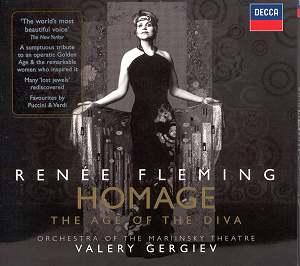

 Renée Fleming (soprano); Yvona Škvárová
(mezzo) (Jenufa); Kirill Terentiev (violin)
(Jenufa)
Renée Fleming (soprano); Yvona Škvárová
(mezzo) (Jenufa); Kirill Terentiev (violin)
(Jenufa) 











