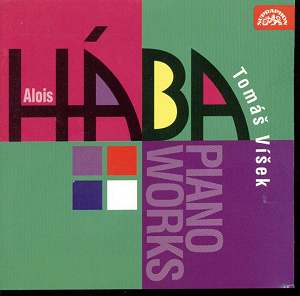
Novák, Alois Hába’s composition teacher, apparently referred to
his pupil as a “harmony fidget”. This would have been around 1923
or 1924 when Hába was admitted, at the relatively advanced age
of thirty, to Novák’s class. He meant the constantly changing
harmonic palette, the brazenly and kaleidoscopically shifting
key signatures. Doubtless this exasperated Novák but Hába was
clearly already serving notice of his own personal forms of evolution.
However very little
here, and that includes the late Op.102 Six Moods, will bring
to mind Hába’s experimentation with micro-intervals. Instead
the bulk of these piano pieces relate to the gargantuan vogue
for popular dance forms and digested jazz rhythms in Czechoslovakia
At the time.
So the early Scherzo is deeply rooted in
lyric nineteenth century soil albeit with some of those Novákian
fidgety moments enshrined. Almost immediately however, in its
opus mate the Intermezzo, we find a very different perspective.
This is a far more advanced piece, harmonically on the move
in the best sense and textually fuller and richer. The Six Piano
Pieces show a further concentration and absorption. They date
from his later studies with Schreker in Vienna and display a
new influence, that of Scriabin. Maybe being in post-Mahlerian
Vienna encouraged Hába to write a mocking March; the final piece
however does have a still, cool expressionism about it, doubtless
inspired by his teacher.
The Four Dances Op.39 are unfortunately undated
in Supraphon’s documentation. But Hába, as with Schulhoff and
Ježek, sailed close to dance band winds. The Shimmy, Blues,
Boston and Tango are just the things Schulhoff was feasting
on at around the same time. But Hába also mines Moravian sources
for his extrapolation on American dance forms and they cohere
well to produce a certain swaggering surety. There’s really
nothing much mournful about Hába’s Blues but there is
something songful about it.
He returns to a Mahlerian sounding Waltz
complete with reveille calls. And in the Toccata, a strong and
personal work, he mines some crepuscular and brooding material.
Víšek is strong on the digital demands of this. Much later,
in the Six Moods Op.102, which was written two years before
his death, we find some elliptical but not off-putting writing;
late expressionism maybe though the style is now very much sparer
and he’s still able to play games with dichotomous registers,
pitting bass and treble very much at odds in the Allegretto.
This is Hába without anything to prove.
Tomáš Víšek proves a commanding exponent
and his real gifts of lucidity of texture are very finely on
show in this recital. With a warm recording in the SR and Domovina
studios his touch is highly persuasive. Above all he demonstrates
that Hába, whatever one may have heard to the contrary, can
be fun as well as serious.
Jonathan Woolf



 Tomáš
Víšek (piano)
Tomáš
Víšek (piano)