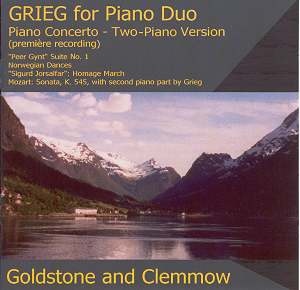
There are two world
premiere recordings here according to the booklet documentation.
To have the Homage March from Sigurd Jorsalfar in piano
duet – Grieg’s own four-hand arrangement – is enjoyable enough
but the main business is the Concerto.
This is partly Grieg’s
own work and partly that of Károly (Carl) Thern, whom as Anthony
Goldstone’s own notes point out was an Austro-Hungarian composer,
conductor and pianist. There’s no evidence that the two actually
met. Grieg’s contribution, in the full score, was to allow the
pianist to play through the tuttis by means of a piano reduction
of the orchestral part. Thern later arranged the orchestral
music - when both orchestra and solo instrument are playing
– for piano. The result of this fusion is a work for two pianos.
The complete score for two pianos was published in Leipzig in
1876 eight years after the concerto had been completed.
I’m not sure if I should be embarrassed or
pleased but I found the experience of listening to the resultant
work highly congenial. Humphrey Lyttelton once wrote, in another
context, that he found the task of identifying a famous tune
from a ruthlessly pared down arrangement rather like trying
to recognise an old friend from his skeleton. Obviously there’s
no chance of that here. We get instead clarity and a keen insight
into the compositional process. It was actually rather worrying
how quickly the ear adjusts to the two piano sonority and one
either absorbs the unusual medium or else projects the orchestral
patina from it. Usually one hears unexpected things. My own
ear doubtless benefited the two pianos with a warm cello burnish
in the first movement but it’s the finale that proves the most
diverting. It clarifies much of the orchestral writing that
in performance one tends to elide in favour of the piano’s romantic
bravura. The folkloric elements are also that much more clear,
although the slow movement naturally suffers the most from the
reduction, well though the Goldstone-Clemmow play.
Grieg arranged two four-movement suites from
Peer Gynt – here we have the Suite No.1, arranged in 1877 and
1878. The birdsong in Morning Mood is warmly evoked and the
Death of Ase brings suitable gravity. The Norwegian Dances were
written for piano duet so it’s not so much of a culture shock
to us to hear them thus. They certainly get an exciting work
out here, dynamic in the First and full of scurrying detail
in the Second with its outer sections insouciantly projected.
The Homage March makes a suitable contrast, full of a certain
static grandeur.
The Mozart sonata has a second piano part
arranged by Grieg in 1877. He probes some chromaticisms, most
especially in the Andante, where the bass part is sometimes
quirkily filled in. It makes for a suitable disc mate for his
own compositions.
The recording, though made in a church, is
actually very well judged. The playing as noted is buoyant and
sensitive by turns; this duo has a real flair for the unexpected.
As such this makes for an unusual perspective on a much-abused
warhorse – with the added attraction of some equally diverting
companion works.
Jonathan Woolf



 Anthony Goldstone
and Caroline Clemmow (pianos)
Anthony Goldstone
and Caroline Clemmow (pianos)