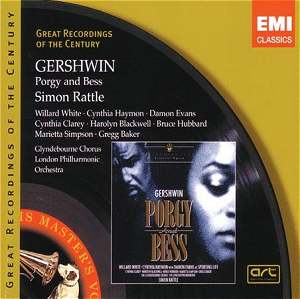
Porgy and Bess has led a troubled life. Gershwin
intended his opera to open at the Metropolitan Opera House but
it premiered instead at Boston’s Colonial Theatre on 30 September
1935. It then ran for 124 performances at New York’s Alvin Theatre
with Gershwin insisting on an all-black cast. Even then critics
debated whether Porgy and Bess was an opera. Conductor
Serge Koussevitsky thought it was but critic/composer Virgil
Thomson had his doubts. The controversy was exacerbated when
a revised version was produced on Broadway in 1942 with the
recitatives reduced to dialogue, the orchestra diminished and
the cast halved. The eventual production was more in line with
American musical theatre traditions.
In 1952 the operatic format was restored
and with Leontyne Price as Bess, William Warfield as Porgy and
Cab Calloway as Sportin’ Life, it toured Europe and made its
London premiere at the Stoll Theatre on 9 October that year.
A film version with Sidney Poitier, Dorothy
Dandridge and Sammy Davis Jr appeared in 1959. But the Gershwin
estate objected to it and in 1974 pulled it from release.
Racial controversy has also plagued Porgy
and Bess from the beginning. Duke Ellington said that ‘the
times are here to debunk Gershwin’s lampblack Negroisms’ and
several members of the original cast were concerned that it
would stereotype black Americans as living in poverty with an
addiction to drugs while solving their problems by fighting.
The American Civil Rights movement in the 1950s, 1960s and 1970s
further fuelled the debate.
Porgy and Bess was eventually performed at
the Metropolitan Opera House - fifty years after its premiere
- on 6 February 1985.
But even after 71 years Porgy and Bess
still hasn’t received unreserved acceptance as an opera. This
1988 EMI Great Recording of the Century version doesn’t answer
that question but it is an excellent recording of what Gershwin
visualised when he first read Dubose Heyward’s book. ‘If I am
successful,’ he wrote, ‘it will resemble the drama and romance
of Carmen and the beauty of Meistersinger.’ Like
Bizet, Gershwin’s portrayal of life in Catfish Row is earthy,
almost primal, and like Wagner his use of leitmotifs, abundant
recitative and ‘incidental’ music evokes an atmosphere that
is both dramatic and musical.
But is it opera? Personally, I feel the
jury is out on that although I tend to categorise it more as
Broadway than Covent Garden or La Scala. This doesn’t mean it
hasn’t got moments of sheer operatic brilliance but the ambience
is suited more to theatre-with-music, the orchestration is at
times ‘big-bandish’ and some of the recitative would have been
more appropriate as dialogue. The gambling scene at the beginning,
for example, is replete with quick and frequent dialogue set
to music. It tends to slow down the drama and, anyway, it isn’t
recitative as we know it from the likes of Verdi or Mozart.
With them the recitative tends to precede an aria. With Gershwin
it is open-ended. It starts from nowhere and you’re never quite
sure when it’s going to end. Consequently there is no tension
and even when seen visually - I’ve actually viewed a DVD of
this same production - the scene is as ponderous as a herd of
elephants tip-toeing through a field of egg-shells.
Having said that, the first scene has one
of the most magical renditions of a popular aria I’ve ever heard.
It’s one of those moments when everything stands still, almost
frozen. The aria emerges perceptibly from a piano playing honky-tonk
in the background. I have heard Summertime sung before
but Harolyn Blackwell as Clara makes it sound so different and
so ethereal the notes seem to defy gravity. Similarly, but perhaps
not as magically, is Cynthia Clarey as Serena singing My
man’s gone now, ain’t no use a’ listenin’ for his tired footsteps
climbin’ up de stairs. It’s a moment of pathos in a storyline
as sordid and unsympathetic as they come. When you get a cripple,
Porgy taking Bess under his protection after her ‘happy-dust’-fuelled
boyfriend, Crown has killed a man in a gambling rage is it any
wonder the coloured population felt aggrieved at its portrayal
of how they lived?
But this album certainly deserves its reputation
of being an EMI Great Recording of the Century. The singing
by everyone is exemplary; Willard White gives a very poignant
rendition of the agony Porgy must have felt as an outcast –
his final Oh Bess, oh where’s my Bess (as well as his
better known numbers like I got plenty o’ nuttin’) is
as fine an aria as you’ll ever hear sung in any opera house
and his bass voice is as decisive and precise as a knife slicing
through butter. His duets with Cynthia Haymon’s Bess are a revelation
and Haymon’s solos are equally as impressive. Damon Evans’ tenor
voice as Sporting Life holds its own in admirable company and
one must sympathise with him for inclining towards the jazz-style
of singing that perhaps Gershwin advocated for his character.
It is this style of singing and the choral finale that tends
to sway me towards thinking this is more a musical than an opera.
The chorus is brilliant, the vividness of
the orchestral interludes and the atmospheric music - the hurricane
scene is a good example – are all admirably controlled by Sir
Simon Rattle. You can tell he started life as a percussionist;
his bursts of music are attacked with a gleeful, almost savage,
intensity.
Randolph Magri-Overend