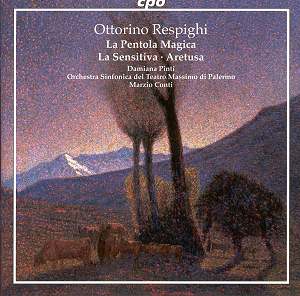
Respighi is celebrated,
perhaps too celebrated, as the composer of the three tone
poems celebrating the history and splendours of Rome – Fountains
of Rome (1914-16), Pines of Rome (1923-4) and Roman
Festivals (1928). These works have too long overshadowed
his considerable achievement in many musical forms including
music for the ballet and orchestral songs.
Respighi was much
influenced by the writings of the English poet, Percy Bysshe
Shelley, and set in addition to the verses on this album,
The Sunset (as Il Tramonto) in 1914, the same
year as La Sensitiva, the most extensive of the three
settings. La Sensitiva’s first performance was
delayed by some seven years after its completion; it was premiered,
with the composer’s wife, Elsa, as soloist, with the Czech
Philharmonic Orchestra under Vaclav Talich in Prague in January
1922. La Sensitiva (The Sensitive Plant) is the fate,
benign and cruel, through the seasons, of the mimosa. Respighi’s
orchestral palette is resplendent with vivid colours; he artfully
creates atmospheres that are vaporous, lush and voluptuous,
coolly melancholic and coldly decaying; all beautifully and
evocatively captured here. Damiana Pinti is a most expressive
mezzo colouring her voice according to the emotions suggested
by the passing seasons, her vocal line silken – although,
it has to be said, often at the expense of text articulation.
Aretusa,
inspired by the Greek myths, tells how the river god falls
in love with a terrified river nymph and relentlessly pursues
her over waterfalls and across seas until she reaches Syracuse,
Sicily where she becomes transformed into the City’s famous
spring. Respighi’s sparkling, evocative music, not surprisingly,
resembles his Fountains of Rome. Again
Pinti’s expressive singing impresses but at a pinch I prefer
the rival Collins recording (13492) that features Dame Janet
Baker and includes a lovely version of Respighi’s Il Tramonto.
In the context
of ballet music, Respighi is best remembered for his adaptation
of piano pieces by Rossini for La Boutique fantasque.
This production, premiered by Diaghilev’s Russian Ballet,
in London in 1919, was so successful that the Company, under
the direction of the Russian dancer, Ileana Leonidev, commissioned
three further ballets from Respighi: Le astuzie di Columbina,
Sèvres de la vieille France and La pentola magica.
The three ballets were premiered together in Rome in November
1920. Premiere recordings of all three ballet scores were
released on Marco Polo 8.223346 with Adriano conducting the
Czecho-Slovak Radio Symphony Orchestra (Bratislava) in witty
and vibrant performances.
This new recording
of La Pentola Magica is of special interest to Respighi
enthusiasts because the detail of the ballet’s story has recently
been rediscovered so that listeners can appreciate Respighi’s
music all the more. The story involves the vain, bored and
heartless daughter of the Czar who rejects all suitors for
her hand, particularly a handsome but poor young prince. She
is intrigued by the sounds of music emanating from a cooking
pot outside the palace. In spite of all her pleadings and
offerings of riches, the owner of the pot, a penniless peasant,
who had been seen dancing to the music, refuses to give it
up. He demands her kisses, she reluctantly agrees. The court
is shocked. The Czar is outraged and disowns his daughter
locking her out of the palace. She cries in despair. The peasant
throws off his wig. It is her rejected suitor, the young prince.
“You refused me … take the pot; I don’t need it, or you …”
The Czar’s daughter is left out in the rain while her cruelly
used maidservants look on laughing.
Respighi performed,
and studied - with Rimsky-Korsakov - in Russia during his
early years and so it was natural that this ballet music should
be strongly influenced by the Russian masters, Tchaikovsky
in particular. The lullaby-like Prelude, for instance, is
derived from a piece by Grechaninov, the ‘Entrance of the
Czar’ by music by Arensky, and the brilliant ‘Dance of the
Tartar Archers’ by Anton Rubinstein.
Pinti responds
excitingly and sympathetically to Respighi’s melodic music,
so colourful, fairy-tale atmospheric, and so Russian. The
CPO sound is that much better than that of the Marco Polo
reading. A sultry yearning melody, featuring Damiana Pinti,
follows the Prelude before the tempi pick up slightly for
the colourful tambourine-led ‘Danza’. The entrance of the
Czar is regal, rather ‘Elgar in Moscow’. ‘Scena della Tzarewich’
is correspondingly tender and entreating, lovely and lyrical
before the music turns grotesque, sounding like squabbling
hens and not unlike Bernard Herrmann’s frenzied Psycho
string music. The presto ‘Danza degli Arceri Tartari’
is proud and one can imagine those arrows swiftly hitting
their mark. ‘Danza Cosacca (Kosaciók)’ is like something one
hears from a music box contrasted with a rustic folk dance
that burns to a wild crescendo. ‘Danza della Seduzione’, like
‘Danza e Horowod’ is gently persuasive, its measures having
an almost 18th century formality.
Brightly-coloured
and involving performances of not-so-well-known Respighi works.
Recommended to Respighi enthusiasts.
Ian Lace
Respighi
website
BUY NOW
AmazonUK
AmazonUS
Note: Amazon suggests
that this disc requires SACD hardware but the review disc
was playable on a standard CD player.



 Damiana
Pinti (mezzo)
Damiana
Pinti (mezzo) [69:40]