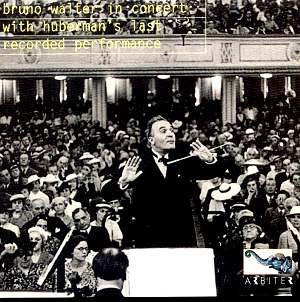
Two
concerts separated by the War. The first took place in March
1939 and found Walter on the cusp of a permanent move to
America. He conducted the NBC Orchestra at the generous invitation
of Toscanini, and here in the C major Beethoven symphony
he proves more lithe than his later 1947 NYPO recording.
The later performance saw a distinct relaxation of tempo
and a less penetrating way with accented material but it’s
nevertheless valuable to hear any Walter Beethoven performance
and to trace divergences from the norm or intensities of
music making for internal or externalised reasons. This was
a particularly unsettled period.
The
three items that derive from the 26 May 1946 concert were
given with the Philharmonic-Symphony Orchestra of New York.
The Leonore Overture is something of an extreme example
of Walter’s art and one could argue for Toscanini’s influence.
Pre-War in Vienna he took thirteen minutes – you can find
it on Naxos (see review) – but
here he drives through it in 11.48 and the differences, in
tempo, feeling and incision,
are
substantial.
It may be more externally expressive in phrasing than other
of his performances but it does feel driven; over-driven,
in fact. Later still in New York, in 1954, he reverted to
a more reserved, Walter-ish tempo of 13.40
Mozart’s
E flat symphony can profitably be contrasted with the 1934
commercial recording with the BBC Symphony. Every movement
bar the finale is quicker in New York though I strongly prefer
Walter’s earlier thoughts. For a start, beyond his control
naturally, this concert has very compressed sonics. More
significantly there’s a rather exaggerated sense throughout
and some lumpy rhythm; transitions don’t sound as natural
as they had a decade earlier. There are ensemble imprecisions
in the slow movement which, whilst intensely communicative,
can sound rather heavily on-the-beat. The finale is actually
the most convincingly thought-through of the movements; spruce
entry points and a spirited sense of direction.
The same concert also saw
Bronislaw Huberman join Walter for what Arbiter calls his “last
recorded performance.” This is not to be confused with the
1945 broadcast survival of the same concerto that the two
men gave that was put out some years ago by Music & Arts.
The performance is however consonant with that one. Huberman’s
intonation does wander and there are bowing eccentricities
along with a typically retrogressive approach to matters
tonal. The signal collapses briefly at 6.16, just before
the first movement cadenza. His phrasing of the slow movement
is the polar opposite of the luminous but as ever he vests
his playing with provocative harshness of tone and penetrating
immediacy of musico-architectural insight. There are some
gloriously anachronistic (then as well as now) successive
downward portamneti in the finale; whatever else one can
say of Huberman in this repertoire, he was never dull.
The
sound quality, as alluded to earlier, is variable. The Huberman
concert has recessive sound, scratches and surface noise;
it’s no different in the remainder. Nevertheless this is
an important document and collectors will find imperfect
sonics a small price to pay for such provoking and unsettled
performances.
Jonathan Woolf
BUY NOW
AmazonUK AmazonUS



 Bronislaw
Huberman (violin)
Bronislaw
Huberman (violin)