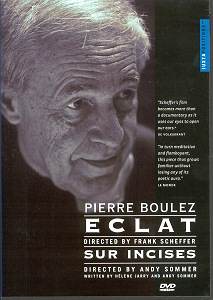
This is another release
in the Allegri Films Juxapositions
series. Excellent as are they all,
this one stands out because in it Pierre
Boulez talks in great depth about two
of his major works, Eclat and
Sur Incises. It is an amazing
opportunity to hear what a composer
says about his work, and how it can
be realised in performance. It is an
essential guide for all who want to
understand how his music works "from
within". By understanding a piece,
Boulez says, a performer can create
a personal response, rather than merely
imitate what has gone before.
Sur Incises started
as a test piece for piano virtuosi.
This was the "seed" which
developed into a piece for three pianos,
three harps and three percussionists.
Its first figure is a "musical
slap, a sharp, quick note replicated
repeatedly in different intervals and
colourations". Watching him conduct,
close-up and in detail, is an education;
not one muscle movement wasted, everything
precise. He describes how the sounds
become a "kaleidoscope", the
shapes shifting and rearranging endlessly
in different patterns as they zigzag
from instrument to instrument. Brilliantly,
the film then uses kaleidoscopic images
to illustrate, moving in time to the
music. It’s extremely vivid. As Boulez
says, the music has "emotional
trajectory", a sense of continuously
moving forward. It is "a toccata
of perpetual motion". There is
movement between the three groups of
instruments as well as between individual
instruments in the group. The film splits
into nine smaller screens, showing each
of the nine instruments interacting.
Longer shots follow the more complex
figurations, such as certain difficult
passages on the piano, thoughtfully
shown together with the notation on
the score, showing how the fingering
translates them into sound.
The music then goes
through a transition, which Boulez said
was inspired by holidays he took in
the Caribbean in his youth. When Boulez
described the island, the camera caught
the reaction of a group of young students
in the audience. Evidently one of them
came from one of those places, for they
all beamed with joy and recognition.
It was a very human touch, the film-makers
reminding us that music is there for
an audience, and reaches out to all.
Then came the passage in which steel
drums join the timpani; metal versus
skin, soft versus hard. Then the music
progresses, reprising the "slap"
and the "Pavlov reflex" figures,
developing them yet further. Traditional
classical music accepts an architecture
which a composer "fills in",
says Boulez. In modern music, a composer
creates the "architecture".
And so we reach the end "that falls
apart", the open-ended ending.
He shows that, when he drops his arm
suddenly to his sides, the players carry
on developing the music unconducted.
Delighted, he heard each player playing
the same notes but in different orders,
a natural outgrowth from what they had
been playing before, but this time,
on their own. The lesson is followed
by a performance which means all the
more having just heard Boulez speak
about it. It’s beautifully played, for
the musicians are his own Ensemble Intercontemporain.
The second film, made
in 1994, focuses on how a conductor,
Ed Spanjaard rehearses a performance
with the Nieuw Ensemble. Eclat is
a tricky piece because it "bursts
out" of the written score, allowing
the musicians to improvise and develop
its themes. It is another example of
the open-ended nature of new music,
even though such ideas have existed
in the distant past and in non-western
music. Boulez and Spanjaard talk about
interpretation, elucidating the complex
interrelationship between the 15 instruments
by diagram. It shows the formal framework
of the piece on which the free improvisation
will grow. The film develops in a lovely,
informal way, showing the players walking
to rehearsal through busy streets, and
the glances of passers-by as they look
into the glass-walled rehearsal room.
It gives the music a "human"
dimension, relating what is happening
in the studio to the real life world
of musicians and audiences. As the rehearsal
goes on, it is interspersed with shots
of Boulez talking about his techniques.
It adds to the sense that this music
is in development all the time, living
and growing with performance. Boulez
likened his dense musical textures to
paintings by Paul Klee which he saw
in New York in the late 1940s. Klee
built up the backgrounds of his paintings
meticulously, with layer after layer
of colour. Only later did he add definite
shapes and lines. What you see, says
Boulez, "is different levels of
perception". It is that exploration
of ways of listening and expression
that makes music have "content"
rather than mere "gesture".
In listening, says Boulez, the listener
discovers himself. Great works like
those of Beethoven and Schoenberg pose
questions, on which the listener is
obliged to ponder, and think for himself.
Anne Ozorio



 Ensemble Intercontemporain, Nieuw Ensemble,
Ed Spanjaard (conductor)
Ensemble Intercontemporain, Nieuw Ensemble,
Ed Spanjaard (conductor)  IDEAL-AUDIENCE
DVD9DS15 [142:00]
IDEAL-AUDIENCE
DVD9DS15 [142:00]