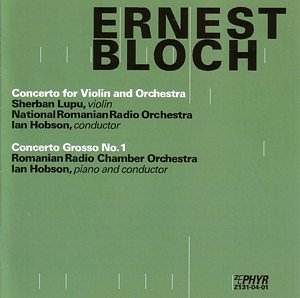
There have been a number of recordings
lately featuring Ernest Bloch’s music.
This is positive as he is largely known
for Schelomo, a Hebrew Rhapsody
for cello and orchestra. One quickly
discovers that the idiom flavouring
Schelomo flavours almost everything
else too, though not the violin concerto.
Featuring two sizable works, this new
recording clearly shows that Bloch felt
he had something to say.
The Violin Concerto
– once recorded by Menuhin – is likely
to be anticipated as the more interesting
work. Bloch trained as a violinist prior
to turning to composition, and the work
proves a curious mixture of North American
sources and the Belgian violin and composition
schools out of which he graduated.
The opening quotes
at least eight themes, none of which
is really developed that far, though
one based on North American sources
proves more memorable than the rest.
For an allegro deciso of over
17 minutes, I was surprised how little
deciso came through in performance.
There are shortish bursts for tutti
orchestra, and these are weightily given,
but much of the opening movement seems
strangely wayward. The andante is
atmospheric in its lines for the wind
instruments placed against Lupu’s finely
strung violin solo. Here, as earlier,
he steers a path that allows bite, beauty
and body to his tone. Thematically though,
the movement is slight.
The closing deciso
opens with brass and strings against
a jaunty solo line which Lupu uses to
further display both quality and fluency.
As with the first movement any impetus
initially created is soon dispelled
as Bloch moves from one textural colour
to another. The orchestra captures these
colours, and it is hard to imagine the
homogenised sound of a western orchestra
doing so with as much individuality.
Hobson’s direction, for the most part
unfussy, cannot disguise the shortcomings
evident in the composer’s imagination.
My main reservation concerns the recorded
sound, as it’s somewhat distant. It
does no favours to the performers who
are capable of more than the recording
really displays.
The Concerto Grosso
(the first of two) opens with a short,
rather four-square, prelude given forthrightly.
Any problems with the recording have
been corrected, as the performance is
much more immediate. Hobson’s piano
obbligato is made of sturdy stuff. The
second movement dirge might have been
more obviously depressing were it not
for the orchestral weight and shading
that frequently gives the performance
a chamber music air. There are also
plenty of opportunities for orchestral
solos to come through: violin, viola
and cello – all register keenly on the
ear. The pastorale and rustic dances
bring a refined view of the country
to the proceedings, to which impetus
is added by Hobson’s playing and the
flexibility of tempi, to which the orchestra
readily respond. The closing fugue-allegro
is the point at which any indebtedness
to the Handelian concerto grosso is
most noticeable. Bloch’s orchestration
announces it as something entirely of
twentieth century origins without once
endangering any tonal sensibilities.
David Z. Kushner’s
six page booklet note makes the case
for Bloch’s music in the face of narrow
criticism. In the end though, it is
the music that must convince, and it
just does not quite do that. These might
be works for occasional listening but
they are given committed performances,
and a pleasure to hear Romanian forces
reaching a wider international audience.
A great pity the recording ambience
lets the violin concerto down.
Evan Dickerson



 Sherban Lupu (violin) (a)