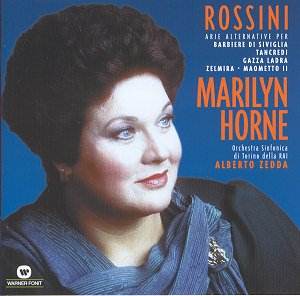
This CD seems to follow
a developing trend with many re-issues,
dropping the price but also the content.
When this recording of Rossini’s alternative
arias appeared on a CBS Masterworks
(MK 44820) they came with the addition
of the composer’s cantata for solo voice
‘Giovanna d’Arco’ to give a total time
of 68 minutes against the 50 here. Also
to be abhorred is the loss of the notes
by the renowned Rossini scholar Philip
Gossett explaining the practice and
circumstances of alternative arias.
The notes are replaced by a pretentious
and diffuse essay titled ‘The Register
of the Human Voice’ which seeks to develop
the thesis of the place of the ‘contralto’
voice as central to Rossini’s operas.
The author, Bruno Cagli, eulogises Marilyn
Horne as fitting Rossini’s intentions.
Maybe. I have my doubts if Gossett,
or the other Rossini scholar involved
here, the conductor Alberto Zedda, would
agree.
At the start of her
long career, Marilyn Horne sang the
soprano roles of Minnie in Puccini’s
La Fanciulla del West, Giulietta in
Offenbach’s Tales of Hoffman and Marie
in Wozzeck, her debut role at Covent
Garden in 1964. In a 1965 recital for
Decca she sang Semiramide’s high soprano
aria Bel raggio lusing hoier.
Later that same year she recorded the
mezzo role of Arsace from the opera
with Joan Sutherland in the title role.
At this stage of Horne’s career it was
her phenomenal wide range, flexibility
and timbre that pointed her to the bel
canto repertoire and the mezzo fach.
On this recording she transposes downward,
the alternative ‘letter aria’ from act
2 of Il barbiere di Siviglia.
This transposition is hardly surprising
as, at the time of this recording, she
had sung the mezzo roles of Carmen and
Dalila as well as some of those of Verdi.
At this stage of her career she was
also making a big impact in the Rossini
dramatic travesti roles at the Pesaro
Festival and elsewhere. In these roles,
such as the eponymous Tancredi (tr 5)
and Calbo in Maometto (tr. 7) Horne’s
renowned lower register is heard to
good dramatic and musical effect. As
was often the case these alternatives
were written by Rossini to accommodate
the skills of individual singers or
the demands of a theatre. In the case
of the second extract from Tancredi
(tr. 5) Rossini changed the original
happy ending of the opera to a tragic
one for performances in Ferrara. He
later incorporated it into the now commonly
accepted happy ending. An example of
changing to accommodate individual singers
is found in the aria from his last opera
for Naples, Zelmira (tr. 4). The creator
of the role was his mistress, later
his wife, Isabella Colbran, renowned
for her florid singing. After Naples
Rossini presented the opera in Vienna,
London and Paris. For the latter his
Zelmira was Giuditta Pasta, best known
at that period for her dramatic rather
than her florid singing. To accommodate
her strengths Rossini re-wrote the final
scene, giving Zelmira this new aria
and incorporating the original one into
an ensemble.
In providing these
contextual explanations I do not wish
to detract from the variety and quality
of Marilyn Horne’s singing. It was not
without benefit to her skills, and our
enjoyment, that she immersed herself
into the diversity of Rossini’s compositional
idiom. It says much for her schooling
and vocal technique that at this stage
of her career she could bring lightness
of tone and characterisation to her
Rosina whilst going to the opposite
extreme for darkness and tragedy. It
is a shame about the short playing time
and lack of contextual explanation.
However, this disc is a must for all
lovers of Rossini’s writing and of Marilyn
Horne’s formidable vocal skills and
abilities. The disc is an ideal complement
to her ‘Rossini Heroes and Heroines’
(Decca) and comparison with Ewa Podles’
equally formidable lower register and
expressive power in her live ‘Rossini
Gala’ (Dux).
Robert J Farr



 Marilyn Horne (mezzo)