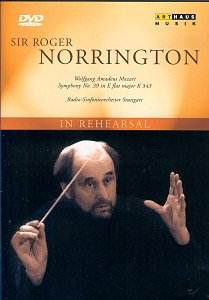
Since DVDs are never
technically consistent let me first
dispose of those issues. The stereo
sound, that is the only choice, is perfectly
listenable; the 4/3 picture is perfectly
watchable and the camera work unfussy.
There is no option for English subtitles
on this disc and all visual titles are
in German. Since Norrington rehearses
in English – a tribute to the German
orchestra’s multi-lingualism – this
is not a problem. It is typical of German
television (SDR here) that the performers
are allowed to speak for themselves.
There is no narrative, in fact no extraneous
commentary at all. One wishes the BBC
Proms coverage was similarly dedicated
to music and music-making instead of
to the posturings of the pseudo-popularisers.
There is talk (and oddly no applause)
at the end of the performance – just
credits. Which is also very refreshing
after yet another season of BBC babble.
On the down-side there are no extras
– just the rehearsal and the performance.
The notes by Tillmann Klein set out
an interesting and convincing theory
that the final three symphonies intentionally
emulate the six Paris symphonies of
Haydn. He suggests that Mozart was planning
to publish them as a set in an attempt
to raise his public reputation and thus
help him to get a salary rise as court
composer. Klein makes it clear that
there is no explicit evidence for his
suggestion but it is a nice thesis.
Norrington is here
trying to turn his orchestra into a
period band thus a lot of rehearsal
time, in a very democratic atmosphere,
is dedicated to dynamic moulding of
Mozart’s symphony. It is interesting
even to a non-player like myself, how
his detailed rehearsing changes the
sound. The players of the Stuttgart
Radio Symphony Orchestra have worked
with Norrington for many years and even
by the time of this nine year old film
had become adept at playing without
vibrato. I enjoyed the way in the third
movement that he enlivened the whole
sound by much encouragement of the clarinets
and of the second violins. Norrington’s
encouragement often takes the form of
singing along. Similarly in the fourth
movement he characterises the stresses
on the appoggiaturas as "carrot-juice",
"carrot-juice" and then holds
up his half drunk bottle of carrot juice
to emphasise the point.
During the performance
one can see that a lot of the conducting
gestures are directed at reminding the
orchestra of points made during rehearsals
where all the real work was done. One
can see knowing smiles among the musicians
as they remember the points made. In
an informative contrast the orchestra
watches the score during the performance
but Norrington during the rehearsal.
There is not much sign of an audience
in this small auditorium though they
are there. As a result the camera roams
freely around the orchestra during the
performance whereas it had focused largely
on Norrington during the rehearsal.
Purchasers interested
primarily in the performance of the
E flat symphony can be reassured that
since Norrington has a clear idea of
the ebb and flow of the work and the
orchestra is very responsive, no viewer
is liable to get bored. It is all very
enjoyable.
David Billinge



 ARTHAUS MUSIC 101 070 [60:00]: