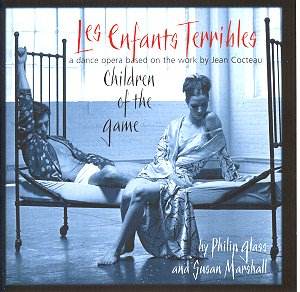
The third of the Philip
Glass stage pieces based on the works
of Jean Cocteau, Les Enfants Terribles,
is a dance-opera. The singers are all
expected to be multiply talented, equally
capable as musicians and dancers. Gerard,
the narrator, tells the story of a brother
and sister who live in their own fantasy
world, totally removed from the real
world. The sister, Lise, eventually
starts to exist more in the world of
natural reality until tragedy strikes.
Her solution to her unhappiness ends
in the death of both her and her brother
when they try to rejuvenate their fantasy
world.
The music is classically
Glass, though not Glass at his most
repetitive. Each individual piece is
built on the minimalist repetitive structure
with its steady pulse and consonant
drones in the left hand. The instrumentation
is extremely small: piano and voice
or piano in solo or duet encompasses
the entire expanse of instrumentations.
There are times when the vocals are
spoken in English over the extended
ostinatos by the narrator. Otherwise
the vocalists sing in French. Glass
uses the music to literally interpret
the words where he can, aiding the pairing
of the sound with the text. One can
assume that he does meld the music to
the dance as well, though it is difficult
to tell when there are no visual elements
from the ballet included.
Thus the plot line
is fairly simple, with only 5 total
characters appearing. The complexity
is derived mostly from the emotions
expressed in dance and song. Theatrically
this is largely a success. Unfortunately
this is not as true when considered
solely in the realm of this recording.
Philip Glass’s music
is at its best when it is presented
with a broad palate of timbres to break
up the monotony of repetition. When
presented in the format of piano and
vocalist only there must be a truly
compelling vocal performance. With this
type of instrumentation, Glass’s greatest
success was his collaboration with Allen
Ginsberg, "Hydrogen Jukebox". When coupled
with the dance, this music is properly
presented. Without the dance, the music
truly should be edited to a shorter,
faster moving, more compelling work.
Presented in its full length without
dancers, the result is overly ponderous.
It actually is a shame
that this was not edited. The music
is certainly not without merit. It is
distinctively Philip Glass, with all
that implies. His musical thoughts are
well expressed and performed through
both discs. Were the total length halved,
this would be a masterfully produced
piece of music. Performed live or on
video it is surely captivating. Alas,
once this work does not end somewhere
around 50 minutes it simply becomes
over-long. There is too much repetition
of previous thematic material and too
little musical development to bear the
weight of the work without the drama.
That said, the performances are well
done. If individual works are included
in some form of Philip Glass iPod shuffle
then this music holds up. If the work
is to be performed, this is a very good
reference point. Otherwise this is probably
a work for the Glass completist more
than the casual listener.
Patrick Gary



 Karen Kemensek, conductor











