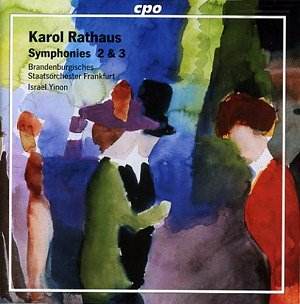
Rathaus was
Polish-born - one of that generation
of composers hounded from Germany by the irresistible rise of
Adolf Hitler. Ultimately he fetched
up in the USA after Britain's narrow-mindedness prevented
him from earning a living. Contrary
to his hopes or expectations he did
not find a home in the film industry
nor on Broadway. Instead he ended
up in the welcoming ranks of American
academia. Had he remained in Poland he would have suffered the
same fate as others who were execrated
by the Nazi-aligned critics. His Second
Symphony performed in Frankfurt
in the 1920s came in for condemnation
as ‘music of the Zulu kaffirs’.
His music has
gradually accrued modern recordings.
The principal orchestral entrants
until now were one disc apiece from
Centaur and Decca. The 1997 Centaur
CD (CRC 2402 see review)
of Suite for violin and orchestra
(1929); Suite for orchestra (1930);
Serenade for orchestra (1931) and
Polonaise Symphonique (1943)
was recorded in the Czech Republic
(see review).
A much more illustrious contender
is the Decca 'Entartete Musik' CD
of Symphony No. 1 and the ballet 'The
Last Pierrot'. While deleted everywhere
else this disc is still buyable in
Germany along with the whole of the
‘Entartete Musik’ range. Try www.jpc.de
where they used to sell for 9.99 euros
apiece.
The Second
Symphony is a product of his early
blooming confidence. The music coasts
close to the perils of 12-tone writing
but evades the trap. There is dissonance
but it is used alongside consonance
for colour and effect. There also
is a deathly starkness about this
music. Rathaus charts a pilgrimage
through a land of loathing, disillusion,
doom and a sort of knowing innocence.
The finale, lasting only 4.40, is
typical of the landscape: some Stravinsky
but much more in the way of late Mahler,
mordant, scorching and driven by the
furies.
Wind the clock
forward a decade which saw uprooting
and hardship and which had not yet
seen the end of Axis fascism and we
find music of greater accessibility.
The four movements of the Third
Symphony are in an idiom moderately
spiced and often of romantic inclination.
Rathaus had found security as a professor
at Queen's College in New York
and, much to his surprise, loved it.
This shows I think in the confident
tumultuous writing of this 42 minute
work. The idiom is anything but spare.
It is laden with dense turbulent Mahlerian
cantabile. There is carefree playfulness
in the diminutive scherzo (tr. 6)
sounding a little like a ländler at
one moment and at another like Bernard
Herrmann's music for the Magnificent
Ambersons. In the Andantino
and final allegro appassionato
an uneasy Mahlerian lyricism takes
hold. That finale also bears the impress
of dancing figuration indebted to
Beethoven's Fifth and Seventh symphonies.
Rathaus was
a Polish composer educated in Vienna, a student of Schreker in Berlin and feted among the avant-garde
during the 1920s. He lived in London during the 1930s and emigrated
to the USA
at the end of the second world war.
While the fifth edition of Grove claims
the influence of Szymanowski his music
as represented by these two symphonies
bears no such resemblance. It is tough
and harmonically game although without
dodecaphony.
Rob Barnett