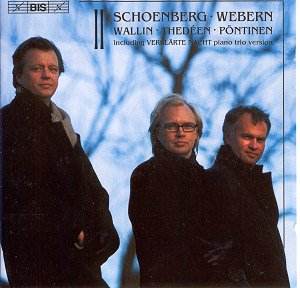
Schoenberg’s Verklärte
Nacht Op.4 is probably one of
his best known pieces, either in its
original version for string sextet or
in the transcription for string orchestra.
However, the present transcription for
piano trio, made by Eduard Steuermann
in 1932 is a rarity; and this must be
its first recording ever. I was not
aware of its existence until now. Besides
being an excellent pianist and a long-time
champion of Schoenberg’s piano music,
Steuermann was also a composition student
of Schoenberg, so that it may seem natural
that he undertook the task of transcribing
Verklärte Nacht;
and he did so successfully, for this
version works remarkably well, although
it is unlikely to supplant either the
original version or that for string
orchestra. It is nevertheless nice to
have it once, especially in as fine
and committed a reading as this. It
is nice, too, to have Felix Greissle’s
transcription for piano trio of the
vocal movement of Schoenberg’s Serenade
Op.34, although it almost seems
a trifle when compared to the Steuermann
transcription.
Although Schoenberg
has the lion’s share, the Webern selection
may be intrinsically more interesting
and revealing, for it confronts mature
works with earlier pieces (Two
Pieces for cello and piano,
1899) and pieces that have been either
discarded or merely forgotten. The Webern
pieces also raise some questions. For
example, why was the so-called Cello-Sonate
(lasting 1:32!) written at about the
same time as the Three Little
Pieces Op.11 not
included into the Op.11 set? The music
is clearly in the same vein and as fine
as anything that Webern composed at
that time, particularly the extraordinary
Bagatellen Op.9 for string
quartet or – for that matter – the epigrammatic
Four Pieces Op.7 for violin
and piano heard here. It is good, too,
to hear some early music by Webern,
in this case the Two Pieces
of 1899, still fairly traditional in
their post-romantic expression, but
already displaying one of Webern’s trademarks:
brevity. The Variations Op.27
of 1936 is the only substantial piano
piece in Webern’s mature output, and
one of his most directly compelling
pieces. His earlier attempts, Sonata
Movement and Movement,
both from 1906, were only discovered
in 1965. They were composed a couple
of years before the Passacaglia
Op.1 and inhabit much the same
harmonic and expressive world, freely
tonal and chromatic but still with some
post-romantic traits. Incidentally,
at 4:46 and 6:55, they may be Webern’s
longest single items. Listening to these
highly chromatic and almost luxuriant
piano pieces, one realises that Webern
travelled a long arduous way to achieve
the perfection of the Piano Variations.
The posthumous Piano Piece
(1925) and Children’s Piece
(1924) are typical of Webern’s mature
style. It is not clear whether the elliptical
Piano Piece of 1924 was
to be part of a larger set or just an
essay in twelve-tone writing. The short
Children’s Piece (apparently
the first twelve-tone piece by Webern)
was obviously planned as a movement
for a set of pieces suggested by Emil
Hertzka, the Viennese publisher, but
was never completed. The Four
Pieces Op.7 for violin and piano
belong to a series of extremely concise
works written at about the same time:
Bagatellen Op.9, Five
Pieces for Small Orchestra
Op.10 and the Three Little
Pieces Op.11, in which the basic
material is often rather bluntly stated
without any real attempt at development,
the emphasis being more on the sonic
qualities of isolated pitches.
This is a very interesting
release, for besides a valuable Schoenberg
rarity, it offers an enlightening glimpse
into some of Webern’s early music as
well as a very telling confrontation
with his maturity, so that his musical
progress may be better appreciated.
Excellent performances and very fine
recording. Completists either of Schoenberg
or of Webern need not hesitate; others
may also find much to enjoy.
Hubert Culot



 Ulf Wallin (violin)c; Torleif Thedéen
(cello)a; Roland Pöntinen (piano)c
Ulf Wallin (violin)c; Torleif Thedéen
(cello)a; Roland Pöntinen (piano)c