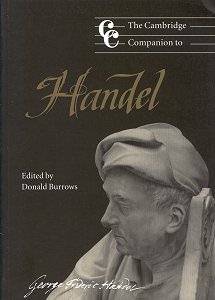
Includes:
Germany: education and apprenticeship:-
John Butt
Italy: political and musical contexts:-
Carlo Vitali
Handel's London: political, social and
intellectual contexts:- William Weber
Handel's London: the theatres:- Judith
Milhous and Robert D. Hume
Handel's London: British musicians and
London concert life:- H. Diack Johnstone
Handel's London: Italian musicians and
librettists:- Lowell Lindgren
Handel's English librettists:- Ruth Smith
Handel and the aria:- C. Steven LaRue
Handel's compositional process:- David
Ross Hurley
Handel and the idea of an oratorio:- Anthony
Hicks
Handel's sacred music:- Graydon Beeks
Handel's chamber music:- Malcolm Boyd
Handel as a concerto composer:- Donald
Burrows
Handel and the keyboard:- Terence Best
Handel and the Italian language:- Terence
Best
Handel and the orchestra:- Mark W. Stahura
Production style in Handel's operas:-
Winton Dean
Handel's oratorio performances:- Donald
Burrows
I must confess that
I came rather late in life to Handel.
And for this I blame my father. He was
born and bred in Lancashire and had
absorbed the Messiah tradition.
In fact his father had conducted
performances of this ubiquitous oratorio
many times in the Manchester area in
the nineteen-thirties. Unfortunately,
my father bought a long playing
record of the famous (notorious?) Huddersfield
Choral Society version of the Messiah
conducted by Sir Malcolm Sargent. Forthwith
I was subjected to this music from an
early age – especially at Easter and
Christmas. I did not really understand
that ‘My redeemer liveth’ or
that ‘He was despised’ was part
of the Christian tradition, in spite
of being brought up in a religious household.
The music to me became purgatorial rather
than a vision of ‘The Glory of the
Lord.’ I buried my head in the Beatles
and Led Zeppelin and Yes. When I came
to classical music this distaste for
the Messiah was still there and
I revelled in Bach rather than GFH.
It was not until I
discovered Handel’s keyboard music that
I began to become interested again.
For some reason it appeared easier to
get ones fingers round than the Preludes
and Fugues and Partitas of
Johann Sebastian, and that was encouraging
to a neophyte pianist. Keyboard music
led to the orchestral works then a few
of the operas and finally back to the
Messiah. So perhaps my father
was right after all, although I still
cannot listen to the ‘Huddersfield’
version – even though my Great Uncle
Tom was singing bass in that particular
recording. It has to be a little more
‘authentic’ for my tastes.
My interest in Handel
has been hands-on. I have listened to
his music and played it. But I have
not really approached his life history
or considered the compositional processes
behind his works. I never really knew
about the time spent in Italy or why
the Chandos Anthems were so-called.
I did know he lived in Brook Street
in London, but had no idea of his career
there. Apart from some obvious references
I am unaware of influences, sources
and parodies in his works – although
I do know he lifted music from other
composers – without acknowledgement.
It is easy to buy a
biography of Handel. There are a number
of them in secondhand bookshops. The
Master Musician volume (also by Donald
Burrows, the editor of these present
essays) is an excellent read, covering
both the man and his music. Further,
in the musical libraries there are plenty
of dissertations, monographs and theses
on all aspects of Handel’s career –
one need only glance at the bibliography
provided in the present volume to see
what is available. [Although if I am
honest, I was a little disappointed
with the bibliography in this book.
It could certainly have been more extensive.]
However it is the middle ground that
is usually lacking in any analysis of
a composer’s achievement. There are
many listeners who want something a
little more than a brief biography but
perhaps a little less than the 500 page
examination of the ‘Use of Plagal
Cadences in the Early Operas’ type
of monograph. This Cambridge Companion
fulfils this wish with aplomb and distinction.
The book is conveniently
divided into three sections. After a
short introduction by the editor there
is a section on the background to the
composer’s life and works. Such topics
as Handel’s training and musical apprenticeship
are explored in a fascinating article
by John Butt. One of the most interesting
chapters examines Handel’s time in Italy
and the influence of Italian opera.
Of course Handel is an honorary Englishman
and deserves to be seen within the context
of London society and musical life –especially
the theatre. There is a fascinating
essay on ‘British musicians and London
Concert life.’ Two more specialised
articles look at both Italian and English
librettists at work in contemporary
London.
The second division
of this book gets to grips with the
music. The first essay I read for this
review was Terence Best on ‘Handel and
the Keyboard.’ This was particularly
interesting to me as it was this music
that led me back to GFH after ignoring
him for a number of years. Plenty of
musical examples bring to life this
somewhat neglected aspect of the composer’s
music.
Anthony Hicks considers
Handel’s achievement with oratorio –
for which most people probably consider
Handel to be famous.
There is a section
on the orchestral suites, but this is
a little thin if the reader wants to
know all there is to know about the
background to the Firework Music
or the Water Music. C. Steven
LaRue considers Handel’s approach to
the aria, noting that in the composer’s
day it was the aria that were the most
popular, whilst today it is the choruses
that have taken that position. Malcolm
Boyd presents a short but fascinating
discussion of the little known chamber
music.
The last section of
the book concentrates on the performance
aspects of Handel’s music. This perhaps
is slanted from an historical perspective;
however there is plenty of food for
thought for today’s performers. The
analysis of the Handelian orchestra
in the 18th century is particularly
fascinating.
There are extensive
reference notes provided for each chapter
and these give information for the most
scholarly of readers. The book is illustrated
with many musical examples and a few
reproductions. The chronology provides
a vital baseline for even the most cursory
consideration of Handel’s works.
Finally it only leaves
me to say that this book is an important
addition to the literature on not only
Handel, but 18th century
British music in general. Having said
this, it is hardly a book for the beginner.
The average music listener will be content
with Donald Burrows’ excellent earlier
volume mentioned above. And of course
there are other popular (but also learned)
volumes dedicated to Handel. Paul Henry
Lang has written a fine biography and
then there is the ‘New Grove’ extract
by Winton Dean.
But for the reader
or listener who wants to explore current
Handelian scholarship issues in some
detail and who wants to get to grips
with the history of his times and music,
then this book is an ideal read. The
text implies a reader with a wide understanding
of musical theory and perhaps history
to reveal its full potential. This may
mean that some people will be daunted
by the rather dense text. However it
will hardly be read at a single sitting
and will probably serve better as a
reference book. The detailed index and
chapter notes well serve this purpose.
John France