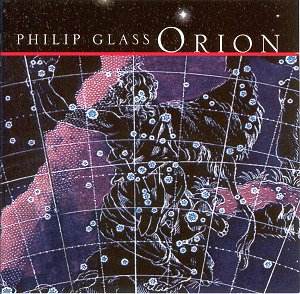
Orion was
created specifically for performance as part of the 2004 Olympic
Games in Athens. The multinational character of such an event
is reflected in the concept: a showcase for the excellent musicianship
of artists and ensembles with whom Glass has previously worked.
Fans of Glass may
initially find that they are more than a little disorientated
by the ethnic nature of much of this music, behind which his
personal voice is sometimes entirely hidden. Persevere, and
you will either warm to the cross-over nature of the music,
or find yourself reaching for ‘Akhnaten’ or ‘Songs from Liquid
Days’ for reassurance. All of Glass’s familiar rhythmic and
melodic fingerprints are here, but ethnic solo instruments plucked
out of their natural element and made to front the Philip Glass
Ensemble can sound a little twee at times.
Each track characterises
a particular country or continent. Beginning with ‘Australia’,
Mark Atkins’ delicious didgeridoo sound moulds nicely into deeply
theatrical throbbing drum pulses; a combination which will no
doubt find its way sooner or later onto an atmospheric film
soundtrack. The single pedal note of the didgeridoo suits the
PG Ensemble and Glass’s idiom down to the ground. ‘China’ begins
with an expressive improvisatory introduction on the Pipa –
an extension of the previous intermezzo in which this plucked
instrument is joined by the didgeridoo in an effective duet.
Pipa soloist Wu Man shows admirable versatility when the Glass
Ensemble weighs in and she has to fall into line with a typical
four-square Glass accompaniment. Despite her undoubted virtuosity
she sometimes ends up sounding like an exotic banjo caught on
stage at the Concertgebouw – a result of the western idiom and
‘orchestral’ backing being imposed on an instrument whose colourful
variety of effects thrives more in a solo or chamber music setting.
In ‘Canada’ we start slowly, and end up with a rollicking dance
in which Ashley Macisaac’s Celtic fiddle comes into its own.
There are three
interludes in which soloists and their respective cultures meet
in a duet. ‘Canada and The Gambia’ is the best of these. Here
the dance character of the fiddle is lifted free of the somewhat
stodgily amplified ensemble sound by the punchy rhythmic playing
of Foday Musa Suso. The ‘Gambia’ movement begins with a Lyle
Mays soundalike keyboard ostinato which, spread over fifteen
minutes, becomes a bit static and leaden. ‘Brazil’ is rather
aimless as well, but while UAKTI’s flautist has little to get
his teeth into the delightfully tactile tuned percussion has
more of a chance to shine, until they’re drowned out; you just
find yourself wishing that the PG Ensemble would shut up for
a while. The Sitar is an instrument made so familiar from other
sources that it seems less of a leap to hear it over the backing
of electronic keyboards. Gaurav Mazumdar is a worthy disciple
of Ravi Shankar, and floats with sometimes irrelevant ease over
the bumpy-noisy Glass backing in ‘India’. The final movement,
‘Greece’, brings everyone together alongside the sultry singing
of Eleftheria Arvanitaki. There are some nice harmonic twists
here, and the whole thing has a sweetly lyrical pomp-pop anthem
flavour I’d feel safe playing for my mother. It misses ‘hit’
quality however, and as far as I’m concerned if she likes it,
she can keep it.
This is a beautifully
recorded and sumptuous production which is almost self-recommending
to those interested in high profile meetings between the music
of the west and the rest-of-the-world. Some of it is great fun,
and as ‘Gebrauchsmusik’ it was no doubt highly effective in
the arena for which it was composed – it was certainly well
received at the London première. The final impression is however
a little like a meal cooked in a wok over too low a flame –
the aromas and flavours of both Glass and his brilliant friends
are tantalisingly present, but the overall result is a rather
mushy and indigestible.
Dominy Clements



 Eleftheria Arvanitaki (vocalist)











