www.concertartistrecordings.com
Timings are not everything,
but the 75:08 of this disc already tells
us something. Looking at the other CD
versions I have to hand, I find they
spread to two discs with timings as
follows: Gifford 81:33, Fou T’Song 84:33,
Antonioli 87:31. Fishing around further,
I find that a few other versions are
on one disc, though all are longer than
Joyce Hatto, but two discs seem to be
the norm. These timings are from "Gramophone",
which rounds them to the nearest minute:
Rogé 78, Tirimo 78, Martin Jones
79, Tan 83, Zimerman 84, Cassard 85.
However, there is one recording that
is faster than Hatto’s, and it
is a very important one, that by Walter
Gieseking: 70:20.
The fact that the modern
norm is around ten minutes longer than
Gieseking should surely be sounding
warning bells in certain quarters, for
was not Gieseking the supreme
interpreter of this music? If his performances
were so fine, and so apparently authentic,
is it not a little odd that everybody
plays the music differently? Furthermore,
in all the comment I have seen on these
famous recordings, I have never seen
it suggested that the great man’s tempi
were over-swift, and it would indeed
be difficult to think such a thing,
so perfectly poised are they even at
their most volatile.
Of course, overall
timings tell us very little about what
happens along the way, so my next observation
was that Hatto is consistently faster
than her modern competitors – whether
in slow pieces, moderate ones or fast
ones – with very, very few exceptions.
Whereas, in comparison with Gieseking,
the situation is more complex. In a
number of pieces – the first, for example
– he is slower, while he is more volatile
in a number of the faster pieces. But
even individual timings don’t tell us
everything. Gieseking has a slower basic
tempo than Hatto in "Les sons et
les parfums", yet on account of
his volatility when Debussy asks for
"En animant", he actually
comes up with a shorter timing. This
raises the point that, if we are to
believe Debussy’s metronome markings,
even Gieseking’s tempi are sometimes
sedate. Obviously a metronome is a poor
guide to music that is peppered with
such instructions as "Plus lent",
"En animant", "Cédez",
"Rubato", "Serrez",
all these in the space of just two lines
in "Les sons et les parfums",
and which obviously demands flexibility
even where nothing is marked. Yet if
you play the first eight bars of this
same prelude at the marked tempo (the
first tempo change is at bar 9), the
music seems radically different from
what we usually hear, almost another
piece entirely, Debussy’s "Modéré"
emerging as a lilting Allegretto. Hatto
has more of this "Allegretto"
quality than Gieseking, let alone anyone
else I’ve ever heard. So, if she is
faster than any modern rival (that I
know), it is because she is closer to
what Debussy wrote. Gieseking has shorter
timings still because of his more radical
reaction to some of the internal tempo
changes. Since Debussy gave no metronome
marks for internal tempo changes, we
shall never know how drastic he intended
them to be, though we do have a piano
roll where he interprets "Un peu
moins lent" in "La Cathédrale
engloutie" as a virtual doubling
of the tempo.
Does Hatto sound
fast? The interesting thing is that
she does not; the performances have
an autumnal glow, thanks to her technical
ease (Gieseking has his adventurous
moments) and warm, limpid sound, very
finely recorded, while not lacking in
either vitality or humour where called
for. She seems to find a just solution,
musically and poetically, to each prelude.
But perhaps I should declare an interest,
since I find I have a wretchedly recorded
tape of myself playing these preludes
around fifteen years ago with timings
that often match Hatto’s to a few seconds.
Which is not to say I played them equally
well (I’m sure I didn’t!), but the fact
that so many of the pieces emerged here
sounding much as they sound in my head
whenever I think of them may make me
suspect as a reviewer. Perhaps we’ve
both got it wrong! And yet I honestly
believe that, if you play what Debussy
wrote, the result is bound to be something
like what we hear on this disc. To say
that this is the most recommendable
of the modern versions that I know becomes
superfluous when many of the others
don’t play Debussy’s preludes at all
but something else of their own invention.
And yet, I have to
say that Gieseking is something else
again (and so is the legendary Guido
Agosti in a handful of preludes on Aura).
I have used the word "volatile"
several times and this is the quality
of those performances that I most remember
for, while his starting point is the
Olympian calm and poise for which he
was famed, he lives dangerously, his
Puck and his Ondine darting hither and
thither, his ocean seething and reeling
in "Ce qu’a vu le vent d’ouest".
I have heard Hatto get outside herself
and play with this sort of inspiration
sometimes in Liszt, and her Islamey
(Balakirev) is hair-raising; more often
it is her calm musicianship and sense
of style which impress, as they do here.
Don’t miss Gieseking, but Hatto has
a relaxed, sunlit quality, pure Monet,
that has its own attraction.
I realize that it’s
getting a little embarrassing that this
site continues to churn out glowing
review after glowing review (not only
from me) of Joyce Hatto’s records while
other magazines and sites, despise Concert
Artist as a cottage industry and do
not review the discs at all. I almost
wish she would make a really
bad disc just so I can show I know how
to listen. But so far she hasn’t … If
any reader who buys this or other Hatto
discs on the strength of our reviews
feels he has been duped, remember we
have a bulletin board. I should very
much like to know why only we
are pushing these recordings.
Christopher Howell



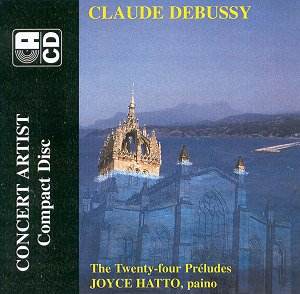
 Joyce Hatto (piano)