Mexican tenor Rolando
Villazón is a real talent and
the fact he has chosen this particular
repertoire for this release is a major
cause for celebration. In amongst the
more famous chunks of Manon and
Roméo come snippets of
Le Mage, Roma (both Massenet)
and La Reine de Saba and Mireille
(Gounod). To hear them in top-class
performances only makes one itch to
hear the operas complete, recorded to
this standard. Well, I can dream, can’t
I?
Villazón’s strengths
are an expressive legato for his generally
light tenor, accurate rhythm and a ringing
top; that Daniel Zalay and Alain
Lanceron’s recording captures nicely.
He is lucky to have Radio France’s orchestra
to accompany him – they play with real
affection and evidently enjoy the various
discoveries. More, Natalie Dessay makes
a guest appearance in the first Manon
excerpt. This begins with an explosion
of ardent love as the pair find themselves
alone before they - mainly the character
Des Greiux - explore their feelings.
The preceding ‘O Souverain’ (Le Cid)
reveals that there can be an edge to
Villazón’s voice, but it is not
too much.
Villazón’s real
strength is his identification with
the various characters and their emotions
at the time of the particular arias.
Werther’s Act 2 aria, ‘Lorsque l’enfant
revient’ is a case in point, as tender
and as imploring as they come.
Richard Martlet’s excellent
booklet notes suggest the difference
is that, ‘Gounod is a French exponent
of bel canto, whereas Massenet tends
towards a more verismo approach’. Moving
then to Gounod (the next three arias
on the disc come from Roméo,
Polyeucte and La Reine de
Saba) one does indeed finds an increase
in intensity, with Villazón positively
relishing the melodic lines it is his
privilege to sing. The ringing top is
once more in evidence (‘Parais’, around
1’50). The Polyeucte excerpt
is a real outpouring, the orchestra
plodding along behind - in the nicest
way possible - but it is perhaps the
Reine de Saba excerpt that impresses
most out of this group of three. Villazón
makes one want to hear the whole opera
just on the strength of this, the orchestra
joining him wholeheartedly in his Gounodian
dedication.
A group of three Massenets
follows. Le Roi de Lahore is
perhaps musically not on the exalted
level of Manon, it is true; the
line is rather disjunct. Villazón
however convinces by dint of sheer ardent
singing. But any admirer of musical
beauty should surely hear the Griséldis
excerpt. Villazón sings this
as if improvising, and carries the listener
along superbly. A more famous Werther
aria rounds off this trio (‘Pourquoi
me réveiller’). It flows gloriously
- the orchestra has a fair amount to
do with this - swelling enormously right
at the end. Wonderful.
The love-pervaded anxiety
of the lover-in-waiting saturates Vincent’s
aria from Mireille (‘Anges du
paradis’). A silent tomb is viscerally
invoked by Villazón in the Roméo
extract (‘Salut, tonbeau sombre …’).
Not only that, the orchestra is perfectly
‘intent’ here. By which I mean it plays
great attention to what would normally
be just ‘chugging’ figures. This is
possibly the most ‘serious’ aria in
this collection, and it receives its
full due here.
If Roméo
is moving towards familiar territory,
we arrive with Faust. How lovingly-shaped
are the strings leading to the vocal
entrance. Villazón avoids any
suggestion of sentimental milking of
the line in his delivery, and in doing
so becomes all the more touching as
he succumbs to love for Marguerite.
Massenet gets the last
word. Des Grieux’s ‘Ah fuyez, douce
image’ contains lovely floated moments,
yet that ‘steel’ edge is there in any
dynamic over forte - not unappealingly.
But what a brave and successful decision
it was to end with two lesser known
snippets. Lentulus’s scene from Roma
- the chorus represents the ‘Voices
of the Vestals’ - includes moments of
real magic from flute and harp, over
which Massenet (and Villazón)
weave a seemingly unending melody. Finally,
the wonderful, glowing music of Le
Mage in Zarastra’s ‘Ah! parais!’.
Quite a decision to end a disc of solo
arias with a chorus, but just listen
to how the chorus enters as the logical
... and magical ... extension of the
pre-extant orchestral texture. Masterly;
as is everything about this disc, really.
Colin Clarke



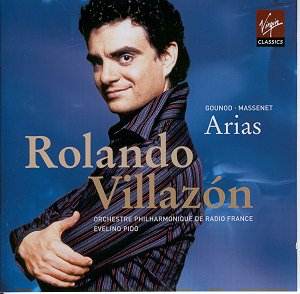
 Rolando Villazón (tenor); aNatalie
Dessay (soprano);
Rolando Villazón (tenor); aNatalie
Dessay (soprano); 











