Roderick Williams is
easily one of the finest young baritones
working in this country at the moment.
Yet he remains relatively unknown, hidden
in the ghetto of English song, occasionally
venturing into mainstream non-English
opera. Nonetheless in his niche he is
hard to surpass. He sings the entire
range, from Purcell to new music, excelling
in Britten, Vaughan Williams, Tippett,
Turnage and his own compositions, which
are very good. Few singers inhabit the
English genre so perfectly
Nonetheless, like all
truly good artists, Williams brings
something innovative to what he does.
Not for him the preciousness of the
quintessential "English tenor"
– he’s a baritone, anyway. Nor does
he sound like a voice from the past,
frozen in performance styles redolent
of the past; no Old Fogey he! English
song isn’t merely rosy-hued nostalgia:
Williams brings out its strength of
character. In recital, he is wonderful.
His rapport with the audience seems
to inspire him to sing with real, personal
vivacity - something that is hard to
replicate in studio recordings.
Finzi’s songs have
had a renaissance in the last few years
and it is interesting to hear how interpretations
have evolved from their last wave of
popularity in the early 1980s. Finzi
had a poet’s soul, choosing his texts
with great care. His settings interpret
the poems without overwhelming them.
Alas, some Hardy poems don’t always
lend themselves naturally to melody.
Nonetheless, they evoke vivid images
whose impact is perhaps greater than
the words alone. Therein lies the challenge
for a Finzi singer. For example, in
The Self-unseeing, you don’t
realise the song is about ghosts until
the final line "Yet we were
looking away!" This gives a
singer the chance to contrast the understated
music with a shock ending, though in
fairness to Williams, Finzi simply scored
the notes downward. For whatever reason,
Williams plays down the drama, even
in songs like Channel Firing
where there’s plenty of licence to go
for emphasis. Even when God says "No!"
to the dead rising from the grave, it’s
more polite than forceful. Stephen Varcoe
may not have as much colour in his voice,
but his Hyperion version is more vivid.
Perhaps Williams, in this showcase recording,
is playing safe, taking no chances.
Again, though, Williams is being faithful
to Finzi’s writing, whose beauties lie
in understatement, and in quixotic breaking
of melodic lines within lines of text.
But I’m being picky, remembering Williams
in recital. This is an excellent recording,
superbly sung.
Williams, however,
is artist enough that he can impress
without obvious dramatic devices. He
deftly navigates the tricky phrasing
in I need not go, making the
song flow naturally, yet enough for
a listener to appreciate Finzi’s artful
setting. Again, in For Life I had
never cared greatly, he shapes the
lyrical lilting lines, so they sound
as unforced as in normal, but melodious
conversation. Even the Shakespeare cycle
Let us garlands bring, sounds
fresh and modern. Williams here is authoritative
– no need for mannerisms or affectation.
He brings out the timeless quality in
these songs which Finzi sought. This
is a more refined, elegant performance
than the version by Bryn Terfel, whose
ventures into the territory have brought
new audiences to the genre.
Williams’ gift for
direct communication shows in songs
like Childhood among the ferns.
His subtle, rolling way with the text
is exquisite, evoking the atmosphere
of a balmy summer day, ferns, swaying
in the gentle breeze. Ian Burnside’s
playing here is particularly delicate
and lovely. So are you drawn into the
reverie that the final words, "this
afar-noised World perambulate"
cause a shudder. Similarly, in Overlooking
the River, he expresses how "the
swallows flew in the curves of an eight
/ above the river-gleam / In the wet
Junes’s last beam" by stressing
the upward pattern : "flew",
"curves" "eight",
and marking the slight gap between "wet"
and "June’s". His attack
on certain high notes, such as "dripped"
is cautious, yet strangely, reflects
the underlying tone of the song as a
whole. He also illustrates accurately
the quirky phrasing of lines like "where
the footstep falls / with a pit-pat
wearisome / in its cadency / on the
flagstones drearisome" in Epeisodia.
The grammar may be convoluted, but Williams
makes it sound perfectly natural.
A wonderful recording
showing how English song can be performed
with freshness and musical intelligence.
Anne Ozorio



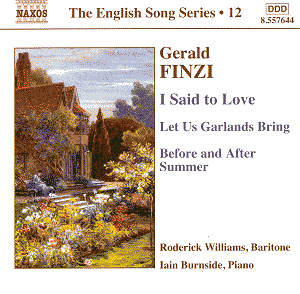
 Roderick Williams (baritone)











