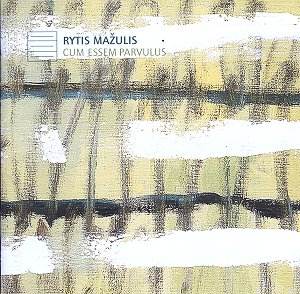
Rytis
Mažulis, now in his early forties, was
a pupil of Kutavičius and Juzeliūnas.
Kutavičius was a choir director
for many years, and a good deal of his
output is vocal. It may thus not be
surprising that Mažulis, too, seems
to be writing quite
a number of vocal works, as this recent
release demonstrates. Mažulis admits
real admiration for composers as diverse
as Josquin des Prčs, Scelsi,
Nancarrow and Horatiu Radulescu, and
his music as heard here tends to confirm
the impact of such seemingly disparate
influences, although he might have added
other names, such as Ligeti.
One of the earliest
works here is Canon solus,
written for the Hilliard Ensemble. The
piece is a canon "in any tone"
modelled, for example, on Ockeghem’s
Mass Cuijusvis toni. It is a
good example of working methods consistently
used by Mažulis
in later works, such as Minimalism,
development of mensural canon and echoes
of spectral music. Sybilla,
on words by Petronius, carries the technique
of perpetual canon one step further,
adding considerable tension between
the voices in play. Variety is achieved
by alternating use of voices (men only,
women only or tutti).
The very title of Cum
essem parvulus
(“When I was a child”) implies some
private joke, in that ‘mažulis’ means
‘little child’ (i.e. ‘parvulus’ in Latin).
The piece is again structured
as a spiralling canon, resulting in
a sort of tintinabulli
maybe inherited from Kutavičius
- as in his more overtly ritualistic
works such as Last pagan
Rites or From the Jatvingian
Stone - rather than from Pärt,
although the origin of both lies in
Baltic runo.
The most recent work
is the imposing ajapajapam
for chorus, string quartet and electronics.
It is also his most radical one so far,
and one in which Mažulis’ own brand
of Minimalism is pared down close to
the extreme. The present annotator describes
the piece as a "slowly slipping
cluster", in which microscopic
dynamic shifts create tiny variation
in the long-drawn lines of what is essentially
a static piece. The basic material is
reduced to a bare minimum, i.e. a few
isolated long-held notes resulting in
a long slowly shifting cluster with
tiny, but often telling variations.
The global impact is not unlike what
Ligeti achieved in, say, Lux aeterna.
String quartet and electronics are fully
absorbed into the vocal textures, so
that they are hardly noticed, but the
music would very different without them.
The impact is either hypnotic or irritating,
depending on one’s frame of mind; but
its power to move or disturb is beyond
doubt. The question is whether the composer
has not reached some dead end with music
such as this. It will be most interesting
to know how or whether he will develop
after this.
Mažulis’s
music, as heard here, is ritualistic
in its own way. It displays a keen ear
for beguiling textures and a considerably
imaginative ability to build on the
age-old canon form.
The present performances,
recorded in the presence of the composer,
can hardly be bettered and we may assume
that they sound as he intends. The Latvian
Radio Chamber Choir is a crack ensemble
that sings beautifully throughout and
bravely manage some rather tricky music
with impeccable intonation and remarkable
assurance. I wonder how they manage
to do so, particularly in the awfully
taxing ajapajapam ...
but they do.
Not easy stuff, quite
unlike anything else I have been able
to listen to up to now: thought-provoking
or overtly provocative, but well worth
trying.
Mažulis’s music inhabits a world entirely
of its own.
Hubert Culot



 Latvian Radio Chamber Choir; Chordos Quarteta;
Kaspar Putniņş
Latvian Radio Chamber Choir; Chordos Quarteta;
Kaspar Putniņş