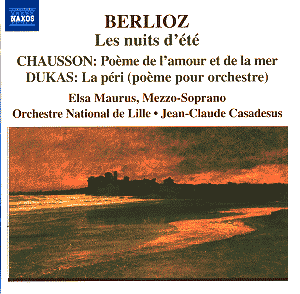
Naxos has assembled
here a varied and enjoyable programme
of French music. The centre of attention
is the mezzo-soprano, Elsa
Maurus, a singer who was new to
me. I believe she is French, though
this is not clear from the booklet notes.
She has a very rich voice and employs
quite a bit of vibrato, though not excessively.
In Chausson’s Poème
the sumptuous vocal lines of the
first part, ‘La fleur des eaux’, suit
her well. She sings the piece with warmth
and passion, clearly identifying strongly
with both the music and also with the
imagery of the text. I’m bound to say,
however, that by the side of Dame Janet
Baker (for EMI, with André Previn
and the LSO) she seems just a trifle
one dimensional. Baker, great artist
that she is, is no less ardent and I
find her even more involving. Again,
at the start of the second poem, ‘La
mort de l’amour,’ there’s more spring
and gaiety in Baker’s singing and Previn
too contributes a touch that is just
a bit lighter than that of Jean-Claude
Casadesus. However, later the mood darkens
and while Baker remains outstandingly
eloquent, Maurus comes into her own,
especially in the stanza that begins
‘Comme des fronts de morts nos fronts
avaient pâli’ (‘Like the brows
of the dead our brows were pale’) She
does this dark, haunting stanza very
well indeed (track 3, 5’30" – 7’01").
Indeed from here to the end of the work
the sadness and regret in the words
is very well conveyed. In this passage,
as throughout the work, Casadesus and
his orchestra support her splendidly.
I must, however, give
Naxos a very large black mark for allowing
a mere three seconds to elapse after
the subdued ending of the Chausson before
Dukas’s brass fanfare begins, shattering
the atmosphere. (If I’d been planning
the disc then for this very reason I’d
have started with the Berlioz and ended
with the Chausson.)
In Les nuits d’été
Maurus faces formidable competition,
not least from Dame Janet (again) and
from Régine Crespin (with Ansermet
on Decca.) In the opening ‘Villanelle’
I find that Baker is more satisfying
than this newcomer. Baker’s conductor,
Sir John Barbirolli, sets a tempo that
is just a fraction perkier and Baker
herself injects more life and lift into
the rhythms. Well though Maurus sings,
for me she narrowly misses the note
of optimism and joy that underpins the
song. In the second song, the wondrous
‘Le spectre de la rose’ Casadesus adopts
a nicely flowing tempo, pretty identical
to Ansermet’s and appreciably faster
than Barbirolli’s. I like the pacing.
Again Maurus sings well, even if she
can’t quite match the individuality
or range of colour that either Baker
or Crespin (or Susan Graham for that
matter) command.
Maurus sings the fourth
and fifth songs, ‘Absence’ and ‘Au cimetière’,
at a lower pitch than Baker or Crespin.
(Crespin, incidentally, places ‘Absence’
third in the cycle.) I wish she hadn’t
found it necessary to do this in the
case of
‘Absence’ for the lower
key imparts a darker colour to the song.
Arguably that’s not inappropriate but
the gently ecstatic longing of the song
is better conveyed in the higher key,
I feel. It’s a combination of key, vocal
technique and insight that makes Baker’s
singing of the refrain ‘Reviens, reviens,
ma bien aimée!’ so unforgettable
... and Crespin’s rendition even more
so. Maurus, for all her merits, can’t
match that. On the other hand, the lower
key works better for her, I believe,
in ‘Au cimetière’, where a darker
hue is very apposite. The concluding
‘L’île inconnue’ is the most extrovert
song in the cycle and Maurus responds
very well, projecting it intensely and
passionately.
To complete the programme
Naxos offers the short ballet by Dukas.
This is sensible programming, not least
because it affords a good contrast with
the two vocal works. The score was composed
in 1911-12 and was originally intended,
I think, for Diaghilev’s Ballets Russes.
It’s a fascinating score, which reminds
one of Firebird at times in its
juxtaposition of voluptuous and (many)
delicate passages. Dukas wrote that
he wanted the orchestration to sound
like "a kind of dazzling, translucent
enamel." This implies a need above
all for the conductor to clarify the
textures and in this Casadesus succeeds
admirably. He and his orchestra give
a fine and atmospheric account of the
colourful work.
This disc has much
to commend it. If your priority is Les
nuits d’été then I
must say in all honesty that, despite
the virtues of Elsa Maurus’s performance,
there are better versions on the market
and not necessarily at full price. That
said, the programme as a whole is attractive
and well done and is presented in good
sound. The disc will give much pleasure
and represents excellent value. As usual,
Naxos don’t stint on the documentation.
There is a very useful note in English,
French and German by Keith Anderson
and the full French texts and an English
translation are also provided.
John Quinn



 Elsa Maurus (mezzo-soprano)