The struggle to find
a title for a varied recital of this
type is often futile. Either that or
(as here) it prompts even more futile
critical comment taking issue with the
final choice. We should fix attention
on the music. But before we do so be
warned or reassured: not all these songs
are terribly Wagnerian ... apart perhaps
from those six by Wagner.
Emile Mathieu stands
downstream from Chausson with heavy
infusions of Schumann and a little Debussy
as well. His four songs are big, two
of them in excess of six minutes. They
are high romantic essays and merit revival.
Mathieu cut quite a dash in Belgium
but his production of music was stemmed
when he took up the post of director
of the Royal Conservatoire, Ghent. His
cantatas Hoyoux (1879) and Freyhir
(1883) can be heard on Cyprès
Musique en Wallonie CYP5683.
Liègeois Sylvain
Dupuis taught at his home town conservatory
and was very active in the performing
sphere. There are symphonies, cantatas,
chamber music and mélodies. In
these songs we find some Wagnerian elements
but let's not overdo the comparison.
The heavy Germanic aspect is leavened
by a ready lyric talent which stands
between the perfumed Debussian voice
and the livelier songs of Fauré.
Some of them even look forward to Poulenc,
as in Matin (tr. 9).
Patrick Delcour has
a voice that shows signs of wear. There
is a shake and other signs of tiredness.
However, allowances made, he gives a
good and very intelligently shaped account
of these largely unknown songs. He receives
sturdy rather than sensitive support
from Diane Andersen who tends towards
a very narrow dynamic range. The too
close recording does not help except
in bringing the listener almost intimidatingly
close to both artists.
Intriguing to hear
the six Wagner songs written in 1840
after the composer left Riga for Paris
and just before starting work on The
Flying Dutchman. These receive their
premiere recording. Two of the songs
needed editorial and completion work
by the Liège composer Berthe
di Vito-Delvaux. Unsurprisingly there
are plentiful pre-echoes of Tristan
und Isolde and Tannhauser.
Leonine triumph and pent-up excitement
are well portrayed in the urgent Attente
(tr. 14). Less predictably these
sometimes fragrant songs reveal how
much the French mélodie fleuve
was indebted to Wagner.
I have already sung
the praises of Adolphe Biarent in my
reviews of the two Cyprès recordings
of his wonderfully Rimskian orchestral
music (see elsewhere on this site review
review).
Here we have five of his songs. They
range from the mesmerising Lied to the
swooning exoticism of Désir
de mort (a typically Wagnerian theme),
to the audaciously wayward harmonies
of Chanson. La Lune Blanche
is a major discovery with its silvery
light and subtly weaving vocal line.
The final song Des ballades au hameau
is Wagner-stentorian, dignified
yet with auguries of doom woven in -
and yes the Dies Irae does make
an appearance.
As expected Etcetera
have done their usual splendid job on
the booklet. I have my doubts about
the recording image, vivid though it
is, but the documentation is excellent.
An unhackneyed and
imaginative collection which I recommend
to students of the French romantic vocal
tradition. There are some fascinating
discoveries here and while I have some
reservations about the performances
they are by no real obstacle to enjoyment.
Rob Barnett



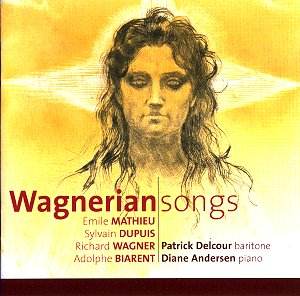
 Patrick Delcour, baritone











