Dussek – or Dusík
– was an impressively versatile composer
for the keyboard and one who absorbed
his heritage whilst retaining exploratory
ambitions well beyond the ordinary.
The Sonata in F sharp major, written
in 1806, was a memorial piece for Dussek’s
patron Prince Louis Ferdinand of Prussia
and is subtitled Elégie harmonique.
Written in two compact movements
it’s nevertheless full of impressive
touches. There’s great pathos in the
rolled chords of the Lento poetico,
which generate an intimacy before the
imposition of an agitato section of
considerable vehemence. There is a quotation
from Haydn embedded here – from the
Seven Last Words – that gives the work
an even greater depth, without ever
calling attention to itself. The finale
is powerfully propelled and the lyric
moments serve to increase the trajectory
of the tribute still further.
In terms of virtuosity,
daring and imagination however this
sonata has to cede to the Op.64 in A
flat major given the title Le retour
à Paris to illustrate Dussek’s
return to the city in 1807. This is
a real barnstormer of a sonata, writ
large in four movements, and an example
of the Bohemian composer’s fabled technical
accomplishment. There’s knotty writing
a-plenty in the first movement, with
plenty of adrenalin coursing left hand
work and a prescient sense of burgeoning
proto-Romanticism inescapable throughout.
If ever there was a composer who stood
on the cusp between the classical and
the romantic periods it was Dussek –
and as ever in these cases, as in the
contemporaneous case of romantic poetry,
critical divisions between adamantine
"periods" tend to dissolve.
The slow movement is expressive enough,
though it never seeks to establish a
tragic countenance – it plays on rich
full left hand chording and right hand
delicacy and tracery – but harmonically
as ever Dussek is advanced. The Minuet
has an infectious sense of circularity
– of going around in tension generating
circles – before finally resolving.
And the finale is a heavy-booted, humorous,
strongly accented example of terpsichorean
decisiveness. Truly arresting.
The Concerto was the
last Dussek wrote and it does sound,
for all its attractive features, somewhat
less innovative and forward looking
than the companion sonatas. There’s
certainly a strong Haydnesque lineage.
There’s an expansive solo, replete with
rippling figuration, and there are powerful
counter themes as well as a spine of
lyrical boldness. The slow movement
is quite pert and has a certain rococo
charm, larded with decorative right
hand flourishes. Marked Allegretto
moderatissimo – there’s an injunction
not to sprint if ever there was one
– the finale is confidence personified.
Though note the careful modulations
and the clever harmonies; listen out
for the horns as well. This is a spirited
and genial work written by a composer
fully in control of his material.
The performances are
themselves genial. Andreas Staier
has recorded both sonatas in his
Dussek series, an original instrument
release I’ve not yet heard. Novotný
takes a rather middle of the road approach
but his solutions are invariably sensitive;
tempos aren’t rushed, timbral matters
are well explored and there’s plenty
of colour in his textures. Other performances
can make Dussek sound more bracing,
rather more modernistic, but he’s still
a thoroughly reliable guide. The recorded
sound is warm, the notes brief though
to the point.
Jonathan Woolf



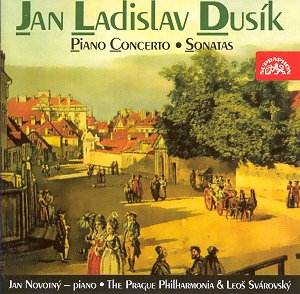
 Jan Novotný (piano)











