It really is good to
see Copland’s piano music getting the
attention it deserves. As has been pointed
out on more than one occasion, it is
second only to his orchestral output
in volume, and many critics consider
these pieces to contain some of his
best, and certainly most ‘serious’,
writing.
This disc does not
have the field to itself, though it
will probably be the cheapest. Leo Smit’s
2-disc complete survey has dated sound
and availability problems, so the nearest
rival to Naxos is possibly Raymond Clarke’s
very well received Divine
Art recital, which has a big advantage
in adding to these three works the early
Passacaglia, well worth having
and taking the running time to a more
generous 77+ minutes. However, we all
know Naxos’ price advantage and no-one
grabbing this in their nearest store
will be remotely disappointed, such
is the quality of Benjamin Pasternak’s
playing.
The earliest and in
many ways grittiest piece here is the
famous Variations of 1930.
In Humphrey Burton’s illuminating biography
of Leonard Bernstein, we learn what
a key work this was for the 19-year-old
Bernstein, who later wrote that ‘…a
new world of music had opened up to
me in this work – extreme, prophetic,
clangorous, fiercely dissonant, intoxicating’.
He would perform it from memory at many
a Harvard party, recalling with a wry
smile that ‘…I could empty the room,
guaranteed, in two minutes.’ Whilst
some of that early shock value has diminished,
there is still no denying the power
of this 12-minute masterpiece, which
Copland biographer Howard Pollack refers
to as ‘a defiant howl of a piece, rather
Beethovenish in its balance of intellectual
rigour and prophetic fervour’. It is
precisely these qualities that distinguish
Pasternak’s playing, where the structural
whole is seen, rightly, as paramount
but not at the expense of the teasing
harmonic and rhythmic details that litter
the 20 diverse variations.
The other two works
here can be seen as direct descendants
of the Variations. The massive
Sonata, begun in 1939
and again championed by Bernstein, has
similarly challenging dissonances but
here the jazz and folk influences can
be heard taking hold. In fact, Pasternak’s
solidly authoritative playing leaves
us, in the main, with memories of the
hauntingly beautiful quieter music,
soon to become a Copland hallmark, that
so effectively tempers the percussive
louder moments.
The biggest and most
ambitious score, and also the composer’s
last for piano, is the massive 30- minute
Fantasy, which effectively
encompasses the more austere traits
of the Variations with the structural
control and dreamy lyricism of the Sonata.
It may seem an unwieldy piece to some,
but the sheer explosion of ideas, coupled
with the astonishing array of keyboard
variety help to hold the attention completely.
Pasternak is especially effective in
balancing out the diverse material,
keeping a suitable air of improvisation
in much of the writing whilst providing
a sense of line and logic with playing
of razor-sharp clarity and precision.
There is also a necessary feeling of
controlled virtuosity in the playing,
given that the work was intended for
the dynamic young William Kappell.
The recording quality
is generally good, full bodied and set
within a fairly warm acoustic, and the
piano copes well with the substantial
demands made on it. As I said before,
this disc is minus the obvious early
work, but these three important scores
are such obvious bedfellows that it’s
doubtful you will miss it, especially
given the high-calibre pianism on offer
at the usual giveaway Naxos price.
Tony Haywood
see also review
by Patrick Waller



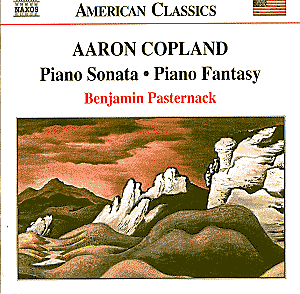
 Benjamin Pasternak (piano)











