When I was young, my
father said: Don't judge others before
hearing them through, listen before
interrupting. His advice applies so
well to Wagnerian opera, with its potential
for diverse interpretation. The greatest
works of art have the power to speak
beyond restricted parameters of space
and time. We may have a preference for
one style or another, but when we listen
to a new production, it's a good idea
to listen to it for what it conveys
on its own terms. Whether we like or
dislike something isn't ultimately the
point, for we learn something along
the way.
This Bayreuth production
sets Der fliegende Holländer in
Wagner's own time. What it loses from
the usual quaint folkloric setting it
gains from a more direct connection
to the social and moral issues that
influenced the composer. It's a cerebral
production. The Weberian fantasy elements
are downplayed, but the links to later
Wagner are clearer. From the very start,
Senta is in full focus. Lisbeth Balslev
portrays her as a nineteenth century
old maid, well past the first flush
of youth and most decidedly neurotic,
clutching the Holländer's portrait
and moving with trance-like stupor.
It's almost a relief to return to "reality"
with Salminen's hearty Daland and Clark's
particularly well characterised Steuermann.
But Senta's pinched, anxious features
are still there – she's on stage, above
the action. Then in a spectacular tour
de force of stage craft, the ghost
ship sails head on into the stage. The
bow opens, to show the Holländer,
chained in its maw like Prometheus.
Simon Estes is superb: the power of
his voice and the magnetism of his body
language are, frankly, erotic. He's
no pallid ghost, he exudes sensual energy.
Senta's obssession is clearly sexual.
Is she a prototype Isolde, for whom
repression connects love with punishment?
It's interesting to observe her reactions
as she listens to her father offer her
to the stranger, Wagner set their "dialogue"
as an interesting cross-current, two
contrasting monologues. Salminen and
Estes both equally powerful, underline
the inherent tension.
Bizarrely, the women
in the Second Act are again dressed
in formal bombazine, images of middle
class propriety. Some of them aren't
even spinning, but drinking tea from
porcelain cups. They sing cheerfully
enough, but it emphasizes the fact that
their chorus praises marriage as a business
transaction – girls spin, men bring
gold, and that's how society works.
So Senta is breaking two taboos, one
with conventional society and the other
with the devil himself, by offering
herself to break his contract with the
Holländer. No Wagnerian heroine
chooses convention when she can do something
of cosmic import. Defeating Satan is
a greater challenge than marrying Erik,
however worthily performed by Robert
Schunk. No wonder Wagner was able to
persuade comfortably married women to
give up their lives for him. But there's
no mistaking what fascinates Senta here,
for Estes projects an almost hypnotic
sensuality. He is wonderful, singing
with smouldering passion, almost carrying
the opera by himself.
The crowd scenes Wagner
was to perfect in Meistersinger, play
an important part in Der fliegende Holländer,
for they contrast the iconoclastic self
absorption of the principals with the
rest of the world, so to speak. Unlike
some productions, the chorus scenes
here have a carefully choreographed
quality. Guests at the feast promenade
in top hats, and bow. Even when the
storm strikes, the sailors move in almost
balletic turbulence. The singing is
precise, if not altogether clear, but
that only enhances the excellence of
Clark's interjections as Steuermann.
In musical and textual terms, this is
extremely effective. There's even an
allusion to Meistersinger at the end,
when the shutters of the town windows
suddenly snap shut. The orchestral playing
is competent if unobtrusive, supporting
the singing rather than stirring it
on.
This is definitely
a thought-provoking interpretation.
I'm not sure that the portrayal of Senta
as insane is one I'd want to follow
too often, but it is valid in this context
and certainly more interesting than
productions which treat her as a brainless
cypher who suddenly finds nobility in
self-sacrifice. Nonetheless it is an
intriguing proposition. It does illustrate,
to borrow a phrase out of turn "Wahn,
Wahn, überall Wahn", Wagner's
most fundamental belief that the complexities
of human nature are beyond simple classification.
In this, he heralded the whole idea
of psychodrama. This production thus
connects this early opera with the others
to follow. It won't perhaps appeal to
those who like a Flying Dutchman redolent
of Der Freischütz, complete with
dancing peasants. But those who like
Wagner on an intellectual level will
enjoy this.
Anne Ozorio
See
other new UNITEL releases



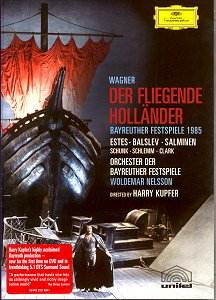
 Orchester der Bayreuther Festspiele/Woldemar
Nelsson,
Orchester der Bayreuther Festspiele/Woldemar
Nelsson,  UNITEL
DEUTSCHE GRAMMOPHON 00440 073 4041 [135:00].
UNITEL
DEUTSCHE GRAMMOPHON 00440 073 4041 [135:00].












