‘Athalia’
was Handel’s third oratorio, coming after ‘Esther’ and ‘Deborah’.
So it appeared when the form was still young, at a time when
Handel was still heavily involved in writing opera and oratorio
was more incidental. ‘Athalia’ was written for performance in
Oxford when Handel was to receive an honorary degree. For some
reason, he did not take the honorary degree but did perform
‘Athalia’. His intention was probably to perform the oratorio
with the mainly Italian members of his opera company, but that
summer saw most of his performers leave to join the rival Opera
of the Nobility. So ‘Athalia’ was launched with a mixture of
his few surviving Italian singers and English singers. (It would
not be until ‘Saul’ that Handel used mainly English singers
in oratorio).
The
libretto, by Samuel Humphreys, is based on the play ‘Athalie’
by Racine. The play was intended to combine French classical
tragedy with choruses after the Greek manner, and was always
intended to utilise music. So it was an ideal source for an
oratorio. Humphreys sticks quite closely to Racine, thus providing
Handel with a well structured libretto. Unfortunately, he weakens
this by leaving out some essential detail and omitting some
crucial points about Athalia’s motivation.
Athalia
is Queen of Judah and a worshipper of Baal; she is Jezebel’s
daughter. She has had all the rightful sons of the House of
David slaughtered; the sole survivor is the child Joas who is
brought up ignorant of his origins, by the high priest Joad
and his wife Josabeth. The oratorio is concerned with the struggle
between Athalia and the Jews for the soul of the Jewish people
and culminates in Joad and Josabeth proclaiming Joas King. Humphreys
added choruses for the Baalites to Racine’s original and Handel
takes advantage of this to give us some wonderfully characterised
and contrasted choruses for the Israelites and the Baalites.
The
title role, Athalia, is a powerfully evil character who obviously
claimed Handel’s attention; he provided the role with some striking
music starting with Athalia’s description of her dream of her
mother Jezebel. Simone Kermes makes the most of this dramatic
character and creates a vivid performance which demonstrates
how much Athalia differs from the Israelites. The other chief
roles are Joad and Josabeth; Joad was probably written for a
castrato but was originally performed by the counter-tenor Walter
Powell. Handel attempts the difficult task of making goodness
interesting and their music includes a haunting love-duet. Olga
Pasichnyk and Martin Oro rise to the challenge and sing creditably
and beautifully.
But
these three have a difficult task before them, because ‘Athalia’
was recorded on Oiseau Lyre by Christopher Hogwood and the Academy
of Ancient Music with Joan Sutherland, Emma Kirkby and James
Bowman. A difficult act to follow.
In
fact Pasichnyk manages to imbue Josabeth’s role with rather
more warmth than Kirkby, who relies on the sheer loveliness
of her voice. Technically Oro is not quite in Bowman’s league
but his performance is affecting. Kermes has the advantage that
Sutherland recorded the role very late in her career. Technically
Kermes is far preferable, but beyond technique she creates a
very vivid character.
The
smaller roles of Mathan, Abner and Joas are well taken by Thomas
Cooley, Wolf Matthias Friedrich and Trine Wilsberg Lund. Hogwood
used the boy treble Aled Jones for Joas. Though Wilsberg Lund
sings with fine purity of tone, I did rather miss the distinctive
quality that a treble can bring to the role, even one as untraditional
sounding as Aled Jones.
The
singers are well supported by Peter Neumann and the Collegium
Cartusianum. Neumann’s speeds are vigorous without being driven.
They open with a fine, crisp performance of the overture and
continue in this heartening vein. The chorus, the Kölner Kammerchor,
relish all of the opportunities for characterisation that Handel
gives them.
I
have left the most vexing point to last, that of language. The
cast is substantially German speaking and the oratorio is recorded
in English. Their English is, on the whole, perfectly acceptable
and creditable (though far from perfect). But their diction
sounds rather occluded and this prevents complete enjoyment
of a genre which has traditionally placed a lot of emphasis
on the words. Only Simone Kermes manages to create a characterisation
vivid enough to overcome these limitations of language.
But
neither is Hogwood’s performance perfect. I treasure Dame Joan’s
performance, but many people will dislike her rather mannered
delivery.
This
is a fine idiomatic performance of
one of Handel’s stronger oratorios
and if the issue of the language does
not worry you then I can highly recommend
this set.
Robert Hugill



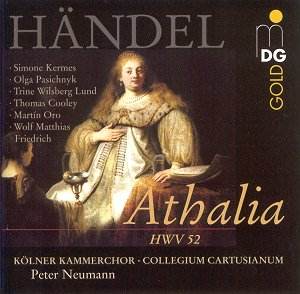
 Athalia – Simone Kermes (soprano)











