This is a most enjoyable program of
colorful, appealing, relatively unhackneyed
music. That said, it inadvertently demonstrates
why posterity, hasn't judged Spohr a
first-rank composer.
The composer seems
undecided whether the C minor Concerto
should be a virtuoso display vehicle
or an expressive, dramatic piece; for
a Mozart, of course, integrating the
two contradictory impulses was no problem.
First we encounter a dark, turbulent
introduction, extending the classical
operatic style forward into Beethoven's
harmonic language and orchestration.
The clarinet then enters with an achingly
wistful lyric line - the sort of thing
Spohr did particularly well. Almost
immediately, however, the phrase dissolves
disconcertingly into noodling figurations
that, though impressive, serve to undercut
its expressive power. This aesthetic
schizophrenia pulls the movement now
this way, now that. After the first
movement's Sturm und Drang, the
central Adagio, animated by a
simple cantabile impulse, seems
unambitious. The jaunty closing Rondo
is fun while it lasts, but it peters
out abruptly.
The E flat concerto
of just two years later offers markedly
more assured results. Lyrical solo lines
unfold and blossom freely, setting up
the showy bits nicely, and making for
a compelling sense of drama in the first
movement. The composer finds room to
innovate, both formally and texturally,
within the standard concerto structure.
Thus, the soloist "answers" the orchestra
in the second phrase of the opening
ritornello, after which the orchestra
continues normally, without further
interruption. The clarinet begins the
pensive Adagio in its low chalumeau
register, a neat and unexpected timbral
and theatrical touch. As the lines finally
ascend, the effect suggests dawn breaking.
The Potpourri
and the Variations posit no conflict
at all. These are display pieces, pure
and simple. As always, the clarinet
writing is fluent and idiomatic, with
the passagework in the Potpourri
successfully deployed for expressive
purposes.
All of these pieces
make considerable demands on the soloist's
digital dexterity and breath control,
and Michael Collins comes equipped with
a formidable technical arsenal. There
is a distinctive, and not unpleasant,
throatiness to his midrange sound, yet
he soars easily and fluidly above the
staff, where the squillante brilliance
never crosses over into an unpleasant
squeal. Two particularly breathtaking
passages stand out. One is a seamless
series of trills about eight minutes
into Op. 80. The other comes at 4:34
in the Second Concerto's first movement,
where sinuous melodic embellishments
open out into a series of descending
arpeggios, cascading magically one upon
the next, all realized in perfect, liquid
tones.
A resonant recorded
ambience lends the sound of the smartly
disciplined Swedish Chamber Orchestra
a welcome heft, but it also causes some
congestion in tutti; and the
perspectives are inconsistent. The soloist
is distinctly over-miked in the First
Concerto - throwing off the first movement's
give-and-take with the orchestral reeds
- and in the B flat variations. He sounds
more naturally highlighted - to coin
an oxymoron - in the other works.
Stephen Francis
Vasta



 Michael Collins (clarinet)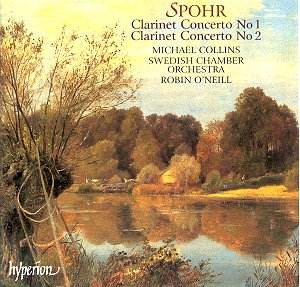
 for
details
for
details











