In recent years the
BBC Legends label has issued a number
of broadcast performances by Jascha
Horenstein, not least an unforgettable
account of Das Lied von der Erde.
These have confirmed what a fine, often
inspirational Mahler conductor he was.
Sadly, he left very few studio recordings
of Mahler symphonies, though his marvellous
1970 recording of the Third for Unicorn-Kanchana
has long been regarded by many expert
judges as one of the best. He also made
a recording of the First for the same
label in 1969. I have not heard that
but it was highly commended by Tony
Duggan in his survey of the symphonies
(link).
In that article Tony makes mention of
an earlier Horenstein traversal of the
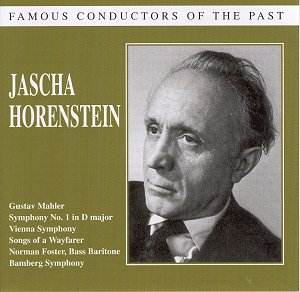
work, then on the Vox label, and this
is that same recording, now re-packaged
and under a different imprint.
According to the notes
accompanying this CD it was with this
symphony and this self-same orchestra
that Horenstein made his debut in 1924.
One imagines, therefore, that this was
a work that had some especial significance
for him. Unfortunately this recording
doesn’t really show him at his best.
The first movement seems to me to lack
just that last but vital bit of tension.
Furthermore there are passages in this
movement where the music really should
burst out in an abandoned way but the
performance doesn’t really convey that
sense of outgoing freedom. I realise,
of course, that this is a heavily subjective
view, which others may not share but
for me there’s just something missing.
The two middle movements
fare rather better. The sturdy rustic
nature of the ländler comes
across well. The slow movement is quite
good too and the passage (between 5:40
and 7:58) where Mahler quotes from the
last of the Lieder eines fahrenden
Gesellen is affectionately phrased
and nicely played too, though this is
one of many passages where one feels
that the horn section of the VSO is
living on the edge!
The eruption with which
the finale begins shows only too clearly
the limitations of the recording. The
exciting loud stretches of this movement
proceed on two levels. Superficially
the excitement is provided by the brass-dominated
fanfares. However, it always seems to
me that the real excitement is provided
by the driving string figurations that
underpin so much of this music and goad
it inexorably forward. Unfortunately,
the VSO strings don’t really dig deep
enough here – or can’t be heard so to
do. In addition, it’s in these frenetic
stretches that the fallibility of the
VSO’s playing, and that of the brass
in particular, is most exposed, as Tony
Duggan so justly observed. The great
passage, beginning at 4:19, where Mahler
unfolds a gloriously long-breathed melody
in D flat major is eloquently done but
the strings don’t have at their disposal
the last ounce of ardour that is needed
to make the climax of this passage (at
around 6:00) really tell as it should.
These technical shortcomings are not
the only reason why I find myself underwhelmed
by this reading of the finale. There
are two or three points where Horenstein
piles on Mahler’s already strong rhetorical
tone by pulling the tempo back excessively
(for example around 10:00 and again
at 18:20, just before the final apotheosis.)
These are disappointing lapses of taste.
The coupling of Lieder
eines fahrenden Gesellen is an apt
one since Mahler quotes from two of
these songs in the symphony. Norman
Foster is an excellent, eloquent soloist
who sings with real feeling and understanding
and Horenstein, supported by a better
orchestra, proves to be a supportive
and perceptive accompanist. Both singer
and conductor convey well the innocence
of the second song, ‘Ging heut’ morgens
übers Feld’, which is quoted in
the first movement of the symphony.
Foster employs an almost Wagnerian sense
of drama in the opening pages of the
third song, ‘Ich hab’ ein glühend
Messer in meiner Brust’ but later he
reins his tone back sensitively and
appropriately for the more withdrawn
passage beginning with the words "Wenn
ich in den Himmel seh" (from 1:16).
Foster’s assumption of restrained but
genuine sadness in the final song is
impressive. He does particularly well
in the episode that provides the quotation
in the third movement of the symphony
("Auf der Strasse steht ein Lindenbaum"),
beginning at 2:50. This is but one of
many passages in the cycle where the
tessitura lies demandingly high but
Foster takes it all in his stride.
So the performance
of the songs is very satisfying and
the sound quality is better overall
that that of the symphony. However,
the recording of the symphony is by
no means so recommendable and I for
one shall follow Tony Duggan’s advice
and try to hear Horenstein’s later account
of this work in preference to this earlier
one.
John Quinn



 *Norman Foster (bass-baritone)











