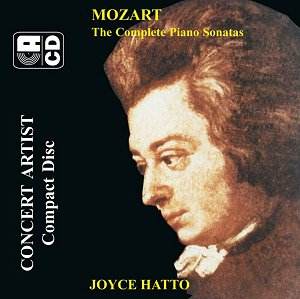
Volume 4 of Joyce Hatto’s
cycle of Mozart sonatas continues to
offer rich rewards. For some reason
K.311 is offered out of sequence – the
cycle has otherwise proceeded in strictly
numerical order, unlike Alicia de Larrocha’s
RCA set. No matter, the opening "Allegro
con spirito" has all the spirit Mozart
asks for and the "Andante con espressione"
is properly songful, not least in the
inspired coda. I suppose that for some
the final "Rondeau" may be among those
finales which Hatto takes a notch too
slowly but for myself this was not so.
I think she must have looked for a tempo
at which the rather complicated passage
from b.127 (with the theme in the left
hand and a shower of semi-quavers in
the right) will sound clear and natural.
In this movement de Larrocha is actually
not all that much swifter and the two
artists’ conceptions of the work are
not greatly different – de Larrocha
a touch more impetuous, Hatto a little
more poised and gracious.
So it is with K.333,
which Hatto allows to speak with an
unforced sublimity. What I think is
so remarkable about Hatto’s achievement
is that so often she seems to have allowed
the tempo and the character of each
movement to flow out of the music
rather than out of herself. This
could, in some hands, be a recipe for
bland literalness but not when the artist
is so clearly alive to the meaning of
the music. Just one minor query; why
are the last three quavers of bar one
played staccato? In my Peters edition
they are clearly marked legato, and
so they are played by de Larrocha and
Alfred Brendel.
The Fantasy in C minor,
which is traditionally placed before
the sonata in the same key, is often
treated as an exercise in rubato or
rather – since true rubato does not
lose sight of shape and pulse – an exercise
in distortion. Hatto shows that true
expressive freedom is not incompatible
with a respect for the note-values.
With the first movement
of the sonata itself, however, I have
to register a slight disappointment.
I have much admired Hatto’s way of letting
the music find its natural tempo, neither
pushing it forward nor holding it back.
But here, with Mozart at his most proto-Beethovenian,
I feel the music can take something
bigger, more urgently fiery. There is
something too small-scale about Hatto’s
conception, and it does not help that
her crotchets in bars 3-4 (where nothing
is marked) are as staccato as those
in bars 1-2 (where staccato is marked).
Surely Mozart wished the answering phrase
to have a contrasting character?
In this case de Larrocha is swifter
without actually saying much more and
I turned to Alfred Brendel, a more interventionist
artist, certainly, but here in imaginative
sympathy with the music, which bursts
into life in his hands.
No complaints, however,
about the gravely sung "Adagio" or the
finale which veers between gentle pathos
and vital strength.
Do not let my reservations
about just one movement in one sonata
put you off buying this latest instalment
of Hatto’s cycle; overall it is proving
to be a major achievement.
Christopher Howell
Volume
1 Volume
2 Volume
3 Volume
4 Volume
5
Complete
listing of Concert Artist recordings



 Joyce Hatto (piano)