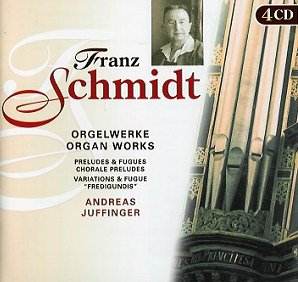
This is a re-release
in one package of Franz Schmidt's complete
organ works recorded fifteen or so years
ago by Andreas Juffinger and presented
chronologically, the works being written
between 1916 and 1935. To the best of
my knowledge this is the only complete
recording of this composer's organ works.
Schmidt represents
a curious figure in 20th century organ
composition. Comparatively prolific
in terms of large-scale pieces, and
a rough contemporary of, for example,
Louis Vierne, this Austrian enigma (of
Hungarian descent) is known among a
few British organists, and then mostly
for just two pieces: the Toccata
in C and the small Prelude and
Fugue in D. The Prelude of the latter
is actually an organ solo for his oratorio
The Book with Seven Seals which
some readers may remember was performed
at the Proms a few years ago. Listening
to the entire oeuvre confirms that these
indeed are the two most immediately
attractive pieces, the sonata-form,
energetic Toccata is especially
compelling. It also raises the question
though of why the large-scale pieces
receive so much less attention than
the large-scale pieces of, for example,
Reger, or indeed Karg-Elert. Schmidt's
bitter-sweet harmonic language, instantly
recognisable, is to my ears more listener-friendly
than that of either of the aforementioned,
with the possible exception of some
of the later pieces, especially the
ultra-chromatic Toccata and Fugue
in A-flat. Probably the leviathan
nature of many of Schmidt's pieces have
led in fact to their neglect. Who else
could write Preludes and Fugues of 25
or 30 minutes, or Chorale Preludes of
more than ten? The question then is
quite simple, is the neglect justified?
I believe not, even the longest Preludes
and Fugues, while sometimes structurally
extremely complex, have a kind of fascinating
inventiveness, which repays repeated
listening. Some pieces are of course
more interesting than others, the earlier
pieces, especially the E-flat Prelude
and Fugue and the Toccata
appealed to me most.
The Austrian organist,
Andreas Juffinger presents what must
have been a mammoth undertaking with
virtuosity and commitment. Unfortunately
his choice of organ is poor. Although
it is known that Schmidt disliked the
orchestrally-inspired organ and organ
building prevalent in his time, the
choice of a sterile and colourless Klais
(I believe), instrument in a rather
dry acoustic is unworthy of the music.
No information about the organ is given.
This is deeply regrettable in any organ
recording.
Chris Bragg
AND
In the music of Franz
Schmidt, the influence of the neo-baroque
is obvious. In many of his works, old
forms are used - for example Chaconne,
Fugue, or in the Toccata, sonata form.
Almost all of his compositions are counterpoint
based, with clearly audible voice-leading.
Schmidt’s music is always transparent,
unlike for example the contrapuntal
works of Max Reger, though extremely
dense texturally. The ‘building-blocks’
of the larger pieces are in most instances
clearly separated, often with a rest.
Harmonically, Schmidt’s earlier works
are the most tonal. In the Toccata
and the E flat Prelude and Fugue,
the harmonic language is frequently
Hindemith-like. The later works become
progressively more chromatic, (the late
A major Prelude and Fugue is
very dissonant). The Chaconne is more
Reger-like. This is one of Schmidt’s
most colourful works.
Unfortunately I find
that many of his works are too long
and indeed long-winded. His inability
to sustain tension across a large scale
is possibly a reason that his music
is not played very often. It takes a
composer such as Reger to write highly
inspired music for forty minutes in
a work such as the Introduktion,
Variationen und Fuge über ein Originalthema.
To record the complete
organ oeuvre of Franz Schmidt and to
make it consistently interesting it
is important that the organist is extremely
good and that the instrument is of a
high quality. Unfortunately, in my opinion
neither is the case here. Andreas Juffinger’s
playing is fairly expressionless while
the instrument is no more than a characterless
factory product. I look forward to a
new release of Schmidt’s works where
both organ and organist are a better
match to the music.
Gijs Boelen



 Andreas
Juffinger, organ
Andreas
Juffinger, organ 











 for
details
for
details