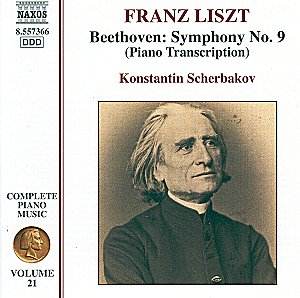
Don’t fall into the
trap of considering this an eccentric
curiosity! This is an expert reading
of an almost completely convincing transcription
of one of music’s most seminal masterpieces:
so, a splendid CD of a great (but little
known) piano sonata!
The truth is that many
composers sketch their material - certainly
their first ideas - without being clear
about its eventual ‘destination’ or
scoring. And in the course of working
on that material, it doesn’t necessarily
change significantly simply because
it’s assigned to this or that instrument,
or because it finds itself in this or
that context. Handel, Bach, Mozart,
Haydn, Schubert and Beethoven all published
pieces in two (several more, in some
cases) instrumentations. Even Ravel,
that most resourceful of writers for
the orchestra, published arrangements
or rather reincarnations, for piano
which in no way betray their origin:
indeed, we can’t always be sure which
he penned first!
For this reason, it
could be said that 90% of Liszt’s transcription
is as pianistic as it is orchestral:
and there’s very little erasing or modifying
of detail for the sake of the new medium.
The problem’s the remaining 10% - but
rest assured, it’s not a big problem!
Quite often, left and
right hand have to deliver contrapuntal
ideas an octave or two apart which,
in Beethoven’s score, are separated
by tone colour, wind versus strings,
for example, rather than by pitch. But
this arrangement usually works well,
and, let’s be honest, sometimes even
better - more clearly - than the original.
Of course it’s not often that Beethoven
gives us an idea which is uniquely
orchestral anyway. You could cite the
isolated bars of timpani in the scherzo,
the mysterious string ‘tremolos’ (but
they’re not tremolos: they’re measured
sextuplets) in the opening pages, or
the military percussion in the finale.
These are the only disappointments.
You may miss the voices, especially
solo voices, in the finale: but, if
you’ve made the necessary aural adjustments,
you may not! And there are advantages:
the hair-raising discord which prefaces
the first vocal entry is far better
balanced on the piano than it is in
the orchestra!
On this recording,
Scherbakov is meticulous in differentiating
by means of articulation between one
idea and its counterpart, so hearing
superimposed lines isn’t a problem for
us, despite the nominal lack of tonal
contrast on a supposedly-monochrome
instrument. Occasionally, sustained,
especially high-lying or slow-moving,
melodic material loses its sense of
line when transferred to the piano,
given its decaying sound characteristic.
But of course the same is true of ‘genuine’
piano music: it’s one of those everyday
problems the pianist has to deal with.
Liszt himself almost never glamourises
Beethoven: when it sounds more like
Liszt than Beethoven (those multiple
unison octaves of the opening movement?)
it’s usually purely coincidental!
I must say I’ve admired
everything Scherbakov has done for Naxos
to date. He’s got all the artistic and
technical credentials to bring this,
and most other programmes, off, and
seems to have immersed himself in this
music. It’s a remarkable achievement.
Think of it this way.
Forget Liszt. Fancy instead a recording
of Beethoven’s sublime Piano Sonata
in D minor, Op 125 - his last, and by
far his most substantial, for the instrument?
Well, this is it: it’s cheap, it’s good,
and it’s in a shop near you!
Peter J Lawson
see also review
by Patrick Waller Recording of the
Year



 Konstantin Scherbakov (piano)