This is ballet music written in the true classical Russian
ballet tradition. Arensky has employed basic North African musical forms
in movements like the Dance of the Egyptian Girls but blended them with
familiar Slavonic idioms in such a way that the 1908 audience must have
felt as though it had barely left St. Petersburg. ln fact the "Pas de
deux" Tempo di valse sounds rather incongruous.
Here is a very brief idea of the story to help readers
visualise the mood of the music and the production of the ballet. Amoun
an accomplished hunter and friend of the High Priest, is betrothed to
nice country girl Berenice. Then Cleopatra arrives and Amoun is smitten
by her beauty to such an extent that he shoots an arrow into a tree
above her head with a message attached declaring his love. Cleopatra
is not amused. Even though she is struck by Amoun's handsome good looks
and grants him the kiss he desires, she orders that he must die by poison,
at the first light of day. Mark Anthony appears and goes off with Cleopatra
after Amoun has drunk the lethal potion. But the ballet ends happily
for the High Priest has given Amoun only a harmless drug and he is reunited
with the for-giving Berenice.
The Music is pleasant enough throughout if not particularly
memorable. The influence of Tchaikovsky is very apparent: so too is
that of Rimsky-Korsakov (Arensky was one of his students). Not surprisingly
therefore, Arensky's instrumentation is sparkling and very colourful.
The music often suggests languid, perfumed nights in lush, sensuous
surroundings, and it is frequently delicate and gossamer-like. The contrasting
ceremonial music for the arrival of Cleopatra and, later, Mark Anthony
is suitably imposing and. once or twice, it sounds oddly Elgarian.
The Moscow Symphony Orchestra clearly revels in this
repertoire and it plays with spirit and enjoyment. Soloists Alexander
Avratnenko (violin) and Vladimir Kolpashnikov (cello) shine in their
movements (erroneously credited on the CD's cue page). Avramenko's ardent,
romantic playing in the Poisoning Scene suggests that Cleopatra's kiss
before the lethal brew is handed to Amoun, must have been lingering
and passionate.
An enjoyable bit of escapism.
Reviewer
Ian Lace
"This review originally appeared in Fanfare
(Nov/Dec 1997) and is reproduced by kind permission of that publication"




















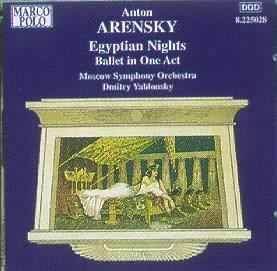
 Moscow SO/ Dmitry Yablonsky