Naxos are nothing
if not adventurous with their catalogues of American and Japanese
Classics. And who has heard of Kósçak Yamada? I would guess
most listeners think of Tōru Takemitsu (1930-1996) when
anyone mentions Japanese classical music. He and Yamada may
come from different generations but both are clearly influenced
by Western music – Takemitsu by Debussy and Messiaen, with some
branches into John Cage and the avant-garde, and Yamada by the
German late-Romantics, notably Richard Strauss (1864-1949).
Yamada studied at the Tokyo Music School
– originally the Ongaku-Torishirabe-Gakari set up in 1879 to
promote Western music – and with Max Bruch at the Musikhochschule
in Berlin. He was exposed to some Western music as a boy, through
military bands and hymns; his mother was a Protestant. Add to
this an interest in traditional Japanese musical forms – something
he shares with Takemitsu – and you have a very individual mix
indeed.
The Nagauta Symphony
‘Tsurukame’ (1934) is just such a blend, with augmented
orchestra à la Strauss and a central contribution from
Nagauta musicians using voices, traditional Japanese instruments
and percussion. Very briefly Nagauta (Naga- means long,
-uta, song) has its roots in the 17th century
and can still be heard today as accompaniment in Kabuki theatres.
Tsurukame is a classic text by Rokuzaemon Kineya X (1851).
This subtitle is significant; Tsuru- means crane, -kame,
tortoise, both creatures associated with eternal life. Hence
this is a festive text suited to weddings and New Year celebrations.
The ripe Straussian
prelude soon gives way to the voice of Touon Tetsuo Miyata and
the Nagauta singers and players with their Japanese flutes (fues),
shamisens (three-stringed lutes) and percussion. The
orchestral writing is chamber-like, lapping at the strange shores
of Nagauta. The soloist is placed quite far forward, his narrative
a sinuous microtonal melisma working in counterpoint with the
orchestra. Anyone even vaguely familiar with the aesthetics
of the Kabuki and Noh traditions will probably recognise the
kind of world this music inhabits, its ‘otherness’ merely accentuated
by the orchestral accompaniment. The music reaches a climax
of sorts after a faster, more animated section and ends with
another overripe contribution from the orchestra (Salome,
anyone)?
Without wishing
to sound parochial I found the symphony rather unsatisfying,
although it might well reveal more after several auditions.
That said it remains a rather uncomfortable collage of musical
styles. It certainly seems more Oriental than Occidental, which
perhaps explains why it never travelled as well as the Symphony
‘Inno Meiji’ (1921), which was performed in London, Berlin
and Moscow in the years before the Second World War. Indeed,
the booklet claims there are 78s of this ‘epic’ piece played
by the Berlin Philharmonic conducted by the composer.
This symphonic poem
is a depiction of Japan in the Meiji Period (1868-1912) as the
country came out of isolation and engaged with the West. There
is a Straussian amplitude to the score that the Berliners would
certainly have warmed to, with a stirring climax at 3:32. The
mystery and exoticism of Japan are suggested in the percussive
rattle familiar from the Nagauta Symphony and the hichiriki,
a double-reed instrument that sounds not unlike a clarinet.
The two worlds then collide rather crudely in a series of bass-drum-dominated
tuttis. The Naxos engineers certainly capture the lower reaches
of the audio spectrum rather well, although the string sound
does seem a little undernourished by comparison.
The stirring martial
theme (from 10:00 onwards) stays just this side of bombast,
and is met with the opposing shimmer of gongs. It’s an entente
cordiale of sorts, though the underlying tread never quite
loses its sense of menace. Towards the end one might hear a
hint of Ein Heldenleben (17:00) before the work ends
with a triumphant if somewhat overextended peroration.
With its rather
schematic East vs West design this piece is long on rhetoric
but short on inspiration. It may be the most accessible work
on the disc so far, but that’s not saying a great deal. Takuo
Yuasa and the Tokyo Metropolitan Orchestra play all the notes
but there’s no disguising the highly derivative nature of this
music and the general paucity of invention.
The Choreographic
Symphony ‘Maria Magdalena’ arose from Yamada’s fascination
with the Russian Ballet, which he saw in Berlin between 1910
and 1913. Begun in 1916 the work was supposed to be a half-hour
ballet based on the Maeterlinck play Marie-Magdeleine (1910).
It never came to fruition but he orchestrated the piano sketches
for Act II and premiered the piece at Carnegie Hall, New York,
in 1918.
At its centre is
the story of Mary Magdalene and the Roman officer who swears
his love for her in return for saving Jesus. Mary refuses, while
outside the captive Christ passes in a torch-lit procession.
The focus returns to Mary, who now seems surrounded by an aura
of divinity. It’s scored for a large orchestra and has some
intermittently noble writing for brass. There is even some tenderness
- voiced by the harps - but the dreary, sub-Straussian harmonies
not to mention the hyperactive bass drum and gongs are too close
to banality for comfort.
Mildly interesting
then, but there are no revelations here. The booklet has some
fascinating background on traditional Japanese music but it’s
a little disingenuous to use epithets such as ‘epic’ and ‘masterpiece’
to describe Yamada’s work. All credit to Naxos, though, panning
for gold where others would never venture. It’s a risky strategy
but they can and do find some nuggets in the sand. Regrettably
this is not one of them.
Dan Morgan
























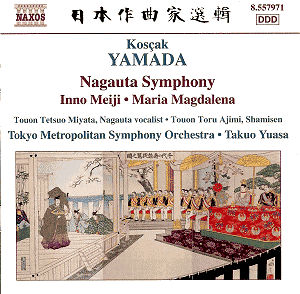

 * Touon Tetsuo
Miyata; Touon Toshimitsu Moraji; Touon Taro Yamaguchi; Touon Jun Ajimi;
Touon Keizo Miyata (Nagauta vocalists); Touon Toru Ajimi; Touon Takehisa
Takahashi; Touon Shiro Minoda; Touon Yutaka Miyata; Touon Gojiro Sakamoto
(shamisens); Sataro Mochizuki; Satahoshiro Mochizuki; Tatsuyuki
Mochizuki; Roei Tosha; Toru Fukahara (hayoshi)
* Touon Tetsuo
Miyata; Touon Toshimitsu Moraji; Touon Taro Yamaguchi; Touon Jun Ajimi;
Touon Keizo Miyata (Nagauta vocalists); Touon Toru Ajimi; Touon Takehisa
Takahashi; Touon Shiro Minoda; Touon Yutaka Miyata; Touon Gojiro Sakamoto
(shamisens); Sataro Mochizuki; Satahoshiro Mochizuki; Tatsuyuki
Mochizuki; Roei Tosha; Toru Fukahara (hayoshi)