Over the years I’ve
heard quite a bit of Gordon Jacob’s
music but when I acquired the première
recording of his Second symphony, made
by Douglas Bostock in 1997, http://www.musicweb-international.com/classrev/jan99/jacob.htm
the seriousness and fine rhetoric of
the music came as a surprise to me.
Had I had the opportunity of previously
hearing the First symphony I might have
been better prepared for the Second.
As it is, I’m not sure if the First
symphony has ever been performed complete
in public – Sir Henry Wood led a studio
play-through in 1932. This present performance
is certainly its first recording. I
was intrigued to read in the informative
notes by Jacob’s biographer, Eric Wetherell,
that Jacob conducted the second movement
of the symphony in a concert at the
Three Choirs Festival in Gloucester
in 1934. I knew that he’d conducted
Vaughan Williams’ Pastoral Symphony
at the same festival and so I presume
that Jacob’s own music was played in
the same concert. What a shame that
the full work wasn’t given.
The First symphony
was composed in 1929. We’ve had to wait
nearly eight decades to hear it in full
but this Lyrita recording makes handsome
amends. It is dedicated to the memory
of Jacob’s brother, who was killed in
action in the First World War; Jacob
himself served in the conflict and became
a prisoner of war. As one might expect,
knowing that background, the symphony
is strong in character rather than sunny.
Much of the first movement
is bustling, including some pretty emphatic
passages, but there are several more
relaxed stretches of music, which provide
sufficient contrast. Though this was,
I believe, Jacob’s first foray into
writing an extensive piece for full
orchestra the scoring sounds pretty
assured to me. The second movement –
the piece aired in Gloucester – opens
with a sombre processional. As Eric
Wetherell says, this is reminiscent
of Holst – though I’m not sure I entirely
agree with his verdict that the movement
is "bleak". To be sure, it’s
an elegy and this is where one feels
that Jacob’s sense of loss at his brother’s
death is given fullest expression. In
fact, for all the grief that lies behind
the music much of the movement is quite
subdued and this adds to its impact.
This is a fine movement, which impresses
through its restraint and relative brevity.
The scherzo is nimble
and rhythmically alive. There’s an admirable
airiness to the scoring and the music
is always light on its feet. The whole
piece is most engaging. There follows
a second slow movement. Here the tone
is wistful but I find warmth in it as
well. There’s a quicker, lighter central
section, which is quite delicate. Eric
Wetherell aptly sums up this movement
as "impressive and thoughtful".
The rondo finale displays exhilarating
energy and the music brims over with
vitality.
I was very impressed
by this symphony, which seems to me
to be an excellent piece of work. After
the unduly protracted delay in getting
it before the public it’s good to report
that the performance under Barry Wordsworth
is excellent. The LPO seems to be consistently
on its collective toes for him and I
sense that the players relished the
opportunity to play an unfamiliar but
extremely well crafted score.
Wordsworth and the
LPO have the field to themselves with
the First symphony but they face competition
in the Second from the aforementioned
ClassicO recording in which Douglas
Bostock directs the Munich Symphony
Orchestra.
Like its predecessor
the Second symphony is coloured by war,
but in this case the score was actually
composed in time of conflict. Jacob
wrote it in 1944 and 1945 and Boult
gave its first performance in a BBC
studio concert in 1946. The composer
himself described the work as a "meditation
on war suffering and victory".
This time there are the conventional
four movements. The first of these opens
with a grave introduction, which is
full of tension. The introduction gives
way to a vigorous and purposeful allegro.
Barry Wordsworth drives this on convincingly.
Calmer waters are reached around 4:00
in an episode in which the woodwind
are prominent but the vigorous material
reasserts itself just after 6:00 and
prevails until the end. Douglas Bostock
is good in this movement but, for me,
he’s not quite so intense in the introduction
nor can he – and his players – quite
match Wordsworth’s dynamism and bite
in the main body of the movement. Furthermore
the Lyrita recording is the more vivid
and spacious.
The second movement
is powerful. The tone is set in a strong
opening passage for the strings but
an important passage of chords on the
brass (1:17) really emphasises that
this movement is to be an important
utterance. That’s followed by a doleful
section led by the woodwind after which
there’s a long, impressive crescendo,
aptly described in the notes as having
a "quite Elgarian splendour".
Hereabouts, and indeed, throughout the
movement Wordsworth’s conducting gives
the music breadth and space and he allows
this melancholy, deeply felt music to
unfold very convincingly. Bostock, too,
has the measure of this movement.
The opening of the
scherzo is gossamer-light. As the movement
unfolds there’s a tremendous buzz about
the music and the LPO plays it with
tremendous panache and at an exhilarating
pace. The trio, in which a long melody
for strings is prominent, is more relaxed
but the quicker material soon reasserts
itself. This is a virtuoso movement
– or, at least, it is in the Lyrita
performance. Bostock’s account is much
less fleet and, frankly, his Munich
players can’t compete with the LPO for
sheer verve and virtuosity. The finale
consists of no less than twenty-seven
compact variations on a six-bar long
Ground. It’s an ingenious movement,
which gradually grows in strength and
achieves an imposing end.
This newly released
Wordsworth performance must now be accounted
a clear first choice for the Second
symphony. It’s superbly played and the
performance is captured in really excellent
digital sound. Of course, Wordsworth
faces no competition in the First symphony
but even if an alternative version ever
arrives in the catalogue it will have
to be pretty special to better this
Lyrita account. Eric Wetherell’s notes
are very good – he also contributes
the notes for Bostock’s recording –
and include analyses of both works,
which usefully include the timings at
which salient points in the score are
reached in these performances, though
occasionally I wasn’t sure if the given
timings were absolutely accurate, but
they’re near enough.
These are two very
fine British symphonies. Both are serious
pieces but they are highly approachable,
tuneful works and they’re expertly scored.
All English music enthusiasts should
investigate them without delay for I’m
confident they’ll find them as rewarding
as I have done. This is another winner
from Lyrita.
John Quinn
See also reviews by Dr
Geoff Ogram and by Rob
Barnett.
The site also has an excellent overview
of Gordon Jacob’s life and career.
























 for details
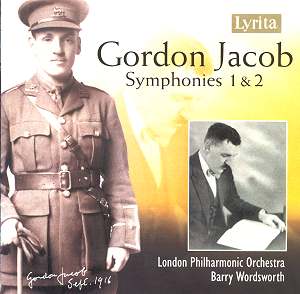
 London Philharmonic Orchestra/Barry Wordsworth