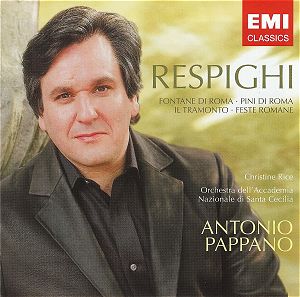
From the Epping-born,
London-based, American-educated Italian
conductor, Antonio Pappano, comes one
of the most exciting discs of the year.
This set of Respighi's Roman tone poems
is terrifically played and wonderfully
evocative.
Pappano takes his time
over the first movement of Fontane
di Roma, coaxing a delicate dawn
from the gossamer textures of Respighi's
gauzy orchestration. The balancing of
parts here is quietly ravishing, as
simmering strings and whispering winds
create tremendous expectation of the
approaching sun. A glittering sunrise
transports us to the Triton fountain,
but Pappano keeps the orchestra light
on its feet in this second movement.
Some will find it underpowered, but
Pappano is determined not to play his
hand too early, allowing the Trevi to
burst forward in climactic glory in
the third movement. The brass playing
here has a full-throated quality. The
legato trumpet playing is lovely. Perhaps
this Trevi has less raw power than some
others on disc, but under Pappano the
orchestral wash is more celebratory.
The orchestra follow him to a man as
he pushes the tempo, leading to a moment
of sublime joy at the movement’s close,
before the fourth movement marks a return
to delicate impressionism by the Villa
Medici Fountain at sunset. The orchestra's
sweet-toned leader contributes a solo
line of melting beauty here.
From first bar to last,
this is a simply gorgeous performance
and one which exhibits a suave elegance
worthy of Debussy.
Pini di Roma opens
with a snappy, boisterous picture of
children playing beneath the Pines
of the Villa Borghese. Pappano's
tempo is very quick, within a hair of
Ashkenazy's on his recent Exton disc.
Perhaps the pace brings a little indistinctness
to the trumpet articulation, but this
is exhilarating stuff and the orchestra
invests every phrase with character.
Pappano coaxes delicate a delicate pianissimo
to illustrate the catacombs of the second
movement, building to a powerful statement
of the Gregorian chant, which here is
open-hearted rather than shrouded in
religious mystery. Delicacy returns
in the depiction of the Pines of
the Janiculum, framing the song
of a distant nightingale. The distant
tramp of soldiers on the Appian Way
at the beginning of the concluding picture
is just that - distant. Pappano again
focuses on atmosphere and does not allow
his players to go all-out too early.
He builds the crescendo almost to the
very end. Only Reiner (RCA) does it
better. Muti (EMI, now on Brilliant
Classics) and Maazel (Decca or Sony)
will overwhelm you more with spectacular
weight of sound, but Pappano is just
as musically satisfying in his own way.
The final tone poem
still has its detractors today and many
reviewers who praise the piece do so
apologetically, as if they should be
ashamed of themselves. Pappano certainly
has no such qualms. He conducts this
final tone poem with conviction. The
picture of the Circus Maximus
has more than a little bloody frenzy,
especially as Pappano hits the accelerator
at 3:55 before the final kill. The raucous
party scene at Epiphany in the
final movement also radiates tremendous
energy and is a lot of fun. The trumpets
about 2 minutes in have a Spanish flavour
and the drunken trombone is a benign
soul, like an embarrassing uncle at
Christmas lunch. The internal movements
once again display thoughtful phrasing
and reveal the score’s inherent beauty.
The musical snuff box quality Pappano
conjures about 5 minutes into The
Jubilee is quite lovely. There are
more overwhelming accounts of this score,
certainly. Not for Pappano the gaudy
colours and violent passion of Ormandy
(RCA) or Maazel (Sony). Style and clear
textures are more his concern, and this
performance has both.
I remain loyal to Reiner’s
fabulous Pines – though I now
prefer Pappano’s Fountains –
and in my book Ormandy still cannot
be beaten for ear-ravishingly gaudy
vulgarity. Pappano, though, more than
any other conductor reveals the delicate
beauty in these scores. He does not
sacrifice the power of their colourful
scoring, though. In terms of sheer musical
quality this disc is a match for any
in the catalogue and will, I expect,
be my "go-to" set of Respighi’s
Roman Trilogy for some time to come.
The playing order of
Respighi’s tone poems is always an issue
in compiling a new set. While chronologically
Fountains comes first, followed
by Pines and then by Festivals,
when played one after another on disc
in that order the effect can be overwhelming.
The Pines of the Appian Way which
closes the second tone poem builds to
such a rousing climax that to follow
it immediately with the explosive cacophony
of the Circus Maximus can lead to aural
overload. Most conductors and labels
solve this problem by placing the gentler
Fountains between the two more
raucous tone poems. Others, like López-Cobos
(Telarc), circumvent the issue by issuing
Festivals on a separate disc
while others still, like Reiner, ignore
Festivals altogether.
Pappano's and EMI's
solution here is unique. Rather than
juggling the chronology of the tone
poems or splitting them across two discs,
they generously offer a beautiful Respighi
rarity by way of an interlude between
triumph of the Appian Way and the frenzy
of the circus.
Il tramonto,
a setting of Shelley’s poem The Sunset
for mezzo-soprano and strings, demonstrates
Respighi’s consummate skill in crafting
music to suit a text. It opens with
a gush of gorgeous string tone, glowingly
Mediterranean in feel, but betraying
in its harmonic language an inflection
of Wagner and Richard Strauss. Christine
Rice is a fresh-voiced soloist and moves
through the remembered rapture and tragedy
of Shelley's verse with warmth and sensitivity.
There is some lovely detail in this
score. The solo violin decoration that
is draped lightly across Rice's vocal
line about 3:30 in is ear-catching and
Respighi surprises with moments of chamber
music-like delicacy between passages
of full bodied strings and bold chords.
This piece was entirely new to me and
is so utterly beguiling that I had to
play it through a few times in succession
when I first auditioned this disc.
EMI's recording is
quite spectacular and I have no complaints
about the orchestra. They know this
music inside out, having premiered the
first two tone poems and given the first
European performance of the third. Their
commitment here is total. It is not
clear to what extent these performances
are "live", but the music making has
a consistently high energy level and
any audience presence is mercifully
inaudible.
With over 80 minutes
of incredible music-making, Pappano
and EMI deserve to do very well with
this release.
Tim Perry
Respighi
website

























 Christine Rice (mezzo)*