Editorial Board
MusicWeb International
Founding Editor Rob Barnett Editor in Chief
John Quinn Contributing Editor Ralph Moore Webmaster
David Barker Postmaster
Jonathan Woolf MusicWeb Founder Len Mullenger
Krzysztof PENDERECKI (b.
1933)
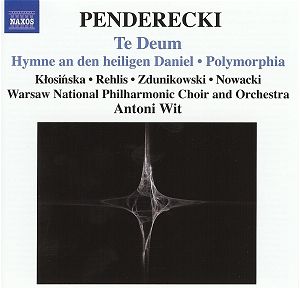
Te Deum(1979-80) (I. Te Deum laudamus [13:02]; II. Te
Martyrum candidatus laudat exercitus [7:53]; III. (Boże
coś Polskę -) Salvum fac populum tuum, Domine [15:51]) Hymne an den Heiligen Daniel (1997) [12:14] Polymorphia (1961) [10:48]
Polish Requiem: Chaconne(2005) [7:18] Izabela
Kłosińska (soprano), Agnieszka
Rehlis (mezzo), Adam Zdunikowski (tenor), Piotr Nowacki
(bass) (Te Deum)
Warsaw Philharmonic Choir/Henryk Wojnarowski
Warsaw National Philharmonic Orchestra/Antoni Wit
rec. 5-7, 29 September 2005, Warsaw Philharmonic Hall, Warsaw,
Poland
Texts and English translations provided NAXOS 8.557980 [67:06]
I first encountered the Polish composer
Krzysztof Penderecki through his 1961
piece Threnody for the Victims of
Hiroshima. Some years later I discovered
Die Teufel von Loudon in a splendid
Philips recording which, as far as I’m
aware, has never made it to CD. However,
there is an Arthaus DVD of the Hamburg
studio production under Marek Janowski,
which may be worth investigating (Arthaus
Musik DVD 101279).
The works on this disc range from the
more avant-garde, experimental Polymorphia
of 1961 through to the neo-Romantic
Hymne an den Heiligen Daniel (1997)
and two choral pieces inspired by Karol
Wojtyla, otherwise known as Pope John
Paul II. At the helm is Antoni Wit who,
along with his Warsaw band, is a mainstay
of the Naxos catalogue. In particular
I enjoyed this team’s Má Vlast
(Smetana) and, especially, their Mahler
8, both very fine performances indeed.
The first part of the Te Deum, written
to celebrate Pope John Paul II’s anointment
in 1978, strikes me as anything but
celebratory. But then one has to remember
the political turbulence in Poland at
the time. (Penderecki’s Polish Requiem
composed in the 1980s but only premiered
in 1993 began as a response to the turmoil
at home, specifically the brutal stand-off
between the Gdansk shipyard workers
and the Polish authorities.)
The work opens with menacing drum rolls
and sombre strings. The liner notes
describe the work as an example of the
composer’s ‘monumental neo-Romanticism’,
which is as good a description as any
(though monumental might be closer to
the mark). The choral writing may have
an austere spikiness, but the solo lines
sound rather more conventional. Again
the mood is anything but uplifting;
indeed, if I were to be uncharitable
I’d suggest it’s a tad lugubrious at
times. The soloists sing with plenty
of east European vibrato, although I
suppose one could argue it is a more
authentically Polish vocal style appropriate
to a work such as this.
The choir – placed quite far back –
sing incisively enough but the big climax
at 8:40 sounds rather messy and unfocused.
There is some respite at the close,
with the gentle shimmer of untuned percussion
underpinning the muted voices, before
the motoric martial opening to Part
2 (‘The army of martyrs praise Thee’).
This is certainly Penderecki in monumental
mode, with great blocks of choral and
instrumental sound punctuated by the
soloists’ supplications. The choir respond
with gusto in this movement, Penderecki
opting for pizzicato strings to carry
the solo vocal lines. The frigid finale
is about as near to repose as we are
likely to get in this music.
The third movement opens with a muted
choral invocation to the ‘God of Poland
…wrapped in great light, power and glory’,
interspersed with some limpid singing
from the soprano. The first climax is
brutal in its dissonance, the battery
of timps powerfully reasserting the
martial rhythms of Part 2. As much as
I wanted to be drawn into this music
I felt a curious detachment throughout.
Occasionally there are instrumental
touches (such as the soft pulse of gongs
at 5:20 onwards) that draw the ear but
rarely engage the heart.
The Hymne an den Heiligen Daniel
comes as a ray of sunshine after
the unremitting gloom of the Te Deum.
Sung in Church Slavonic – as in the
Grechaninov Passion Week I reviewed
recently – this hymn seems to have more
in common with Eastern Orthodoxy.
The first section (‘Slava’) certainly
has a strong liturgical flavour, with
its gently undulating choral writing.
The gong strokes add to the atmosphere
of mystery, with ecstatic brass and
choral interjections. There is also
a strong, flexible rhythm here, the
old Slavonic cadences adding a genuine
sense of fervour to the music. This
is much more vigorous, more harmonically
interesting and varied than the Te
Deum (there is some febrile writing
for the trumpets, too). And what a heaven-storming
finale. Definitely the composer at his
most approachable.
The experimental Penderecki is represented
here by Polymorphia. As with
Threnody (written in the same
year) this piece is for strings only,
beginning with a long, hypnotic figure
for cellos and basses. There is a process
of harmonic metamorphosis as Penderecki
adds more ‘layers’ to this foundation.
The results are pulsating glissandi
that grow in weight, volume and complexity.
The similarities to Threnody
are very striking indeed, Wit bringing
out all the jagged instrumental and
rhythmic elements of the music.
Ideally a more transparent acoustic
would have helped here – and in the
other works, come to that – but one
can’t deny the extraordinary frisson
of those percussive tuttis, which have
all the savage abandon of a pagan rite.
Penderecki also manages to achieve long
orchestral lines that even sound like
unison voices; technically very adroit,
but very much a piece of its time. Needless
to say the orchestra respond with enormous
energy and precision and the engineers
must have had a field day trying to
capture the work’s sheer weight and
complexity.
The Chaconne is not taken from
the Polish Requiem (as one might
assume from the track listing) but is
a lament for Pope John Paul II, who
died in 2005. Subtitled ‘in memoria
Giovanni Paolo II’, this is bold
and stark in its appeal. It also has
a fleeting intimacy in places (a glimpse,
perhaps, of the gentler man within)
but the biting upper strings and grinding
basses eloquently remind us of public
grief as well.
When the first Naxos CD appeared twenty
years ago few thought the company would
become such a fertile source of interesting
repertoire. Granted, some releases are
going to be more successful than others,
but in this case Naxos have put together
a well-chosen programme that offers
a good introduction to Penderecki’s
work, past and present. The playing
is committed and the sound is adequate,
but I would particularly like to hear
Hymne an den Heiligen Daniel recorded
in a more grateful acoustic. This disc
may not appeal to everyone but I’d buy
it for this work alone. Dan Morgan
Information received
from Ozzie Polatkan
There is indeed a CD
version of Penderecki's opera "Die
Teufel von Loudun" which I purchased
about 10 years ago at Tower Records
in New York City's Greenwich Village
(alas, no longer there)...I've never
seen another copy! (The same with a
boxed set I picked up there of the 6
Symphonies of Ikuna Dan on Decca, are
you familiar with it?)...
The Penderecki is on Philips (446-328-2)
with the Chor und Orchester der Hamburgischen
Staatsoper conducted by Marek Janowski
(recorded 1969 - released 1970)...
............................................................
Universal have informed
us they have no plans to re-release
this set at the moment.
Please support our advertisers below by clicking on the logos for further information.

























 Izabela
Kłosińska (soprano), Agnieszka
Rehlis (mezzo), Adam Zdunikowski (tenor), Piotr Nowacki
(bass) (Te Deum)
Izabela
Kłosińska (soprano), Agnieszka
Rehlis (mezzo), Adam Zdunikowski (tenor), Piotr Nowacki
(bass) (Te Deum)