Editorial Board
MusicWeb International
Founding Editor Rob Barnett Editor in Chief
John Quinn Contributing Editor Ralph Moore Webmaster
David Barker Postmaster
Jonathan Woolf MusicWeb Founder Len Mullenger
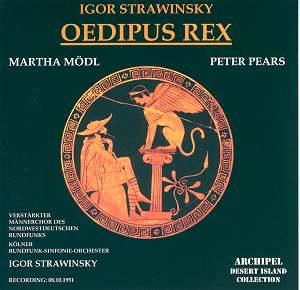
Igor STRAVINSKY (1882-1971) Oedipus Rex - opera-oratorio in two acts
(1927) [57:09]
Symphony of Wind Instruments(1920, rev 1947)
[9:04] Peter Pears
(tenor); Martha Modl (soprano); Heinz Rehfuss (bass-baritone);
Otto von Rohr (bass); Helmut Krebs (tenor);
Werner Hessenland (narrator) (Rex)
North-West German Radio Cologne
Symphony Orchestra/Igor Stravinsky
rec. 8 October 1951, Cologne. Mono. ADD ARCHIPEL
ARPCD0228 [59:67]
As
I have written in other reviews, music with a narrator can
be a minefield but this doesn’t apply to Oedipus Rex (1927).
It uses a text by Cocteau but set in the Sophocles Latin
translation from the Oedipus trilogy.
The
narration problem only occurs if one happens to lack the
language skills required by the various versions. I fall
into this category so had no choice other than to concentrate
on the music. Ignorance isn’t quite bliss and of course anyone
can make a shift to another important lingo with a translation.
Sadly this CD lacks even that feature and in its remarkably
scrappy notes scores 0 out of 10.
Cocteau’s
narrative in French has some fine blank verse balance. I
have an extremely rare tape of Cocteau in late life with
Stravinsky conducting. At some stage others might be able
to comment on this version for general enlightenment. It’s
stored in England and I am in Ireland.
In
this review I intend to avoid detailed analytical comparisons
of the work on record/CD with an
American narrator, including the composer’s own. I merely
comment that Prof Higgins was right, although
Paul Newman does make a good fist of it in his version with
Craft and the Orchestra of St. Luke’s on Music Masters. That
CD is well worth a hearing.
Sir
Ralph Richardson with Colin Davis on a Philips resurrection
is a bit declamatory in an otherwise excellent musical performance
with Remedios and the RPO in top form. Edward Fox in the
Naxos
Craft version sounds as if he had a late night or was
in the role of Edward VIII’s abdication speech. This totally
ruins a superb performance under the baton of a direct link
with Stravinsky. Robert Craft was a protégé and assistant
to the composer. Definitely an example of the need to re-dub.
The
best reason for buying this Archipel CD, with narration in
German and delivered subtly by Werner Hessenland, is down
to the authenticity of what Stravinsky intended in his Opera-Oratorio.
Part and parcel of this is the dry acoustic the composer
favoured when recording the CBS series with Craft as assistant
in the 1960s.
It
is worth mentioning that the composer’s famous falling out
with CBS over their schedule resulted in many of the best
recordings being achieved in Canada. Stravinsky wanted the
purity of voices he heard there. He was also suspicious of
the CBS producers.
After
the CBS-Sony merger the old man was proved to have been right
as the putative ‘complete edition’ had never been complete
by a long chalk. The company disappointed the composer and,
it seems, held back some recordings altogether. Readers will
note various omissions and restrictions if they recall what
Stravinsky actually recorded in late life. Where for example
is In Memoriam Dylan Thomas a major work setting ‘Do
Not Go Gentle Into That Good Night’; late Stravinsky at his
best? No doubt there are other examples.
Soap-box
away after point made. Back to the CD under review. The dry
acoustic the composer loved was perhaps all there was in
1951 Cologne but it’s the making of this recording which
I suggest is definitive in execution by all the musicians
performing it.
The
idea of combined opera-oratorio could only have come from
a great genius. Setting a Greek tragedy in the static way
of Sophoclean times but getting inside the presented characters
in an operatic, personal way must have seemed doomed to failure.
Not so; Cocteau’s rather stiff Narrator role (in French)
was enough to show to the audience in 1927 that they had
to witness the work out of time and perhaps judge later.
This
release has a superbly balanced cast which I have not heard
in any other recording. Peter Pears as Oedipus had a thicker
voice in 1951 than in the majority of his Decca recordings
with Britten. What annoys some people about his voice might
be absent here. Langridge springs to mind hearing Pears in
this amazing issue. Pears is best heard in Track 9 when Oedipus
takes up a note from Tiresius (Otto von Rohr, baritone) better
than any. At this point the drama is on the turn as king
Oedipus meets the reality of being mortal, faulty, sinful
and doomed by Fate – the exact definition of ‘tragedy’ in
Classical terms.
From
Track 7 we know for sure that things are going wrong for
Oedipus. This isn’t all that clear in any other commercial
recording I know. Stravinsky’s spare orchestration and depressing
harmonies are interpreted here by the composer so mercilessly
that anyone could pick up the plot even without a text.
Track
8 for chorus is perfect as Stravinsky achieves a subdued
quality in the chorus singing about Minerva. The snake-like
woodwind writing has more to do with Medusa. In this movement
of just under two minutes we know that a mere human cannot
stand against the Fates. The sober, tonal entry of Tiresius
on Track 9 is genius because Oedipus’s music of fear takes
up the crucial clashing wind undertones of 8 despite the
king’s noble attempts to sound heroic. Peter Pears gets this
spot-on and anyone (like our Editor) who is allergic to Pears’ voice
ought to listen to this.
The
conclusion of Track 9 and the transition into Track 10 is
paced so perfectly that the celebration of king Oedipus in
the ‘Gloria’ is undermined by harmonies sown earlier and
by parodies of Oedipus phrases from Track 6 as the hero-victim
suspects that something is going wrong.
Stravinsky
in this 1951 recording makes full sense of the strange notion
of an ‘opera-oratorio’ immediately after the ‘Gloria’ when
Jocasta (Martha Modl) sings operatic passages. The orchestra
parts are at odds with the pastiche grand opera lines so
the whole of the longest movement Track 12 [9’29] really
needs a great singer like Modl. Her romantic lines become
uneasy as she realises the trap she and Oedipus are in but
he fails to grasp the enormity (used correctly) of
his inadvertent sins.
By
Track 15 Oedipus, informed by the Shepherd (Helmut Krebs)
and the Messenger (Heinz Rehfuss), utters “LUX FACTA EST”.
Well,
killing one’s father and marrying one’s mother covers a fair
few sins by any standards. In Track 16 the narrator tells
how Jocasta hangs herself and how Oedipus blinds himself
with the pin of her gold brooch.
The
final Track 17 with chorus and the Messenger is very dark
but with pity too as the king is driven into exile by the
public, blind, shamed and insane. Stravinsky does better
than any other conductor in pacing this with Sophoclean dignity
and thus the great work ends in a muted way.
Served
by top soloists of their time, a very tight orchestra and
a chorus with only a few scrappy bits as well as a dry acoustic
Stravinsky must have enjoyed himself no end. He probably
rehearsed in his picky way and recorded both these pieces
on the same day of 8 October 1951.
Symphony
of Wind Instruments is also
masterly under the composer but choose your own name for
the 1920 work (rev 1947) as it changed a few times – the
point being that ‘symphony’ meant ‘playing together’ rather
than the post-C.P.E. Bach and Boyce usage in Stravinsky’s
neo-classical phase.
Back
in the 1970s I favoured Czech versions of Stravinsky’s and
Hindemith’s neo-classical chamber works on Supraphon. They
were ‘dry’ while offerings from the UK and USA used unnecessary
resonance.
This
version by the composer himself in Cologne is surely the
reference standard. It offers superb texture so that we hear
every harmonic resonance - the bassoon sounds are just plain
sexy. There’s no fuss in this extremely complex but disciplined
structure of just over 9 minutes. Some other versions take
nearly 10 minutes.
Stravinsky
demonstrates here what he wanted to prove and that, I suggest,
is what musical instruments sound like when played superbly.
This is not just an object lesson so much as a beautiful
jewel of music for all time.
In
these days of muzak, MP3 compression and computer showing-off,
it’s great to recommend a CD which sounds realistic to those
of us who still attend live concerts when we can.
Recorded
in 1951, in mono, with no texts, translations or even a full
list of engineers, producers and the suffocating info we
now tend to get, this remarkable release is pure music. The
fact that both great works are carried off to the best in
my experience is decisive.
The
24-bit re-master rate for CD means that to get a full range
of sound needs a good audio set-up with decent speakers or ‘cans’ but
mainly a good DAC such as a Benchmark, Beresford or something
more up-market if one has it.
There
are touches of pre-echo in Tracks 1 to 8 but for a definitive
version of a truly great work I can live with that.
This
Archipel release of genius at work is remarkable with the
right gear and is a sheer pressure-cooker of drama linking
a millennium showing that humans are frail no matter how
great they become in repute at a given time.
Stravinsky’s
own humanity joins with that of Sophocles (Track 17) when
the chorus comments on the departure of Oedipus with pomp,
some blame and then the supreme regret. This allows the composer
to conclude this essential recording with quiet depth on
cellos and basses. It’s heartbreaking stuff and great in
every sense.
Stephen Hall
Please support our advertisers below by clicking on the logos for further information.

























 Peter Pears
(tenor); Martha Modl (soprano); Heinz Rehfuss (bass-baritone);
Otto von Rohr (bass); Helmut Krebs (tenor);
Werner Hessenland (narrator) (Rex)
Peter Pears
(tenor); Martha Modl (soprano); Heinz Rehfuss (bass-baritone);
Otto von Rohr (bass); Helmut Krebs (tenor);
Werner Hessenland (narrator) (Rex)