Editorial Board
MusicWeb International
Founding Editor Rob Barnett Editor in Chief
John Quinn Contributing Editor Ralph Moore Webmaster
David Barker Postmaster
Jonathan Woolf MusicWeb Founder Len Mullenger
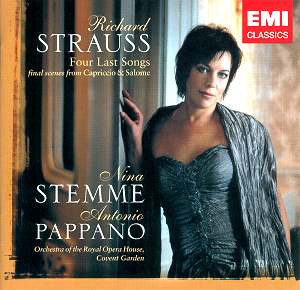
Richard STRAUSS (1864–1949) Salome, Op. 54 (1905) Final Scene
1. Ah! Du wolltest mich nicht deinen Mund küssen lassen,
Jochanaan! [15:56] Capriccio, Op. 85 (1942) Final Scene
2. Interlude: Mondscheinmusik [3:14]
3. Morgen mittag um elf! [15:51] Vier letzte LiederOp. posth. (1948)
4. Frühling [3:10]
5. September [4:42]
6. Beim Schlafengehen [5:11]
7. Im Abendrot [7:35] Nina Stemme
(soprano)
Gerhard Siegel (tenor) (1), Liora Grodnikaite (mezzo) (1),
Jeremy White (bass) (2), Richard Clews (horn solo) (5),
Peter Manning (violin solo) (6)
Orchestra of the Royal Opera House, Covent Garden/Antonio
Pappano
rec. Studio No. 1, Abbey Road, London, on 1-2, 4-5, 11 September
2006 EMI CLASSICS
3787972 [56:22]
Since her debut, Nina Stemme
has had a dead straight career upwards, conquering
the world’s most important opera houses. Strangely
though she has not been vouchsafed a corresponding recording
career. The few recordings she has made have however had
glowing reviews, not least on Musicweb-international. Hubert
Culot praised her only previous solo recital with Wagner’s Wesendonck
Lieder, Gösta Nystroem’s Sånger vid havet and
songs by August de Boeck, Christopher
Webber was impressed by her singing in Zemlinsky’s Der
König Kandaules, Em
Marshall admired her Senta in Chandos The Flying Dutchman,
and Marc
Bridle made EMI’s much publicized Tristan und Isolde,
where she sang against Placido Domingo, a Recording of the
Month.
Last year I reviewed her twice for Seen and Heard, where especially
her Sieglinde in Stockholm’s new Walküre was an achievement
to set beside the best ever (also the Twelfth
Day concert).
Now comes a Strauss disc that certainly lives up to the high
expectations.
It
is cleverly
arranged with the three works in chronological order so we
can follow the evolution of Strauss’s orchestral palette
through a period of 43 years. It ranges from the ostentatious
late-romantic eruptions of passion and brutality in Salome via
the reduced, more classically-oriented melancholy of Capriccio to
the autumnal darkness of the Four Last Songs. With
Antonio Pappano drawing at the same time powerful and refined
playing from the admirable ROH orchestra and EMI offering
a recording that lets us hear all the strands in the orchestration,
we are in for a sonic treat. The ominous opening sounds of
the Salome piece make one feel in the midst of a tornado.
Without being in the least rushed Pappano manages to keep
the tension close to the boiling-point through this abominable
scene. He is just as apt at keeping the subdued Capriccio finale
alive.
Having within the last year or so listened to reissues of
the possibly two most formidable Salomes, Inge Borkh and
Birgit Nilsson,
it was quite a revelation to hear Nina Stemme’s leaner, more
girlish timbre. She projects a certain vulnerability depicted
through the slight flutter in her voice, while there certainly
is no lack of force and intensity. She has a mezzo-like roundness
of tone, not unlike Flagstad’s, but the upper layer of her
tone is all glittering silver where Flagstad’s was frosted
bronze. Salome is a monster, as Herod says, but she is also
a human being with basic feelings and when she sings Und
das Geheimnis der Liebeist grosser als das Geheimnis
des Todes (And the mystery of love is greater than the
mystery of death) Stemme also expresses the weakest of emotions
in a beautifully inward and deeply probing reading.
After the barbaric and horrifying crashing of Salome the beautiful
and poetic Moonlight music of Capriccio comes as balm
for a wounded soul. The ROH strings create a luminous nocturnal
atmosphere and when Countess Madeleine appears it is still
Stemme, for sure, but she is now a quite different character:
lighter, more lyrical, nobler, more dignified. She is also
slightly vulnerable through her ambivalence: Willst du
zwischen zwei Feuern verbrennen? (Do you want to be consumed
between two fires?). That slight flutter again reveals this – as
was the case with the two foremost Countesses from the past:
the Elisabeths Schwarzkopf and Söderström. Stemme, though
possessor of a larger voice than either of them, is still
able to pare it down to the requirements of the part and
is on a par with her great predecessors. She has recently
taken on Arabella and judging from this Countess she should
be great in that part too, as she was as Feldmarschallin
in Gothenburg a couple of years ago.
Turning then to Vier letzte Lieder I was very much
looking forward to this recording since I heard her in these
songs
relatively early in her career at a concert in the Berwald
Hall in Stockholm with Roberto Abbado conducting. This was
in March 1996. Details of interpretation tend to slip out
of one’s memory but I seem to remember a fresh lyrical approach
that was very appealing. Her reading here is still very appealing
but it has changed, mainly through her voice having grown
and adopted that mezzo-roundness I referred to earlier. Considering
that it was Flagstad, the Isolde of her time, who
first sang these songs in 1950, it seems quite appropriate
that the Isolde of our time also should sing them.
Tradition has made them lyric soprano repertoire and certainly
they are mainly inward and soft but there are passages where
a more powerful voice can make its mark, as for instance
in Frühling. Stemme sings the opening In dämmigen
Grüften with the darkness of tone and bite that possibly
only Jessye Norman has challenged on disc. The same goes
for September, where she more readily creates an autumnal
feeling. Twilight sets in gradually during the course of
the songs, the vocal line becomes more inward, only the opening
strings of Im Abendrot still glow, but this represents
only the last rays of sun: … es dunkelt schon die Luft (already
the air grows dark). Two larks still soar in the sky, but
for us it is time to sleep – is this perchance death? These
are touching words to read only, enhanced by the music and
performed by a decent singer they can provoke deep thoughts;
as sung by Nina Stemme they go directly to the heart.
The orchestra play just as wonderfully here, there are fine instrumental
solos by hornist Richard Clews and violinist Peter Manning.
Tempos are fairly measured but not long-winded. I have compared
ten recordings of the songs and Stemme and Pappano occupy
the middle ground. In general timings differ within a few
seconds within the songs. The greatest spread can
be found in the last song Im Abendrot, where the extremes
are Lisa Della Casa (5:59) and Lucia Popp, who is constantly
the slowest, (8:23). Stemme at 7:35 steers a middle course.
Of course it is well nigh impossible to give a clear recommendation,
considering how many first-class versions there are. Schwarzkopf
and Della Casa will always be on my short-list. I do like
Studer, Lott and Te Kanawa, and Soile Isokoski’s quite recent
recording should not be missed. Nina Stemme belongs in this
select company. With the extra dramatic over-drive she can
switch on when needed and her superb portraits of Salome
and Madeleine as bonuses this is a disc that should find
a place in every Strauss lover’s collection. Let me only
add that besides informative liner notes by Michael Tanner
we get the full texts with translations in French and English.
Göran Forsling
Please support our advertisers below by clicking on the logos for further information.

























 Nina Stemme
(soprano)
Nina Stemme
(soprano)