It would appear that
Pentatone’s policy for their Shostakovich
symphony cycle is to have the same orchestra,
the Russian National, and a variety
of conductors. The results so far seem
to have largely paid off, with encouraging
reviews for earlier efforts by as diverse
a bunch as Paavo Berglund (8), Vladimir
Jurowski (1 and 6)[review]
and the orchestra’s founder, Mikhail
Pletnev (11). It’s an interesting concept
and the present coupling, an increasingly
popular one, has some excellent things
to offer, though there are caveats.
The American–based
Russian Yakov Kreizberg clearly has
a distinct view on both works, especially
No. 5. Whether you agree will be entirely
personal, but from the very first bars
you will almost certainly sit up and
take notice. The opening string canon
is possibly the swiftest I’ve heard,
sharp, no-nonsense, beautifully articulated
and crisp. He then slows down to a hushed
whisper, illustrating two things about
the performance generally – the quality
of the playing and the gear changes
he tends to indulge in occasionally.
The worst is in the finale (of which
more later) but this grimly impressive
reading is generally gripping. I like
the first movement’s pace and sharpness,
the second movement’s bitter irony (how
those amazing strings dig into the opening
figure!) and the slow movement’s hushed
intensity, spoilt only momentarily by
a clumsy studio bang (music stand?)
during the oboe’s poignant, wistful
solo at 6:36. Since Solomon Volkov’s
Testimony, the finale has become
the most hotly debated movement of the
symphony, and Kreizberg is obviously
in the pro-Volkov camp, making a case
for the ‘hollow victory’ of the closing
moments. Unfortunately, he tries to
achieve this by indulging in some awkward
gear shifts. For instance, the timing
of 12:44 overall must make it one of
the slowest on record, but you’d never
know it from the opening, which is so
swift that Kreizberg has virtually nowhere
to go when the composer asks for things
to speed up, which he does twice in
the first few minutes. Then, later in
the movement as we creep towards the
final minutes, he nearly grinds to a
halt and instead of speeding up fractionally,
as the composer asks again, he actually
slows down at 10:51, a gesture which
signals a long, slow drag to the last
bars, which are drawn out interminably.
It’s effective in a theatrical way and
would have been fine live, but it’s
infuriating on disc, and turning to
Barshai (Brilliant) or Järvi (Chandos)
makes one time and again aware of what
can be done by just playing it straight.
There’s no doubt that Kreizberg’s cause
is helped by the authentically Russian
sound he gets from the orchestra, recognizably
the same one as on their debut Tchaikovsky
6 with Pletnev in 1991 (Virgin). Listen
to the forthright, vibrato- laden horn
at 3:10 in the first movement, or the
blaring brass in the finale, to say
nothing of that phenomenal string tone
and unity, reminiscent of the Leningrad
Phil. in its heyday.
The Ninth Symphony
is less controversial, at least for
the most part. The same elements that
make the scherzo of the Fifth so effective
are all present and correct here, biting
strings, perky, shrill woodwind and
punchy brass, especially the recurring
rising fourth ‘raspberry’ on trombone.
The conductor still indulges himself
unnecessarily at times; why slow up
8 bars earlier than the composer’s marked
ritenuto poco a poco in the third
movement (2:35) and why slow up at all
in the finale at 5:44? Again, Barshai
shows that by adopting a slightly slower
tempo in this movement, the marked shift
into a sudden allegro at this
point is even more effective. Kreizberg
seems to be doing what other conductors
have done and show us that he knows
better than the composer, though without
the force of personality of, say, a
Bernstein to quite bring it off. Talking
of Bernstein, a still have on video
a talk he gave before a concert of the
Sixth and Ninth with the Vienna Philharmonic,
in which he referred to the Ninth as
a ‘five-act carnival’ and proceeded
to have great fun, even with the straight-laced
VPO. Kreizberg sees another side, one
in which the humour is bleak indeed
and linking it more directly to the
Fifth, a valid viewpoint.
Overall, these are
exciting performances and I don’t want
to put anyone off the disc as there
is much to enjoy, not least the orchestral
virtuosity and superb SACD recording,
which I only heard in conventional stereo.
You just need to be aware that there
are indulgences that may, or may not,
work for you. Try before you buy.
Tony Haywood
























 for
details
for
details
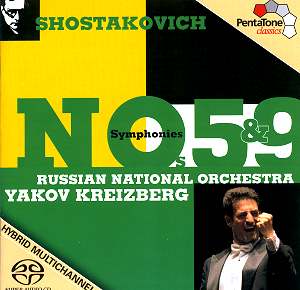
 Russian National Orchestra/Yakov Kreizberg
 PENTATONE PTC 5186 096 [77:16]