Editorial Board
MusicWeb International
Founding Editor Rob Barnett Editor in Chief
John Quinn Contributing Editor Ralph Moore Webmaster
David Barker Postmaster
Jonathan Woolf MusicWeb Founder Len Mullenger
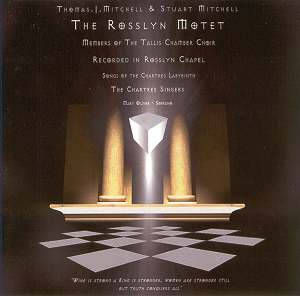
The Rosslyn Motet and Songs of the Chartres
Labyrinth Thomas MITCHELL (b.
1932) and Stuart MITCHELL (realisation) The Rosslyn Motet: 1 .The Apprentice Pillar [2.39]; The
Journeyman’s Pillar [1.40]; The Master Mason’s Pillar [3.30]; Finale [3.29] Thomas MITCHELL (b.
1932) arr. Stuart MITCHELL Songs of the Chartres Labyrinth: To Equity
[5.30]; The Demeter [5.23]; To Dionysius [6.02]; To Persephone
[5.19] Members
of Tallis Chamber Choir; Edinburgh Renaissance Band (Motet)
Tallis Chamber Choir; The Chartres Singers, instrumentalists/Philip
Gault (Chartres Songs)
rec. Rosslyn Chapel, 20 June 2006 (Motet); Morningside Parish
Church, Edinburgh. 24 August 2006 (Songs) THE DIVINE
ART DIVERSIONS DDV24122 [33:36]
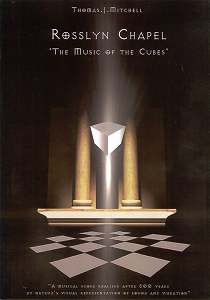
Rosslyn
Chapel and Music of the Cubes
by Thomas J Mitchell
Published by Diversions Books 2006. 108pp.
Softback.
The
Rosslyn Chapel founded in 1446 and completed several decades
later is without doubt an extraordinary building. It is a
few miles south of Edinburgh and came to especial fame recently
due to Dan Brown’s iconic ‘Da Vinci Code’ success.
It is, he says, a place where the ‘Holy Grail’ might be discovered.
The chapel has always been considered a unique and architecturally
outstanding building, but now its significance is further
increased. It profile is enlarged by the discovery by Thomas
Mitchell and his son Stuart that the decoration on the ceiling
of the Lady Chapel and around the various pillars has coded
music on its roof bosses and in its general decoration. His
arguments are set out in the book which along with the CD
gives a fuller picture of what lies behind his discovery.
First,
why the Rosslyn Chapel?
Mitchell
makes out a case that the Chapel is the end of, in fact the
seventh stage of, a pilgrimage route from Compostella where
the bones of St. James were discovered in the 9th Century.
The pilgrimage takes in Chartres, more of that later, and
Amiens in Northern France as well as Notre Dame in Paris.
All of these cathedrals had/have mazes, again more of that
later. These seven stages/sites are linked says Mitchell
by ley-lines. Towards the end of the book he points out how
these lines were first discovered by pre-flood humans, who
were supremely intelligent and who were able to make the
links between the sacred sites. This was only to have them
taken over by Christians thousands of years later who also
realized their significance. Further evidence of this is
that the family who had this great collegiate chapel rebuilt
on or next to the ancient site were the remarkable St. Clair
family. They came over with the Conquest, but according to
the official guide to the chapel by the present Earl of Rosslyn
it was the second Henry St.Clair who first lived and built
a chapel here c.1120. This was at a time when the Compostella
Pilgrimage was very popular and churches were going up on
pilgrimage routes all over Europe in the prevailing Romanesque
style. On a decorated boss William St.Clair is seen beside
some cockle shells, the insignia of the St. James pilgrim.
Of
course one could argue that churches not on the ley-line
also have significant connections with the St. James pilgrimage
where their founders are discovered with the insignia. Various
churches in Herefordshire for example, carved by the so-called
Herefordshire School (c.1130) show the influence of the Romanesque
work at Compostella. Their patron was Oliver de Merlimond
who also visited the shrine. Similarly, churches in Worcester,
Bristol and East Anglia. Why shouldn’t these churches have
a special significance also?
Mitchell
tells us that the carvings of the angel musicians in the
Rosslyn Lady Chapel are another clue as to its significance.
These, he says, are striking. A variety of instruments appear
including a bagpipe. These can be heard on the CD. But carved
angel musicians are no rarity in roof carvings or any sort
of ecclesiastical art work. Hundreds of churches have them.
In Southwell Minster they are everywhere especially in the
aisles along the walls and at Long Melford in Suffolk. Are
we to believe that Southwell is on a ley-line and has music
imprinted and secreted in its walls too? He also mentions
an angel holding an open book and facing inwards which he
thinks may indicate that we should be reading the music of
the carvings like a book. Yet, such angels with open books
can be in many other churches, for example Lincoln Minster.
But
what are these carvings and decorations? You must look above
the angel musicians into the roof and into what has been
described as star decorations. The CD booklet illustrates
them as does the Rosslyn Chapel official guide. Mitchell
calls them cubes and there are 213 of them, each slightly
differently patterned. After what he describes as ‘a ten
year mission’, Mitchell discovered that by using Cymatics
he could unlock the pitches described by these patterns.
The only problem being that Cymatics were not discovered
until 1725 by one Ernst Chladni. So he has had to conclude
that the St. Clair family were party to information perhaps
discovered in what was then ‘Cathay’ and therefore not generally
known at the time. But what are Cymatics? The answer, put
simply is sound waves and shapes. Any particular note can
create its own wave-shape and it is these, embedded in the
roof patterns that Mitchell has transcribed into music; music
written therefore in the 15th Century and not
performed since then, if ever.
But
what order to put the notes in? Where is the beginning and
where the end? Almost arbitrarily he decided to start from ‘The
Apprentice Pillar’; the most striking piece of work artistically.
He says “this is the direction of the music, in my opinion
moving South to North”. He noticed that a definite key began
to emerge: A minor, the Aeolian mode. He does not tell us,
whether, in true scientific spirit, he experimented and ventured
to transcribe a tune in a different direction. Never mind
that for now.
He
seems only to be discussing melody but on listening to the
CD there are many sections in harmony although some are unison.
Mitchell also speaks of “sections forming cadences” which
obviously implies harmony. But from what source did he derive
these harmony notes? He writes that a “simple phrase is repeated
on the next arch”. This of course is not impossible in any
patterning, be it on arches or on carpets. Then he had to
define a rhythm for these notes. He feels that in “the middle
phrases there is a definite feel of triple time” … “although
a great beauty comes forth in duple time”. In other words:
take your choice.
Then
I came at last to listening to the CD. I was fully prepared
and generally speaking still open-minded. I should point
out that I have been for some years investigating the relationship
between the mathematics that lies behind much Romanesque
architecture, especially at Notre Dame de Paris and the
proportions found in the music of the contemporary Leonin
and Perotin. I was ready to be impressed. Let’s start with
the text.
On
page 52 of the companion book Mitchell writes “There are
thirteen stanzas to the hymn and thirteen melodic arches
emanating from the pillars which is possibly why the text
matched up so well in form and meaning, the text carried
the word easily”. The text is ‘Ut Queant Laxis’ which for
musicians is important because it was used by the 10th Century
music theorist Guido of Monaco as a helping hand in remembering
the letter name of the scale. Whilst listening to the performance
I attempted to follow the text. It is split into four sections
as listed at the top. I immediately noticed that the stanzas
were not clearly divided; there is no indication where each
section begins. Secondly the first text you hear, sung by
the counter-tenor is the second line, then the first verse
and then I started to lose my way. I could not follow where
we were; some lines are repeated some are simply not set.
Mitchell has cut the text about in a random way simply to
suit his whim. I felt that given the score I could have removed
his words and pasted in phrases from Yellow Pages; it would
have fitted perfectly well. I was not helped by the indifferent
diction of the voices. In addition, throughout the CD, their
intonation is not too good especially in the middle parts.
On repeat hearings I have still not found my way through
the text which apparently “fits so perfectly”.
What
does the music sound like? Presumably 15th Century
music, possibly Dufay or Ockeghem? Well it sounds like no
other 15th Century music I have ever heard. In
fact it is like a weak pastiche. The way the melody - which
Mitchell describes as beautiful but I think is rather dull
- keeps reverting to a single pitch is most out of character
and many of the harmonies are totally uncharacteristic as
are so many unison passages. I do not have a score so I cannot
pinpoint specific moments for you. There is little in the
music that sounds authentically of its time.
On
moving to the four sections of ‘Songs of the Chartres
Labyrinth’, the text, which is set out nicely in the
booklet, again is not used complete. The last lines in some
cases are missing but that does not matter here as Mitchell
wrote this music himself and clearly says so. Curiously enough
it inhabits the same sound-world as the Rosslyn motet. Labyrinths
are especially important. Recently I read a fascinating book ‘The
Maze and the Warrior’ by Craig Wright (Harvard University
Press, 2004) in which Wright mentions the maze dances of
the middle ages. He also points out, as does Mitchell in
lesser detail, that ordinary folk who could not go on a pilgrimage,
say to Compostella, could walk a maze in the cathedral and
this would suffice. Cymatics have shown that wave-shapes
often produce a Maze outline. On p.48 of his book Mitchell
presents us with four examples. These are the Chartres Maze
design (dated and still visible at the west end of the cathedral
c.1225-30) and three shapes produced by Cymatics. There is
indeed a striking similarity. But how does the music fit
in to this you might ask … and where does the text come from?
The
text set is the ancient ‘Hymn of Orpheus’. I quote: it “was
inspired by the sacred thread that runs through the Cathedrals
and their history connecting them to the final mystical destination
at the Rosslyn Chapel”. Well, I just found myself wondering
why he set this text. The first one is addressed to ‘Equity
(an aspect of Themis, Ma’at in Egypt) Goddess of Balance
and Justice’ and is subtitled ‘Fumigation from Frankincense’.
It begins, in translation, ‘Eternal friend of the one who
is just and lawful/Abundant, venerable, Honourable Maiden/You
are the dispenser of constant aid, a stable conscious and
upright mind” etc. You get the picture.
In
the latter chapters of the book, the point is clearly made
that the music and the chapel itself may well be the ‘Holy
Grail’ so sought after. However we move from a repetition
of earlier ideas, except written in a convoluted style where
words seem to be placed at random. This serves only to cloud
the issues. There is then a clearer chapter or two on music
theory, chords and scales.
All in all I cannot recommend
you spend time on this fudge. There is however a proviso.
You may think, as with the ‘Da Vinci Code’ that 95% of it
is rubbish. In which case it is the remaining 5% that should
worry you.
Gary Higginson
Please support our advertisers below by clicking on the logos for further information.

























 Members
of Tallis Chamber Choir; Edinburgh Renaissance Band (Motet)
Members
of Tallis Chamber Choir; Edinburgh Renaissance Band (Motet)