Catching the acoustic
leakage through my nice open-backed headphones while I was listening
to Threnody for the Victims of Hiroshima, my better half
said, “gawd, that’s an awful noise – sounds like something from
Dr. Who!” Much worse in fact, for there are no rubber monsters
here. The skin is peeled back, the burnt screaming flesh exposed
like no other piece of music you’ve ever heard or could imagine.
Aspiring composers
like me were drawn like flies to the revolutionary music coming
from Poland in the 1960s and 1970s. Anaklasis was one
of the works which introduced Penderecki’s uncompromising style
to Western ears, and nearly 50 years on it still sounds original
and challenging. When you get to know these pieces they become
as familiar as Picasso, and returning to some of the works we
performed as students at the R.A.M., like Canticum canticorum
salomonis, is like greeting old friends. Penderecki was
a highly communicative conductor – I always remember him instructing
the poor percussionists who had to learn how to blow ocarinas:
‘It must sound like the ’uman voice’ he said, and after that
they knew exactly what to do. Unforgettably, he shook like a
bear during some of those seemingly chaotic moments of aleatoric
freedom, and then we all knew what to do. As conductor
of all of the performances on these discs, you can be sure the
performances are pretty much definitive. Canticum is
a wonderful piece, full of extraordinary colour and effects
which give me goose-bumps every time.
The De natura
sonoris works are like an inverse pair – No.1 is
the more expressionist one, full of gothic darkness and almost
wilful creepiness. No.2 approaches the semantics of electronic
music, with a singing saw, sawing textures and fields of sound
which resolve, dissolve, gather and rise up like a distressed
column by Brancusi. You can listen to this work as if it was
a poem, but you couldn’t recreate it by writing one. The
Dream of Jacob further refines some of the techniques used,
making for an even more coherent piece whose logic, from the
deep breaths of the low brass clusters in the opening to the
wild string and brass climaxes, is that of high romanticism.
Moving on to the
second disc, and we start with Emanationen -
two string orchestras, one of which is tuned a minor
second higher than the other. This again was one of the pieces
by which Penderecki stormed into fame in Europe, but there are
so many glissandi and movings about here and there that the
effect is not as striking as you might imagine. This might have
to do with the recorded performance however, which seems a little
more lacklustre than some of the others – it was already over
12 years old by the time this recording was made, and therefore
maybe a bit old-hat. The Partita for harpsichord and
orchestra is interesting in its ostinati and sound-field textures,
effects which had their influence on composers such as Ligeti.
An electric guitar also gives an up-to-date feel to this piece,
though the recording betrays heavy spot-miking for this instrument
and the soloist, which gives rise to some odd perspectives here
and there.
The Cello Concerto,
now due the suffix ‘No.1’ as the second was premiered by Rostropovich
in 1983, is full of fascinating action and mad moments from
the orchestra, which is supplemented will all kinds of exotic
instruments. Penderecki was one of those Polish composers who
helped the trend for large percussion sections, but he uses
his instruments with panache. The ear and the imagination are
taken on an incredible journey, sometimes moving, sometimes
confusing, sometimes filled with wild and rocky adventure. Soloist
Siegfried Palm lays into the part with theatrical eloquence,
and the work sounds every bit as fresh and modern as it must
have in 1972.
The final work in
this set, the Symphony (No.1) of 1973 is massive, theatrical,
and tinged with some of that religious awe which affects Penderecki’s
later work, the piece having apparently been inspired by a pair
of angels on an arch in Ravenna. Surprising, sometimes beautifully
understated resolutions and subtle orchestral effects prevent
this work from becoming overblown and pompously self-conscious,
and, while the early Penderecki fingerprints are expanded and
projected onto a much larger canvas there are more than a few
hints of later developments, and these fingerprints are such
distinctive and powerful ones that they can take being blown-up,
even though the symphonic structure may be hard to grasp. Like
the shorter works, this piece has a poetry and a dark theatricality
which opens the mind to regions rarely explored: you might not
want to go here often, but work like this is like a weighty
and well-respected novel – one you always keep on your shelves
and acknowledge every time you pass by.
Throughout both of
these discs the analogue recordings have been well preserved and
re-mastered, although there are some moments when a little woolly
opaqueness betrays needles pushing into that dangerous red zone.
The booklet notes are fine as far as they go. Both orchestras
play out of their skins, and almost all of these recordings possess
an intensity which rival any current catalogue performances. Disc
1 of this pair appeared as part of the ‘Matrix 5’ series in 1994,
but the renewed availability of these landmark recordings has
to be welcomed. Naxos is the immediate competitor to this kind
of budget re-issue, and while their often remarkable and excellent
recordings and performances fill a much needed gap in the record
shop shelves, these premiere recordings conducted by the composer
have something that bit special to offer. The music won’t be everyone’s
cup of tea, but if you fancy something a little stronger than
slop water then this is the real thing.
Dominy Clements
























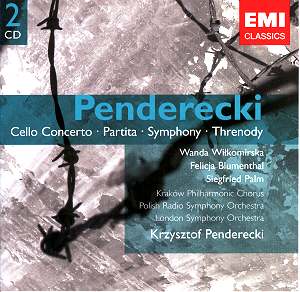

 Krakow Philharmonic
Choir (Canticum), Polish Radio National Symphony Orchestra,
London Symphony Orchestra*
Krakow Philharmonic
Choir (Canticum), Polish Radio National Symphony Orchestra,
London Symphony Orchestra*